DropCue vs MusicBox Labs
Both platforms connect composers with music supervisors through opt-in discovery and briefs. DropCue adds the half most tools leave out: pitching your own contacts directly, with per-recipient analytics telling you exactly who listened, for how long, and what they did next. Here is a fair side-by-side so you can choose the right fit.
Start Free Trial →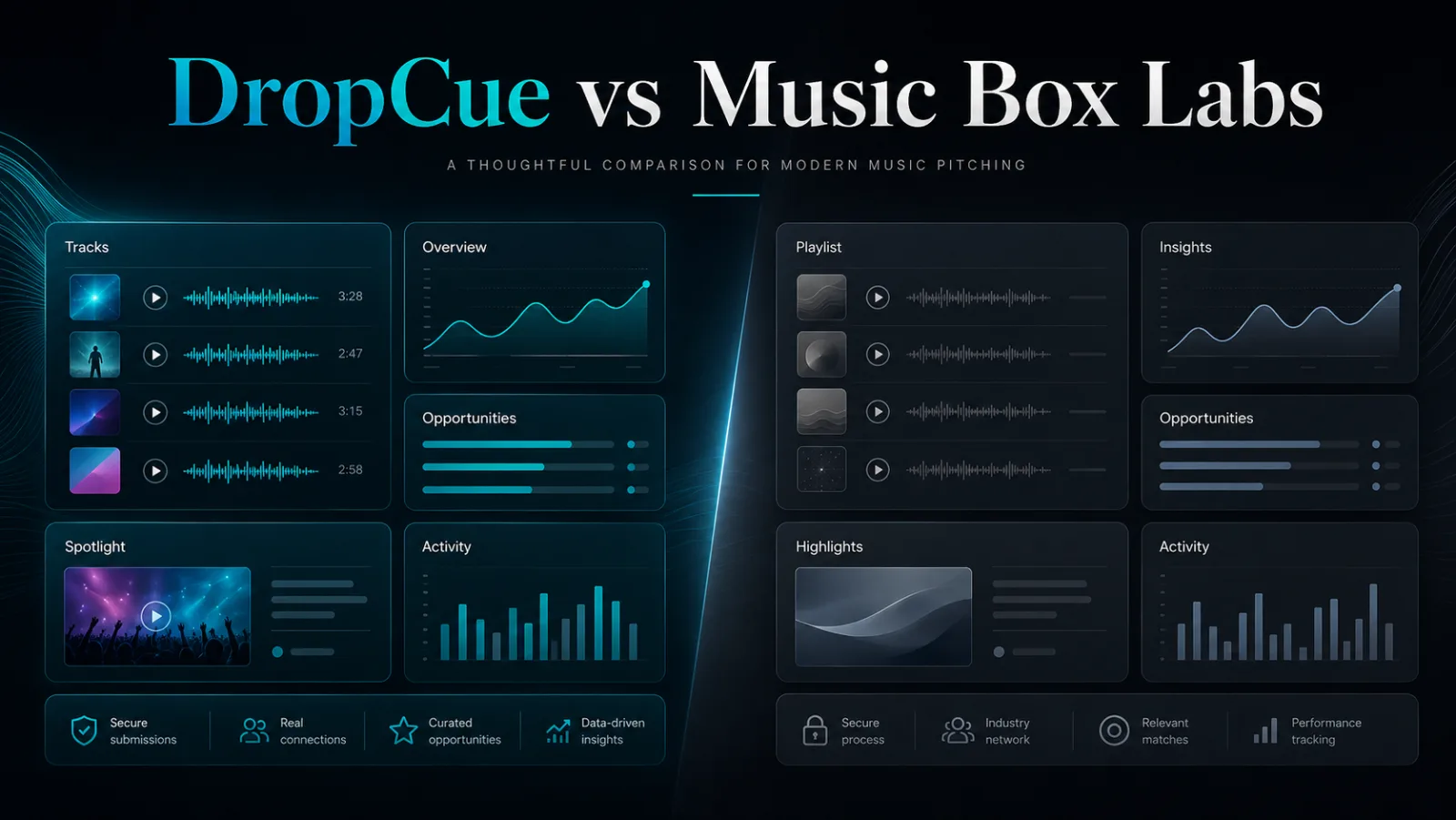
Two different companies
DropCue (dropcue.app) is an established music sharing and sync-pitching platform. MusicBox Labs (musicboxlabs.com) is an AI-first catalog management and discovery platform whose Maestro product enables conversational, plain-language brief search. They are separate, unaffiliated companies. MusicBox Labs is also distinct from MusicBox the personal iOS catalog app and Music Box Licensing, which share part of the name. This comparison is independent and covers both fairly.
Where MusicBox Labs is strong
MusicBox Labs is built by composers and technologists around a genuinely modern idea. Its Maestro product lets a supervisor paste a creative brief and refine results conversationally in plain language, then curate playlists across preferred vendor catalogs, and it presents music through clean, interactive Showcases. Conversational, plain-language search is genuinely ahead of DropCue's keyword and metadata search. If natural-language discovery across many vendor catalogs is the thing you care most about, evaluate it on its own terms.
Where DropCue leads
DropCue covers both halves of sync. Opt any subset of your catalog into its discovery marketplace, where verified music supervisors search across composers and post briefs you can submit tracks to. Then pitch directly to your own contacts, with per-recipient listen analytics on Pro plans (duration, location, device, and return visits, organized by named recipient). It adds timestamped waveform comments for feedback at exact moments in the audio, a submission inbox for receiving pitches, password-protected expiring links, per-recipient download controls, and built-in AI tools for cue descriptions, BPM and key detection, lyrics transcription, stem separation, and cover art. It is live now with a 7-day free trial and no credit card.
How the two price
Both publish pricing openly, on different models. MusicBox Labs lists $10 per month annual for artists and composers with no track limit, catalog plans from $500 per year, and supervisor plans from $20 per month. DropCue prices by track tier: Artist at $8 per month annual with no track limit, and Pro from $15 per month annual for 1,000 tracks with all AI tools, per-recipient analytics, email campaigns, and the submission inbox included. Both include supervisor discovery and briefs at every tier; what DropCue adds on top is the outbound side, per-recipient analytics and access controls on every send.
DropCue or MusicBox Labs: which fits your work?
Choose DropCue if you want discovery and outbound pitching in one place, you need per-recipient analytics on every send, you leave or receive timestamped feedback, you want password protection and expiring links on your shares, and you want to start today with a real free trial. Choose MusicBox Labs if AI-first conversational brief search across multiple vendor catalogs is your single biggest need.
Try DropCue free for 7 days
No credit card. Per-recipient analytics built in, never an add-on. Available today.
Start Free Trial →Frequently asked questions
What is the difference between DropCue and MusicBox Labs?
They overlap more than you might expect. Both run an opt-in discovery marketplace where verified music supervisors search composer catalogs and post briefs that composers submit tracks to. MusicBox Labs (musicboxlabs.com) leads on the search itself: its Maestro product handles conversational, plain-language brief search across preferred vendors, which is ahead of DropCue on that specific capability. DropCue covers discovery too, with per-track opt-in, an approved-supervisor portal, briefs, and shortlists, and then adds the outbound half: branded share links to named contacts, per-recipient listen analytics on Pro plans, timestamped waveform comments, password protection, expiring links, download controls, and built-in AI cue, lyrics, stem, and cover-art tools. They are separate, unaffiliated companies.
How much does MusicBox Labs cost versus DropCue?
Both publish pricing openly, and they price on different models, so compare against your own catalog size. As of August 2026, MusicBox Labs lists $10/month annual ($12 monthly) for artists and composers with no track limit, catalog and publisher plans from $500/year for under 2,500 tracks up to $5,000/year for under 100,000, and supervisor plans at $20/month individual or $50/month for five seats. DropCue prices by track tier: Artist at $8/month annual (or $10 monthly) with no track limit, and Pro from $15/month annual for 1,000 tracks up to $69/month annual for 20,000, with all AI tools, per-recipient analytics, email campaigns, and the submission inbox included. Both include supervisor discovery and briefs at every tier. What DropCue adds on top is the outbound side, per-recipient analytics and access controls on every send, included rather than sold as an add-on. Check both pricing pages for current terms.
Is MusicBox Labs or DropCue better for sync licensing?
Both cover discovery, so the question is what else you need alongside it. Both let you opt tracks into a marketplace where verified supervisors search and post briefs you can submit to. MusicBox Labs is stronger on the search experience itself, with conversational plain-language brief matching across vendor catalogs and polished Showcases. DropCue pairs its discovery marketplace with the outbound side: sending your catalog to specific supervisors by name, seeing who listened and for how long, collecting timestamped feedback, controlling access per recipient, and receiving submissions through your own inbox. If you want both halves in one place, that is what DropCue is built for.
Is MusicBox Labs the same as DropCue?
No. DropCue and MusicBox Labs are separate, unaffiliated companies. DropCue (dropcue.app) is an established music sharing and sync-pitching platform. MusicBox Labs (musicboxlabs.com) is an AI-first catalog management and discovery platform. MusicBox Labs is also not the same product as MusicBox the personal iOS catalog app or Music Box Licensing, which are unrelated companies that share part of the name.
Is DropCue available now with a free trial?
Yes. DropCue is live and used by thousands of composers, production libraries, and sync agencies, with a 7-day free trial that includes full Pro access and requires no credit card. You can upload your catalog, build playlists, and see the analytics on the same day. MusicBox Labs also offers a free trial on all accounts; confirm current trial length and terms with them directly.