Workflow
How sync agencies pitch music
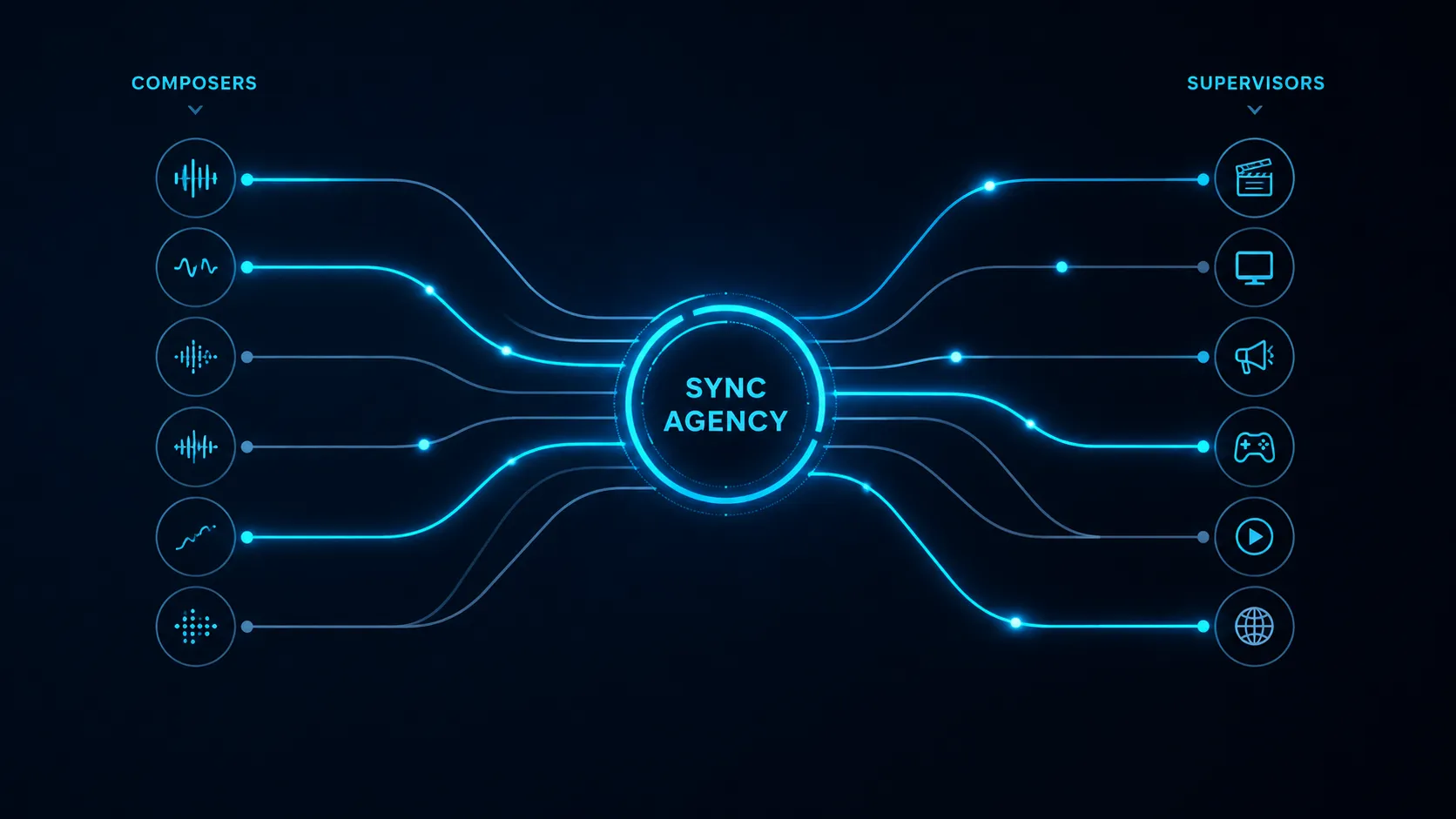
Sync agencies represent rosters of composers and labels, sit in the brief flow with music supervisors, and pitch matched cues against active needs. The pitching workflow runs on relationships, fast turnarounds, and ruthless catalog organization.
A sync agency is the connective tissue between music creators and music buyers. They hold a roster of composer or label clients, build relationships with supervisors at studios, networks, and ad agencies, and run a pitching machine that turns active briefs into placements. The day-to-day workflow is part curation, part sales, and part air-traffic-control.
Who does this
Sync agency staff at companies like Sugaroo, Heavy Hitters, Riptide, Synergy, Position Music, and dozens of independent boutique agencies. Roles inside an agency typically include sync agents, A&R, catalog managers, and a creative head who handles the most senior supervisor relationships.
Larger publishers and labels run their own in-house sync teams that perform the same workflow. Indie composers without representation effectively perform a one-person version of this workflow themselves.
Step by step
- 1
Sign or onboard a new artist or composer
The agency signs a creator under a sync representation deal. Terms vary widely: exclusive vs non-exclusive, term length, commission percentage (typically 25 to 50 percent of placements the agency books), territory, and whether the agency controls publishing administration too. Onboarding pulls in catalog metadata, masters, stems, and any pre-existing splits.
- ✓Exclusive deals get more agency time, non-exclusive deals scale better
- ✓Commission ranges from 25 percent to 50 percent of net fee
- ✓Term lengths often run 2 to 5 years with sunset clauses
- 2
Catalog and tag the music
Every track on the roster gets tagged across multiple axes: genre, sub-genre, mood, tempo, instrumentation, vocal vs instrumental, lyrical themes, energy arc, and use cases (trailer, ad, TV, film). This metadata is what makes the catalog searchable when a brief comes in. A 2,000-track catalog without tags is useless. A 200-track catalog tagged correctly out-pitches it every time.
- ✓Most agencies use a custom tag taxonomy refined over years
- ✓Tagging happens at intake, not lazily later
- ✓Re-tagging old catalog is one of the biggest agency time investments
- 3
Receive briefs from supervisor relationships
Active supervisors send the agency briefs by email or DM, often with reference tracks ("we want something like this but cheaper to clear"). A senior agent might receive 5 to 30 active briefs at a time. Each brief has a deadline, a budget range, and a list of internal stakeholders who need to approve.
- ✓Hot briefs need a response within hours
- ✓Cold briefs sit for days while the supervisor explores in parallel
- ✓Reference tracks tell you what the supervisor cannot afford to license
- 4
Search the catalog for matching cues
The agent runs the brief against the catalog using their tags. A good agent narrows from 2,000 tracks down to 8 to 15 candidates in 15 minutes. Slow agencies take hours and pitch worse matches. The speed of this step is the single biggest competitive advantage between agencies.
- ✓Tag combinations beat single-axis search every time
- ✓Reference tracks should be reverse-tagged for matching
- ✓A senior agent often pulls cues from memory before searching
- 5
Curate a tight pitch playlist
The agent assembles a pitch playlist of 5 to 12 tracks. Top of the playlist is the strongest match. Each track has a one-line note explaining why it fits. The playlist is shared as a single branded URL with the agency name, the supervisor name, and the brief context. Bonus points for embedded stems and ALT mixes already linked.
- ✓Top track is the audition for the whole playlist
- ✓Each track gets a sentence of context
- ✓Branded URL beats raw file dumps every time
- 6
Send the pitch with a tight email
The pitch email is short. Three sentences max: which brief, why these picks, link. Subject line names the project. Supervisors do not read long pitch emails. They open the link and decide in 30 seconds.
- ✓Subject line: project name, not "music for you"
- ✓Body: brief reference, link, sign-off. Done.
- ✓Attach nothing. Link to everything.
- 7
Track engagement and follow up smartly
Modern pitching platforms show analytics on which tracks the supervisor played and how long they listened. The agent uses this to refine follow-ups. If the supervisor listened to track 4 three times, the follow-up pitches more like track 4. If they listened to nothing, the agent sends a different angle two weeks later.
- ✓Analytics reveal what the supervisor actually responded to
- ✓Re-pitch the engaged track at the next brief, not this one
- ✓Silence after 7 days means try a different angle
- 8
Negotiate the deal when a track is selected
Once the supervisor or director picks a track, the agency negotiates the fee, scope, and term. This is where the agency earns its commission. A skilled agent can sometimes double the offered fee by pushing back on scope or finding extra usage windows the supervisor had not considered.
- ✓Initial offer is rarely the final offer
- ✓Scope (broadcast, digital, regional, term) often hides extra fee
- ✓MFN clauses can backfire if the agency is not careful
- 9
Execute paperwork and deliver the asset
License agreement is drafted, reviewed by both sides, signed. The agency delivers the final cleared file plus any requested ALT mixes and stems. The composer gets paid (after the agency takes its commission), and the cue is filed for cue sheet purposes.
- ✓License negotiation typically takes 3 to 14 days
- ✓Files delivered as 24-bit WAV with metadata
- ✓Composer gets paid 30 to 60 days after license execution
- 10
Track placement and statement reconciliation
Once the placement airs or releases, the agency tracks the cue sheet filing, monitors PRO statements for performance royalty income, and reconciles the composer's share against the agreed splits. This is where the slow-motion revenue tail starts.
- ✓Cue sheets must be verified within 30 days of broadcast
- ✓PRO statements arrive quarterly and require manual review
- ✓Composer royalty splits are the most common dispute source
What can go wrong
- ●Tagging the catalog poorly. A 2,000-track agency with bad tags pitches slower than a 200-track agency with good ones. Garbage in, garbage out.
- ●Pitching the same supervisor every brief regardless of fit. Supervisors notice. Within 90 days, the agency is filtered into the spam pile.
- ●Missing the brief deadline. Trailer briefs sometimes have 24 hour windows. An agency that responds in 48 hours gets the brief, then the brief is already closed.
- ●Not tracking analytics. Agencies that send blind pitches with no follow-up insight learn nothing and improve nothing.
- ●Underselling the deal. A junior agent who accepts the first offer leaves real money on the table on every placement. Multiply that across hundreds of deals a year.
Pro tips
The agency that responds first to a brief almost always gets the placement. Speed beats catalog size at the brief level. Build internal tooling that lets a senior agent narrow 2,000 tracks to 10 candidates in under 15 minutes.
Build supervisor-specific catalogs. Every senior supervisor has style preferences. Pull a private playlist for each top-tier supervisor with the 30 cues from your roster they would most likely use, refresh quarterly. When a brief lands, you start from a 30-track shortlist instead of a 2,000-track catalog.
Stop pitching cold. Senior agents who do volume cold pitching dilute their relationships. Tight, on-brief pitches to known supervisors generate more placements than mass-blast spray-and-pray.
Watch your composers' analytics. If a composer's tracks consistently get 30+ second listens but no placements, the issue is not the music, it is the brief targeting. Re-target. If their tracks get 5-second listens, the issue is the music. Talk to them about what to write next.
Document every supervisor preference in a CRM. Genre tags, lyrical sensitivities, recent placements they loved, projects they have coming up. This is the agency's real asset, more valuable than the catalog.
Tools that help
DropCue
DropCue is built for agency-scale pitching. Sub-accounts for each composer on the roster, branded agency-wide playlists, supervisor-specific links with analytics, expirable shares, and timestamped feedback that funnels back to the composer. Used by sync agents who graduated from juggling Dropbox folders.
DISCO.ac
Long-time market leader for agency catalog management. Strong tagging system, robust permissions, and deep agency relationships. Expensive at scale and slower to adopt new features. Many agencies still run on DISCO out of inertia and supervisor familiarity.
SourceAudio
Library and pitching platform with strong AI tagging tools. Less prevalent at boutique agencies, more common at large publishers and production music libraries.
Custom internal tooling
The largest agencies (Heavy Hitters, Sugaroo, Riptide) often build proprietary tools tailored to their workflow. Effective but expensive to maintain.