Guide
The Best Music Sharing Platform for Jingle Composers
 Marc Aaron Jacobs
Founder, DropCue · Composer
Marc Aaron Jacobs
Founder, DropCue · Composer
Jingle work is fast, demanding, and surprisingly lucrative when you nail the workflow. The platform you use to ship cuts to creative directors and account executives shapes whether you turn a 48-hour brief into a placement or watch the deal fall to a faster competitor.
Who this is for
Jingle composers writing for ad agencies, brands, and broadcast advertisers. Composers running their own commercial music shops. In-house jingle teams at production music libraries that focus on advertising. Composers transitioning from sync into ad music.
Also relevant: ad agency creative directors evaluating composer pitches, music supervisors at advertising agencies who maintain freelance composer rosters, and brand-side music coordinators at large advertisers who handle their own composer relationships.
The audience-specific reality
Jingle work runs on advertising calendars, not music industry calendars. A brand books an agency on Monday for a campaign that airs Friday. The agency briefs three composers on Tuesday morning. By Wednesday afternoon the agency creative director has heard everything, picked one, and started revisions. By Thursday the cue is locked and shipped to the broadcast operator. Friday it airs.
This compression is brutal but the economics are good. A 30-second jingle for a regional Toyota campaign pays $3,500 to $8,000. A national campaign pays $25,000 to $150,000. Compared to library work, the per-placement fee is substantial. Compared to film scoring, the time investment per placement is small.
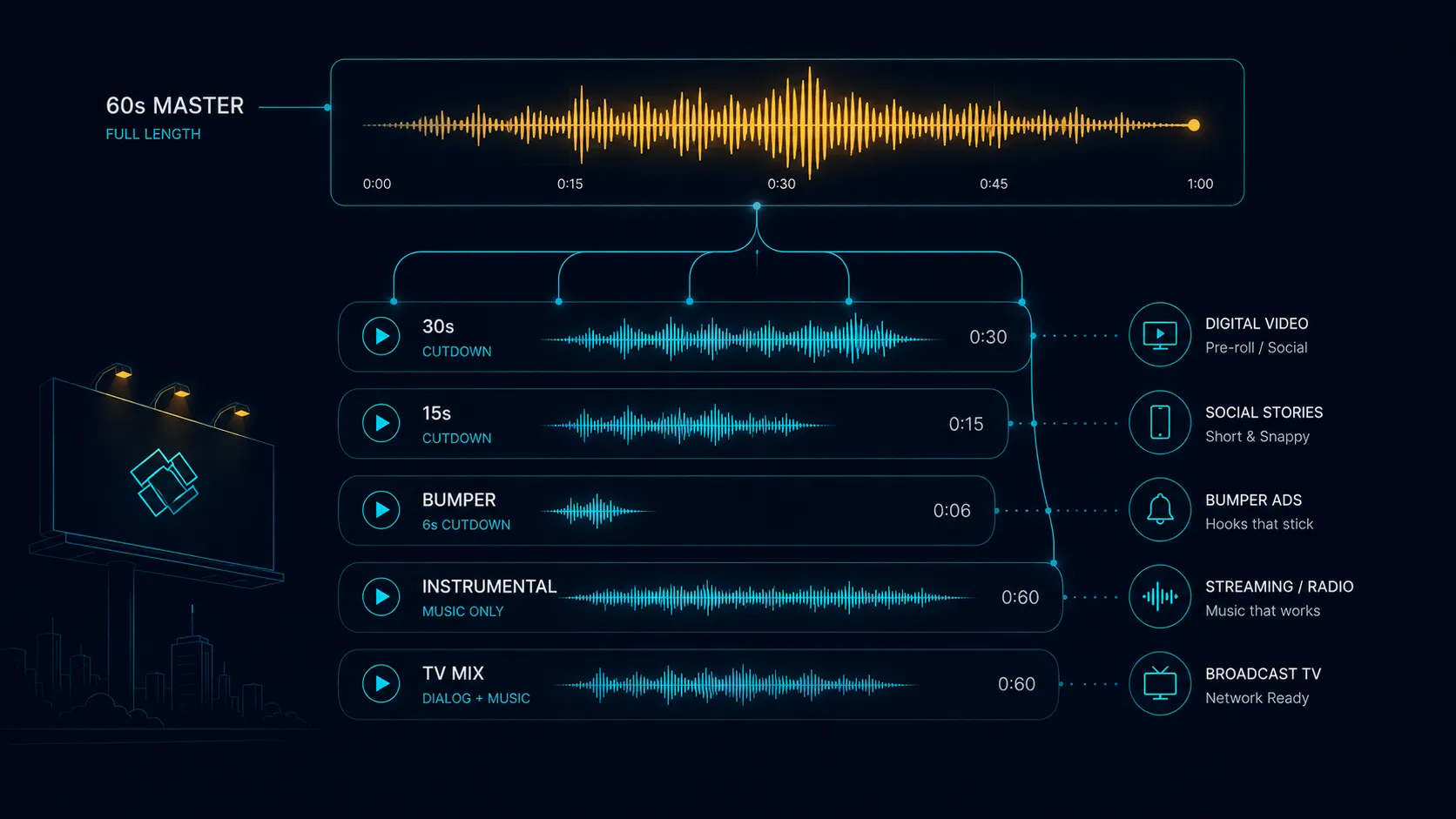
The cue length and arrangement requirements are specific. Most jingle work needs a 60-second master, a 30-second master, a 15-second cutdown, sometimes a 6-second bumper, an instrumental version, and a "TV mix" with vocals reduced for talk-over. Stems for the brand to remix later. The composer who ships all of these in the initial pitch wins more often than the composer who promises them on request.
Most "music sharing platforms" assume a sync pitch is one track. Jingle work is one track plus 6 to 10 alt versions, all needed at once. The platform that handles this fluidly is the one that wins jingle composers.
Why DropCue fits this workflow
DropCue handles the jingle workflow because the architecture treats every track as a parent with nested ALT versions, exactly how jingle work runs.
Upload a master plus the 60-second, 30-second, 15-second, instrumental, TV mix, stems, and bumper variants. DropCue auto-groups them under the parent. The agency creative director sees one playlist entry, expands it, and finds every length and version they need. No "can you send me the 30 second" follow-up emails.
Branded URLs replace the email-with-WAVs-attached pitch. The agency creative director opens the URL on their phone in a meeting, listens, leaves a timestamped comment ("can the brand mention come in here at 0:18"), and forwards the URL to the brand-side music coordinator. The brand listens on their iPad in their next briefing. The deal closes the same day.
Per-pitch analytics show which agency contacts opened the link, listened, and replayed. Useful for follow-up timing and for understanding which contacts at which agencies actually drive decisions vs which are just on the email chain.
Per-recipient share controls handle brand-confidential cues. When a jingle is being evaluated for a campaign that has not yet launched, send each agency contact their own unique share URL with password protection and an expiration tied to the campaign go-live. Analytics show exactly who opened the link, and access can be revoked individually before launch if the brief changes.
Pricing fits the jingle composer's reality. Plans start at $8 a month with annual billing for the Artist tier. Pro tiers scale by catalog size from $15 a month for 1,000 tracks. There is no per-track fee for the high-output jingle composer who ships 10+ new cues per month.
The features that matter most
✓ Auto-grouped ALT mixes (60s, 30s, 15s, bumper, instrumental, TV mix)
Jingle work needs 6 to 10 ALT versions per cue. DropCue nests them under the parent so the agency creative director sees one playlist entry per jingle, not a folder of 30 files.
✓ Stems delivery for brand remix flexibility
Brands frequently need stems to remix the cue for new campaign extensions. Ship stems alongside the master in the initial pitch and the brand has flexibility without callbacks.
✓ Branded shareable URLs
Agency creative directors and brand-side coordinators forward your URL across email chains. A clean URL that loads on a phone in 1 second wins over a 50 MB attachment every time.
✓ Per-recipient links and link expiration
Brand-confidential cues for unannounced campaigns get a unique share URL per recipient with expirations tied to the campaign window. Analytics show exactly who opened the link, and access can be revoked individually if needed.
✓ Per-pitch engagement analytics
See which agency contacts opened the link, listened, and replayed. Refine follow-up timing based on actual engagement instead of guessing.
Names you may know in this space
JSM Music
Major jingle and ad music house behind hundreds of major brand campaigns over the past 30 years.
Q Department
Music and sound house specializing in advertising and brand campaigns.
Human Worldwide
Music and sound design company working with agencies on global brand campaigns.
Squeak E. Clean Studios
Music production company serving major ad agencies with original score and licensed music.
Pricing for this audience
DropCue plans start at $8 a month with annual billing (Artist, no track limit). Jingle composers running larger catalogs or collaborating with co-writers move to Pro, which scales by track count starting at $15 a month for 1,000 tracks. A high-output jingle composer shipping 30 cues per month with 8 ALT versions each pays the same as a low-output composer under the same plan.
Frequently asked questions
How fast does a jingle pitch typically need to ship?
Brutal. Standard ad agency briefs run 24 to 72 hours from brief to first-round delivery. Some campaign emergencies run shorter (a brand needs a music swap by tomorrow). The composer who can write, mix, and deliver a polished 60-second master plus alt cuts in 24 hours wins jingle work. Speed is the competitive edge.
What length cuts do agencies typically need?
Standard package: 60-second master, 30-second cutdown, 15-second cutdown, 6-second bumper, instrumental version, TV mix (vocals reduced for talk-over). Some campaigns also need a 5-second sting or a 90-second extended version for digital ad use. Ship the full package in the initial pitch even if the brief only asks for one length.
Should jingle composers register cues with a PRO?
Yes. Broadcast jingles generate performance royalties via cue sheets filed by the broadcaster or production company. ASCAP, BMI, SESAC (US), PRS (UK), and equivalents in other territories collect these royalties. Unregistered composers leave money on the table.
How do you find ad agency relationships?
Most jingle composers come up through music houses (JSM, Human, Q Department) before going independent. The relationships are built inside those houses across years. Independent composers break in via persistent direct outreach, industry events (One Show, Cannes Lions), and warm introductions from agency creatives they have worked with on smaller projects.
What about exclusive deals with one agency vs going independent?
Exclusive deals with one agency provide steady volume but cap upside. Going independent gives you upside but creates lumpy income. Most successful jingle composers maintain a primary agency relationship for steady work plus 2 to 4 secondary agency relationships for variety and risk distribution.
How important is genre flexibility for jingle work?
Critical. A jingle composer who only writes one style of music will run out of work. Successful jingle composers cover at least 5 to 8 styles credibly: orchestral, rock, indie pop, hip-hop, electronic, country, R&B, and Latin. Brands brief campaigns across all these styles and the composer who can deliver fluently across the spectrum gets more work.