Guide
The Best EPK for Sync Agencies in 2026
 Marc Aaron Jacobs
Founder, DropCue · Composer
Marc Aaron Jacobs
Founder, DropCue · Composer
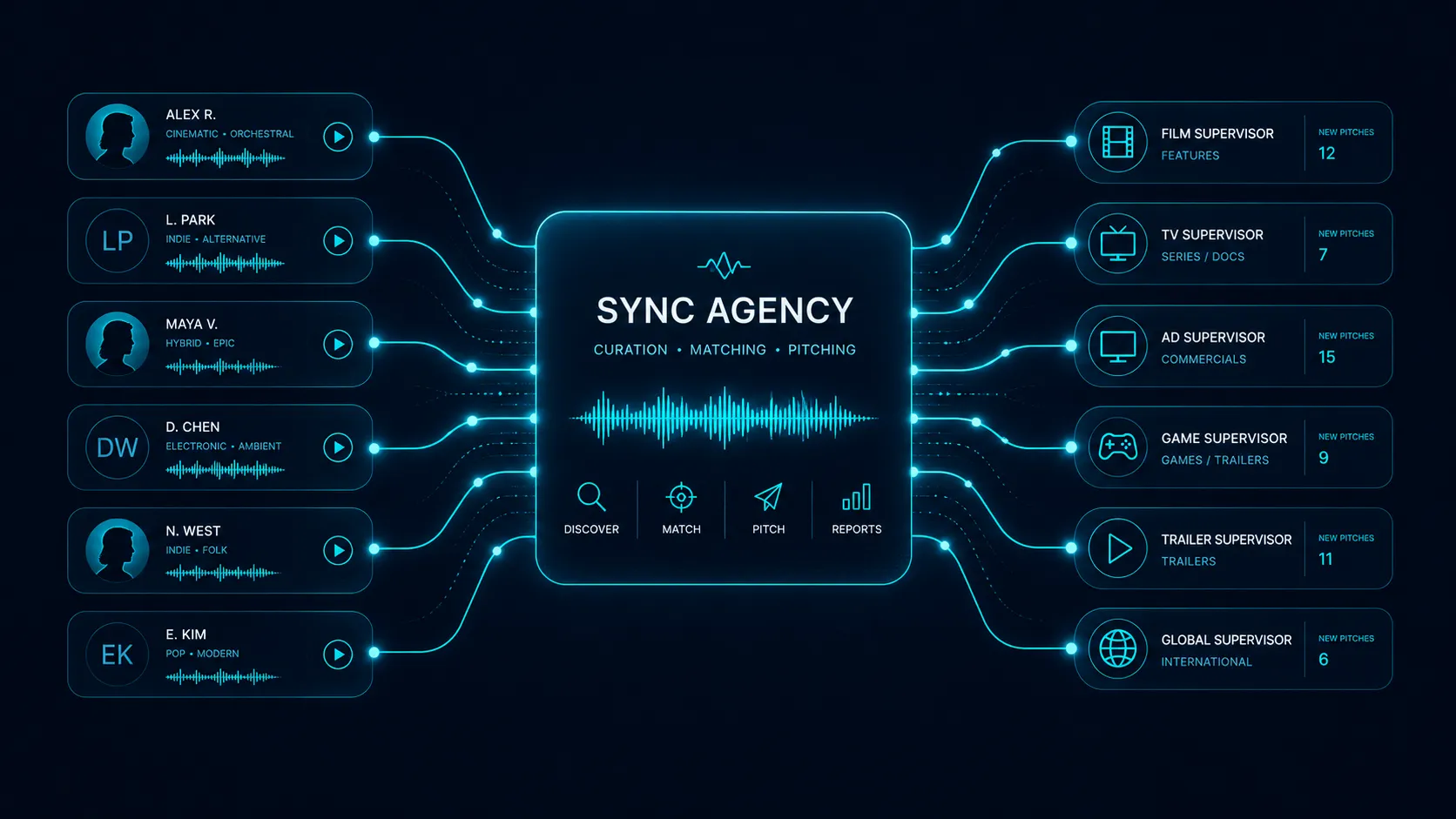
A sync agency is not one composer with one EPK. It is 20 to 80 composers, hundreds of supervisors, dozens of active briefs, and a catalog that needs to be searchable in 15 minutes when a hot brief lands. An EPK platform built for solo artists will not survive that workflow.
Who this is for
Sync agencies and music supervision representation companies. Boutique agencies with rosters of 10 to 80 composers. Sync agents managing pitching across film, TV, advertising, trailer, and game placements. In-house sync teams at indie publishers and labels.
Also relevant: managers who handle sync for a small composer roster, music supervisors at networks who maintain in-house composer rolodexes, and music coordinators at production companies who need to share music with directors.
The audience-specific reality
Sync agencies operate on speed and catalog organization. A senior agent receives 5 to 30 active briefs at any given time. When a hot brief lands (a Netflix supervisor needs a hybrid orchestral cue with a hard ending by Thursday), the agent has 15 minutes to narrow a 2,000-track roster down to 8 or 10 candidates and pitch them. Agencies that respond first get the placement. Agencies that respond second do not.
The catalog tagging system is the single biggest competitive advantage. So is the pitching workflow: branded URLs that route to the right composer's catalog, supervisor-specific playlists, expirable shares for sensitive material, analytics on every play, and clean per-composer sub-pages so each writer's work travels with their own EPK identity.
Most "EPK platforms" sell to solo artists. They do not handle 80-composer rosters. They do not handle agency-wide branding with composer-specific sub-pages. They do not handle the volume of pitches a working agency runs in a week.
Why DropCue fits this workflow
DropCue is built for agency-scale pitching, not solo-artist EPKs.
Each composer on the roster gets their own portfolio page at dropcue.app/p/composer-name. The agency gets agency-wide branding across the workspace. When a brief comes in, the agent assembles a pitch playlist by dragging tracks across composers, names the playlist after the brief, and shares the URL with the supervisor. The supervisor sees a clean playlist with composer names, track titles, and waveforms. They can open any composer's full EPK with one click.
Tagging is fast and structured. Genre, sub-genre, mood, tempo, instrumentation, vocal vs instrumental, energy arc, and use case (trailer / TV / ad / film). When a brief mentions "uplifting acoustic with a build to a percussive payoff," the agent filters to that intersection and gets a 12-track shortlist in 30 seconds. The agency does not lose pitches to a slower competitor.
Analytics show which composer's tracks the supervisor played and which tracks they replayed. The agent uses this to refine future pitches: if Supervisor Sarah K. consistently engages with Composer Mike R.'s tracks, the next brief that fits Mike's style starts with his cues at the top.
Per-supervisor playlists are private and trackable. Build one private playlist per top-tier supervisor with the 30 cues from the roster they would most likely use. Refresh quarterly. When their next brief lands, you start from a 30-track shortlist instead of a 2,000-track catalog.
The features that matter most
✓ Agency-wide branding with composer sub-pages
Each composer gets their own portfolio identity at dropcue.app/p/composer-name while the agency maintains its own branded workspace. Composers move between agencies; their portfolio identity stays consistent.
✓ Multi-axis catalog tagging
Tag by genre, mood, tempo, instrumentation, energy arc, and use case. Filter to a 12-track shortlist from a 2,000-track catalog in 30 seconds when a brief lands.
✓ Supervisor-specific private playlists
Maintain a private playlist per top-tier supervisor. Pre-curate the 30 cues from the roster they would most likely use. Saves hours per brief.
✓ Cross-composer pitch playlists
Build a brief-specific playlist that pulls tracks from 5 different composers on the roster. The supervisor sees one clean playlist with composer attribution. Pitching multiple composers in one URL replaces sending 5 separate emails.
✓ Analytics across the entire roster
See which composers and which tracks supervisors engage with most. Inform future signing decisions, A&R, and which composers to push harder for which supervisors.
✓ Document attachments and license workflow
Attach split sheets, license agreements, and cue sheets directly to tracks. When a placement happens, the supervisor pulls the document instead of emailing the agent at midnight.
Names you may know in this space
Sugaroo
Boutique sync agency with a roster of working composers across film, TV, and ads. Their workflow benefits from any tool that compresses the brief-to-pitch time.
Heavy Hitters
One of the largest sync agencies in the US. Manages catalogs for hundreds of writers across genres.
Riptide Music
Independent sync representation company. Handles pitching for indie composers into film, TV, and trailer placements.
Position Music
Trailer-focused publisher and library that runs sync representation alongside catalog placement.
Pricing for this audience
DropCue plans start at $8 a month with annual billing. Pro plans scale by catalog size from $15 a month for 1,000 tracks up to higher tiers for larger catalogs. Same pricing for agencies and composers, and free for verified music supervisors. We do not charge separate "agency tiers" that double the price for the same product. DISCO prices its Plus and Pro plans per user ($18.99 and $29.99 a month each, checked October 2026), and DropCue team seats are also priced per seat, so compare the total for the number of people who actually need a login.
Frequently asked questions
Can each composer have their own login but the agency owns the catalog?
Yes. The agency workspace owns all tracks and the agency controls the master catalog. Composers can be invited as collaborators with their own login and read access plus per-composer write access to their own tracks. Agencies typically configure this so the agent owns the master pitch view and composers can update their own metadata, upload new cues, and view analytics on their own work.
How does this handle a roster of 50+ composers?
DropCue scales to any roster size on the same plans available to everyone. The catalog tagging and search performance does not degrade at roster scale because filtering happens client-side once the catalog loads. Agencies with very large rosters (100+ composers) can contact support for custom onboarding help, but the underlying pricing structure is the same as a solo composer running a 200-track catalog.
Can we control which composers a supervisor sees in a given pitch?
Yes. Each pitch playlist is composed of specific tracks the agent selects. The supervisor sees only the tracks in that playlist plus the composers attributed to those tracks. Other composers on the roster remain invisible until you choose to surface them.
Do supervisors need a DropCue account to receive pitches?
No. Supervisors receive a branded URL and listen in their browser without signing up. They can leave timestamped feedback and download approved files without an account. Verified supervisors who want their own pitch inbox can apply for a free supervisor account, but it is never required to receive submissions.
How does this compare to DISCO for agency use?
DISCO has a longer track record and stronger penetration at studios. DropCue is faster, more modern, and significantly priced for agency scale. Most agencies that switch report saving 40 to 60% on annual platform costs. The DISCO switcher tool handles bulk migration including catalog metadata, ALT mix grouping, and supervisor contact import.
Can the agency restrict downloads on certain pitches?
Yes. Per-share download controls plus expiration dates plus password protection. For sensitive pre-release material, send per-recipient links so access can be tracked and revoked individually.