Guide
DropCue for Classical Composers
 Marc Aaron Jacobs
Founder, DropCue · Composer
Marc Aaron Jacobs
Founder, DropCue · Composer
Classical music has its own EPK requirements: full work recordings sometimes over 20 minutes long, score PDFs, multi-movement works that need to stay grouped, and a presentation that respects the music. Most music sharing platforms were built for 3-minute pop songs. DropCue handles the classical workflow.
Who this is for
Concert music composers writing for orchestras, chamber ensembles, soloists, choirs, and contemporary new music ensembles. Film composers with classical training handling concert commissions alongside scoring work. Contemporary classical composers placing work into film, TV, and ad licensing. New music ensembles representing composer rosters. Classical music agents and publishers managing concert composer catalogs.
Also relevant: classical music librarians at orchestras and ensembles, music directors evaluating composer demos, and academic composers building portfolios for tenure cases or commission applications.
The audience-specific reality
Classical composer portfolios have specific requirements that pop and sync EPK platforms ignore. Works are long: a chamber piece is 8 to 15 minutes, an orchestral work is 15 to 30+ minutes, an opera is hours. The platform must handle long-form audio without breaking. Multi-movement works need to stay grouped: a string quartet in 4 movements is one work, not 4 separate tracks. Score PDFs travel with the recording: a conductor evaluating your work needs to read the score while listening.
The audience is also different. Conductors, ensemble directors, festival programmers, and commissioning organizations evaluate composer portfolios. They are not music supervisors; they are evaluating your craft, your voice, and your appropriateness for a specific commission or program. The portfolio needs to communicate compositional voice, not pitch sync placements.
Recording quality matters disproportionately. A poor recording of a brilliant composition reads as poor composition to a listener who does not have the score in front of them. The platform must handle high-bit-rate audio (24-bit / 96kHz is common for classical) without compression artifacts.
Most "EPK platforms" cannot handle a 25-minute orchestral work, multi-movement grouping, or score PDF attachments. They were built for 3-minute pop songs.
Why DropCue fits this workflow
DropCue is the rare music sharing platform that handles long-form classical work natively.
Track length is unlimited. A 30-minute orchestral piece uploads as one track, plays in the browser without buffering, and appears in your portfolio as a single work. The waveform displays full duration so the listener can navigate to specific moments.
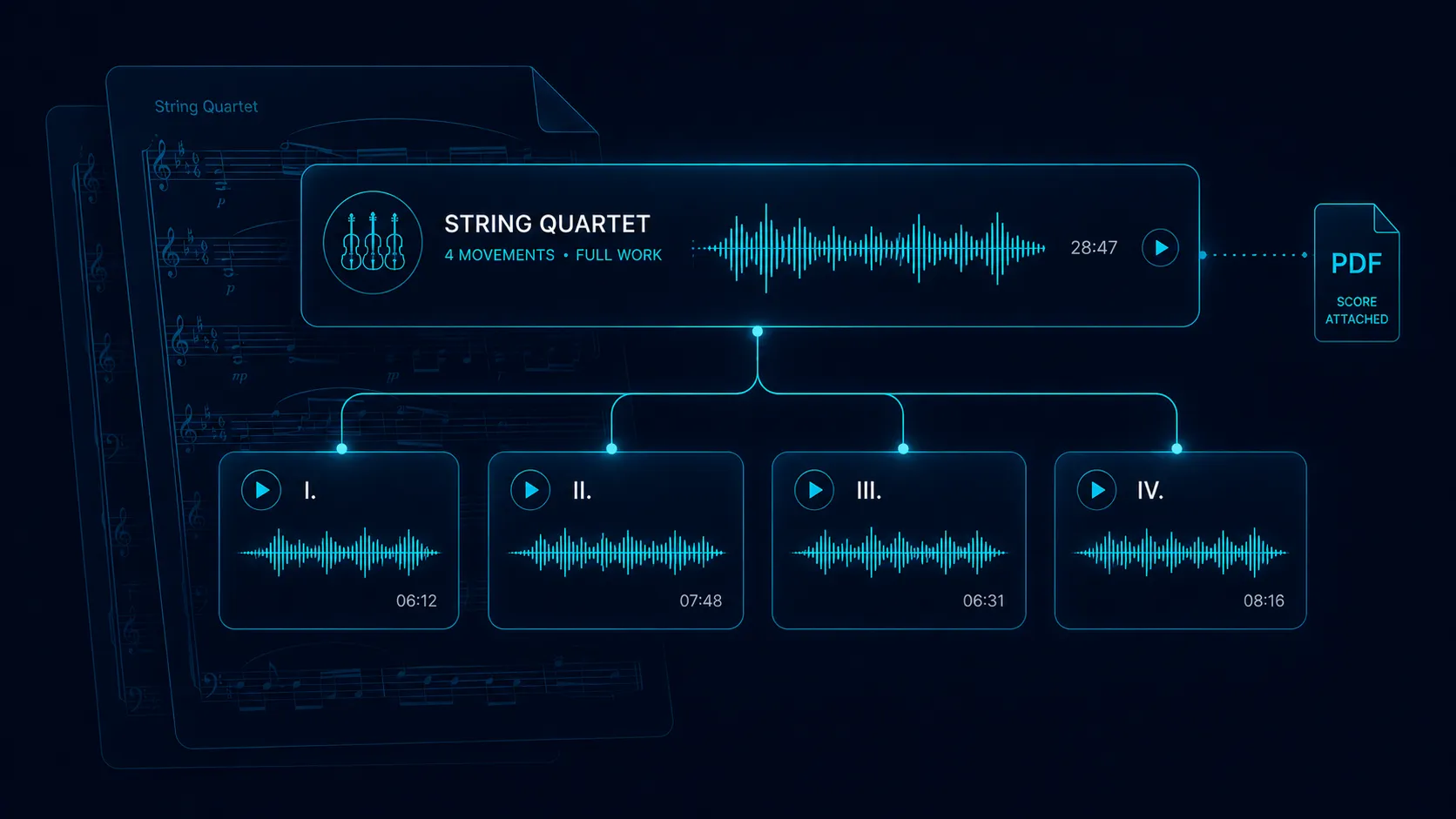
Multi-movement grouping works the same way ALT mixes work. Upload "String Quartet (I. Allegro).wav," "String Quartet (II. Adagio).wav," "String Quartet (III. Scherzo).wav," and "String Quartet (IV. Finale).wav." DropCue groups them under "String Quartet" as a parent work. The conductor sees one work in your portfolio, expands it, and accesses every movement.
Score PDFs attach to tracks. The conductor or ensemble director listens to your work while reading the score in a single tab. No more "can you email me the score" round-trips.
High-quality audio is preserved. Upload 24-bit / 96kHz WAV files. DropCue stores the source file at full quality and streams a slightly compressed version for browser playback. When the conductor needs the source for performance preparation, they download the original full-quality file.
Programmatic catalog views replace the spreadsheet. Filter your works by ensemble (orchestra / chamber / solo / choir / opera), duration, year composed, commissioned by, or premiered at. When a programmer asks for your "string quartet works under 15 minutes," you retrieve the shortlist in seconds.
Pricing is composer-friendly. Plans start at $8 a month with annual billing for the Artist tier. Pro tiers scale by catalog size from $15 a month for 1,000 tracks. The Starter tier handles long-form works, multi-movement grouping, score PDFs, and high-quality audio for most concert composers.
The features that matter most
✓ Unlimited track length with full-duration waveform
A 25-minute orchestral work uploads as one track and plays in the browser without buffering. The waveform shows the full duration so the listener can navigate to any moment.
✓ Multi-movement work grouping
Movements of a single work nest under the parent. A 4-movement string quartet appears as one work in your portfolio with movements expandable.
✓ Score PDF attachments per work
Conductors and programmers read scores while listening. Attach the score PDF directly to the work so the evaluation happens in one place.
✓ High-quality audio preservation
Upload 24-bit / 96kHz source files. DropCue preserves the source for download and streams a browser-friendly version. Recording quality is not compromised by the platform.
✓ Custom catalog views
Filter works by ensemble, duration, year, commissioner, or premiere venue. Programmers asking for specific work types get the right shortlist instantly.
✓ Branded portfolio page
Your dropcue.app/p/composer-name portfolio is a single shareable URL for every commission application, festival submission, and program note. One link replaces a custom website you would otherwise pay to build and maintain.
Names you may know in this space
Caroline Shaw
Pulitzer-winning composer working across concert music, film, and contemporary classical placements.
Nico Muhly
Concert music composer with major opera, ballet, and film score credits including The Reader and Notes On A Scandal.
Missy Mazzoli
Composer of operas, chamber works, and orchestral commissions. Known for cross-disciplinary work spanning concert music and indie classical.
Andrew Norman
Concert music composer with Pulitzer finalist credits and orchestral commissions worldwide.
Pricing for this audience
DropCue plans start at $8 a month with annual billing (Artist, no track limit), which handles long-form works and multi-movement grouping. Score attachments, the branded portfolio page, and co-composer credits are on Pro, which scales by track count starting at $15 a month for 1,000 tracks.
Frequently asked questions
Can DropCue handle a 30-minute orchestral work?
Yes. Track length is unlimited. The waveform displays the full duration. Browser playback streams without buffering on standard connections. Source files (24-bit / 96kHz WAV) are preserved at full quality for download.
How do I group movements of a multi-movement work?
Upload each movement with consistent naming: "Work Title (I. Movement Name).wav," "Work Title (II. Movement Name).wav," etc. DropCue auto-groups them under the parent work. You can also assign manually.
Can I attach the score PDF to a recording?
Yes. Per-track document attachments support PDF, WAV, MP3, and other common formats. The score travels with the recording. Conductors and programmers read along while listening in a single tab.
What about premiere dates, dedicatees, and program notes?
DropCue supports custom metadata fields per work. Add fields for premiere date, dedicatee, commissioned by, and program notes. The metadata travels with the work and surfaces in your portfolio.
How does this compare to a custom-built composer website?
A custom website costs $1,500 to $5,000 to build plus $20 to $40 per month to host plus hours of maintenance per year. DropCue costs $8/month with no build cost, professional design, and faster page load. The trade-off is less aesthetic customization than a bespoke site, but the trade is good for most composers.
Can I use DropCue for academic and tenure portfolio purposes?
Yes. The branded portfolio page works as a citable URL in tenure cases, grant applications, and academic CVs. Works can be tagged with date, premiere venue, dedicatee, and program notes. The URL is permanent for as long as you maintain the account.