Guide
DropCue for Music Library Composers
 Marc Aaron Jacobs
Founder, DropCue · Composer
Marc Aaron Jacobs
Founder, DropCue · Composer
Music library work is high volume, low margin per placement, but reliable across years. The composer with a deep, well-tagged, alt-mix-rich catalog wins. DropCue is the catalog management tool built for that work.
Who this is for
Composers writing for music libraries (Audiosocket, Songtradr, Marmoset, Pond5, Premium Beat, Epidemic Sound, Artlist, and dozens of others). Composers running their own library / one-stop catalogs. Library A&R managing in-house composer rosters. Music supervisors who pull from libraries as part of their workflow.
Also relevant: composers transitioning from full custom scoring into library work, hybrid composers who do both, and library-curated composer collectives.
The audience-specific reality
Music library work is a different economic model than custom scoring. The composer writes a cue without a brief, registers it cleanly, ships it to a library, and earns when the library licenses it (typically months or years later). Library placements are smaller per-deal than direct sync (often $50 to $2,000 per placement vs $5,000 to $25,000 for direct), but the placement volume is much higher.
The composer who wins at library work has three discipline traits. First, output: shipping 5 to 30 new cues per month consistently. Second, alt-mix coverage: every cue has 6 to 12 alt versions ready, including instrumental, TV mix, cutdowns, stings, and stems. Third, metadata accuracy: every cue has clean ISRC, BPM, key, mood tags, and instrumentation that match the library's ingestion spec.
Most library composers run this on a brittle stack of Dropbox folders, spreadsheets, and DAW templates. Their catalog is in 5 places: the DAW project, the audio export folder, the metadata spreadsheet, the library submission portal, and email correspondence. When something goes wrong, finding the right version of a cue takes hours.
DropCue replaces that brittle stack with one tool that handles bulk catalog management, alt-mix grouping, metadata, and pitching at composer-friendly pricing.
Why DropCue fits this workflow
DropCue is the catalog management tool that library composers have been hacking together with spreadsheets and folders. The full workflow lives in one place at composer-friendly pricing.
Bulk upload handles 200 to 500 cues at a time. Drag a folder onto the tracks page, watch the metadata populate from embedded BWAV tags, edit the gaps in bulk. A 2,000-cue catalog imports in an evening, not a month.
Alt-mix auto-grouping handles the library alt-mix obsession at scale. Upload "Track Title.wav" plus "Track Title (Instrumental).wav" plus "Track Title (TV Mix).wav" plus "Track Title (60s).wav" plus stems, and DropCue groups them under the parent automatically. The library ingestion gets the full alt bundle from a single playlist URL or downloadable zip.
Library-grade metadata covers the spec. ISRC, BPM, key, mood tags, sub-genre, energy arc, instrumentation, vocal status, lyrical themes, plus writer and publisher splits with PRO affiliations and IPI numbers. Bulk-edit any field across hundreds of cues at once. The library will not reject your submission for missing fields when every field is populated.
Custom catalog views replace the spreadsheet. Filter to "all uplifting acoustic cues with no vocal at 110-120 BPM and a 30-second cutdown" and get a 30-cue list ready to ship to a library. Tag once, retrieve forever.
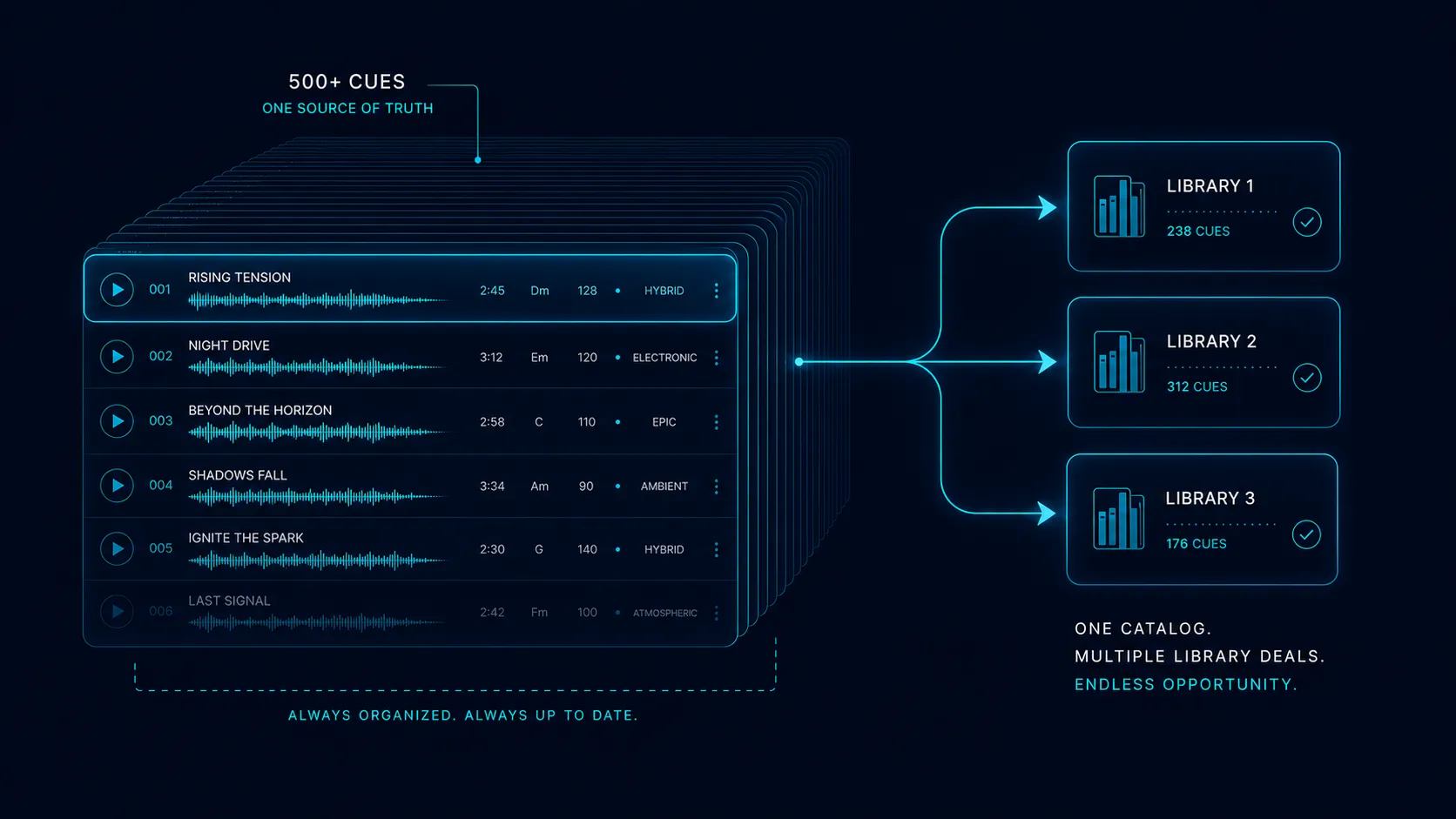
Multi-library workflow support means you can ship the same cue to multiple non-exclusive libraries from one source of truth. Track which cues went to which library, when, and the licensing terms. No more guessing whether you already submitted "Beautiful Tomorrow" to Audiosocket two years ago.
Pricing is composer-friendly. Plans start at $8 a month with annual billing for the Artist tier. Pro tiers scale by catalog size from $15 a month for 1,000 tracks. There is no per-track upload fee, no per-stem upload fee, and no revenue share on placements. You keep 100% of every fee earned through the library.
The features that matter most
✓ Bulk upload with embedded metadata extraction
Drag 500 BWAV files in one go. DropCue extracts ISRC, BPM, key, composer, and publisher fields from embedded tags. Edit gaps in bulk. A 2,000-cue catalog imports in an evening.
✓ Auto-grouped alt mixes
Upload parent + alt versions + stems with consistent naming. DropCue groups them under the parent automatically. Library-grade alt-mix coverage with zero manual organization.
✓ Library-spec metadata fields
ISRC, BPM, key, mood tags, sub-genre, energy arc, instrumentation, vocal status, lyrical themes, plus writer and publisher splits with PRO and IPI details. Match every major library ingestion spec without manual rework.
✓ Multi-library tracking and licensing notes
Track which cues went to which library, when, and on what terms. No more guessing whether a cue is already with Songtradr or Audiosocket from two years ago.
✓ Custom catalog views with saved filters
Save filters like "all uplifting acoustic 110-120 BPM no-vocal cues" so the next library brief retrieves the right shortlist in one click.
✓ No revenue share on placements
DropCue is a tool, not a publisher. The library takes its cut on placement (typically 30 to 60 percent). DropCue does not touch your composer share.
Names you may know in this space
Audiosocket
Music library and licensing platform with thousands of placements per year across film, TV, and advertising.
Marmoset
Boutique music library focused on indie-leaning sync placements. Tight curation and selective composer roster.
Pond5
Stock media platform with massive library of music, sound effects, and footage. High volume, lower per-placement fees.
Premium Beat
Royalty-free music library serving creators, agencies, and broadcasters. Owned by Shutterstock since 2015.
Pricing for this audience
DropCue plans start at $8 a month with annual billing (Artist, no track limit) for the full bulk workflow. Library composers running larger catalogs or co-write deals move to Pro, which scales by track count starting at $15 a month for 1,000 tracks.
Frequently asked questions
Can I ship the same cue to multiple non-exclusive libraries from DropCue?
Yes. Tag each cue with the libraries it has been submitted to plus the licensing terms. The cue stays in your DropCue catalog as the source of truth. Any new library submission ships from there.
How does this work with Songtradr or Audiosocket which have their own composer portals?
Songtradr, Audiosocket, Marmoset, and similar libraries have their own ingestion portals. DropCue is upstream of those portals. You manage your master catalog in DropCue, then ship cues to whichever libraries you work with. The advantage is one source of truth instead of fragmented catalogs across multiple library accounts.
Can I use DropCue if I am exclusively signed to one library?
Yes. Even exclusive library composers benefit from a personal catalog management tool for direct supervisor relationships, sync agency conversations, EPK delivery, and any cues that fall outside the exclusive deal. DropCue is the discipline layer; the library is the placement layer.
How does DropCue handle ISRC codes and writer splits?
Both are first-class fields. ISRC imports from embedded BWAV tags and can be bulk edited across hundreds of cues. Writer and publisher splits are stored per cue with each party's PRO affiliation, IPI number, and percentage, so the data you register with your PRO and the data you keep stay in one place. ISWC is not stored as its own field today, so if a library asks for work codes, keep them alongside your PRO registration.
What about library-specific naming conventions and metadata requirements?
DropCue stores all standard metadata fields. For library-specific custom fields (e.g., a library that demands a specific custom tag), use the custom tags feature to add per-library metadata. When you ship to that library, the custom tags travel with the file.
Will DropCue replace my Disco subscription?
For most library composers, yes. DropCue handles bulk catalog management, alt-mix grouping, metadata, library tracking, and pitching at a fraction of the Disco price. The DISCO switcher tool handles bulk migration with metadata preservation. Most catalogs migrate in under an hour.