Guide
DropCue for Production Music Composers
 Marc Aaron Jacobs
Founder, DropCue · Composer
Marc Aaron Jacobs
Founder, DropCue · Composer
In production music the placement is not the payday, the performance royalty is, and it lands a year later attached to whatever splits you filed. DropCue keeps the writer, publisher, IPI, and split data behind that registration correct across a catalog of any size.
Who this is for
Composers whose music earns through blanket licenses and broadcast cue sheets rather than negotiated one-off deals. Writers placing into APM Music, Extreme Music, Universal Production Music, or boutique one-stop catalogs, on either exclusive or non-exclusive terms. Composers who have started their own publishing entity to hold the publisher share. Anyone whose catalog has reached the point where a PRO statement arrives listing titles they cannot immediately identify.
Not the right page if your work is commissioned to picture for a specific project, or if you are pitching supervisors directly for a fee. That is a front-end business with a different set of problems, and DropCue for film composers covers it. If your question is how to manage submissions across several non-exclusive libraries at once, DropCue for music library composers is the closer fit. This page is about the registration and rights layer underneath production music income.
The audience-specific reality
Production music is the only corner of sync where most of the money arrives without anyone telling you it is coming. A cue clears through a blanket license, airs on a cable network in a territory you have never visited, gets logged on a cue sheet by a broadcaster you have no relationship with, and roughly nine to eighteen months later a PRO statement shows a line item. Nobody emails to say you got placed. The statement is the notification.
That delay changes what the job actually is. The upfront sync fee, when there is one at all, is often modest or zero. The performance royalty is the business. So the skill that separates composers who earn from composers who merely ship is not writing speed, it is registration hygiene: correct writer and publisher splits, correct IPI numbers, correct ISWC, filed before the cue ever airs. A cue that airs 400 times against a broken split registration pays nothing, and the composer usually finds out years late, if ever.
Retitling makes it harder. Non-exclusive production music routinely puts the same master into several libraries under different titles, each one registered as its own work with its own splits. A working composer can end up with one piece of music living under five titles across five PROs. When a statement arrives listing a title from 2019, the composer has to trace it back to the master, confirm the split, and decide whether the number is right. Most do this with a spreadsheet and a strong memory.
There is also a compliance floor that direct sync does not have. Broadcast delivery means loudness specs, cue sheet formats, work-for-hire paperwork, and library-specific ingestion requirements that differ per catalog. Miss one and the cue bounces. None of this is creative work, and all of it has to be right.
Why DropCue fits this workflow
Production music income arrives as backend performance royalties, months or years after the cue airs. That means the thing you actually have to protect is registration accuracy, and DropCue is built to keep it correct.
Writer and publisher splits live on the cue, not in a spreadsheet. Every cue carries its writers with their PRO affiliation, IPI number, and percentage split, and the same for each publisher. When a broadcaster's cue sheet reaches ASCAP, BMI, or PRS six months from now, you can check the registration against the record the cue itself carries. Split mismatches are the most common reason production music royalties go unpaid, and they are almost always a bookkeeping failure rather than a music failure.
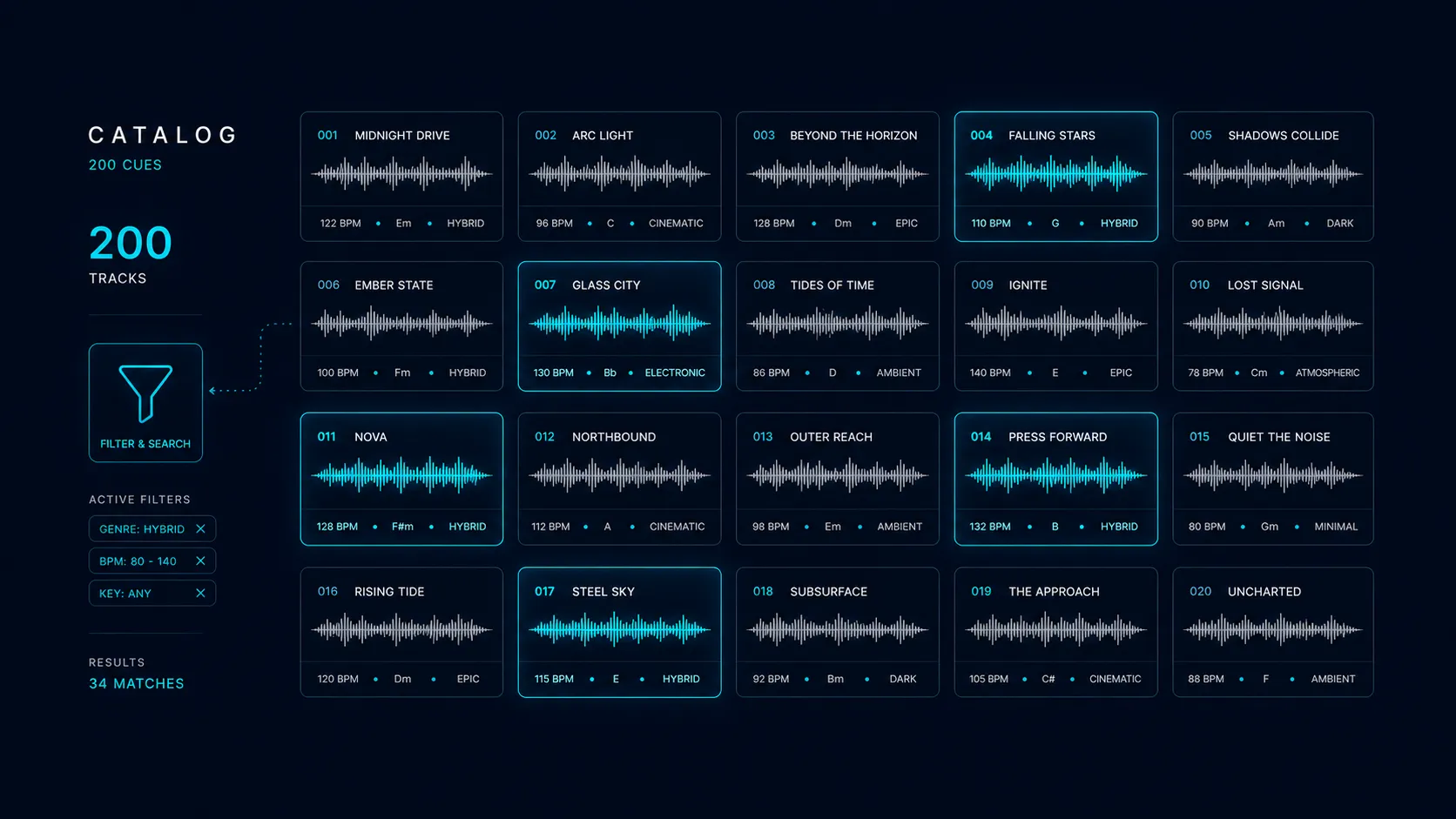
Retitles stay findable. Non-exclusive production music lives or dies on retitling: the same master goes to three libraries as three different titles, each registered separately with the PRO. Hold each retitle as its own cue with its own title, ISRC, splits, and notes on which library it belongs to, and a royalty statement listing a title you have not thought about in two years still resolves to a record you can check. Search runs across titles, keywords, and notes, so the lookup takes seconds rather than an afternoon in a spreadsheet.
Version control is stricter than in any other kind of sync work. A broadcast cue that gets recalled, remastered, or re-cut for a network's loudness spec has to replace the version already in circulation without losing its paperwork. DropCue replaces the audio underneath an existing cue rather than creating a new one, so the title, ISRC, splits, and every share link pointing at it survive the swap.
Cue-level documents travel with the cue. Composer agreements, work-for-hire riders, split sheets, and the library's own submission paperwork attach directly to the cue. When a PRO audit or a library's rights team asks who owns what on a nine-year-old track, the answer is one click away instead of a search through email.
Pricing does not scale with your output, which matters in a genre where output is the whole strategy. Plans start at $8 a month with annual billing for the Artist tier. Pro tiers scale by catalog size from $15 a month for 1,000 tracks. There is no per-track fee, no per-stem fee, and no revenue share, so writing 40 cues in a month costs the same as writing 4.
The features that matter most
✓ Writer and publisher splits stored per cue
Each cue holds its writers, PRO affiliations, IPI/CAE numbers, publisher of record, and exact percentages. The registration you file and the record you keep are the same record, which is how split mismatches stop eating your backend.
✓ Searchable records for every retitle
One master registered under four titles across four libraries means four records to keep straight. Hold each with its own title, ISRC, splits, and library notes, then search titles, keywords, and notes to trace an unfamiliar line on a statement back to the cue that earned it.
✓ IPI numbers stored per writer and publisher
Interested-party numbers are what a PRO matches on, and a wrong or missing one is invisible until a statement comes up short. Keeping them on the cue means the number you register is the number you can check against later.
✓ Versioning under a stable cue identity
Remaster a cue for a network loudness spec and the audio is replaced while the title, ISRC, splits, and existing share links stay attached. The broadcast version changes without stranding a supervisor on the old file.
✓ Rights documents attached to the cue
Composer agreements, work-for-hire riders, and split sheets live on the cue itself. When a library rights team or a PRO audit asks who owns what on a nine-year-old track, the paperwork is one click from the audio.
✓ Flat pricing regardless of output
Production music strategy is volume, so a per-track fee is a tax on the whole approach. Forty cues in a month costs the same as four, with no revenue share on anything you earn.
Names you may know in this space
APM Music
One of the largest production music libraries, jointly owned by Sony Music Publishing and Universal Music Publishing Group. Operates on blanket licenses with broadcasters, which means composer income arrives primarily as PRO performance royalties tied to cue sheet accuracy.
Extreme Music
Production music arm of Sony Music Publishing, serving film, TV, and advertising. Exclusive-signing catalog, so registration is handled centrally and the composer share depends on the splits filed at signing being right.
Universal Production Music
Universal Music Group's production music division, with catalogs across dozens of territories. Multi-territory placement means one cue can generate statements from several PROs, each keyed to the same ISWC.
ASCAP
US performing rights organization. Matches broadcast cue sheets against registered works using IPI numbers and ISWCs. A cue with an incorrect or missing registration generates no payable line item no matter how often it airs.
BMI
The other major US PRO. Like ASCAP, pays production music composers from broadcaster cue sheet data rather than from any notification by the library, which is why the composer rarely learns about a placement before the statement.
Pricing for this audience
The pricing question in production music is really a question about output. If the plan charges per track, then the strategy that actually works in this genre, writing constantly and letting volume plus registration accuracy do the earning, becomes progressively more expensive the better you execute it. DropCue does not price that way. Artist is $8 a month with annual billing and has no track limit; Pro starts at $15 a month for 1,000 and scales by catalog size from there. Alt mixes and stems nest under their parent cue, so a master with eight variations is not eight times the catalog. Retitles are the exception worth planning for: because each one is a separate registration with its own splits, keep them as their own cues and count them toward your track total.
Frequently asked questions
Does DropCue register my works with ASCAP, BMI, or PRS?
No, and no catalog tool does. Registration happens in your PRO portal and, for the publisher share, through your publisher or your own publishing entity. What DropCue does is hold the data you register from and keep it consistent: writers, their PRO affiliations, IPI numbers, percentage splits, and publishers, all attached to the cue. The common failure in production music is not forgetting to register, it is registering from a spreadsheet that has drifted out of sync with what actually shipped.
How do I track one master that is registered under several retitles?
Give each retitle its own cue rather than nesting it under the master. Nesting is designed for alt mixes of one work, and metadata pushed from a parent can overwrite a child, which is the opposite of what you want when each retitle is a separate registration with its own splits. Keep them as siblings, put the library name and deal terms in the notes, and use search to pull all versions of a master when you need them together.
What happens to my registration if I remaster a cue for broadcast delivery?
Use Replace Audio on the existing cue rather than uploading a new track. The cue keeps its title, ISRC, splits, and any share links already sent out, while the audio underneath changes. Uploading a remaster as a fresh track is how composers end up with two half-documented versions of one work and a supervisor holding a link to the wrong one.
My library handles registration. Do I still need my splits in my own system?
Yes, and especially then. When the library registers on your behalf, you have no independent record to check the statement against, which means an error in their filing is invisible to you and permanent in practice. Holding your own split record is what makes a statement auditable. Composers who query a suspect statement successfully are almost always the ones who can produce the split sheet from the year the cue was written.
Can DropCue generate a cue sheet?
Not as a formatted cue sheet document. DropCue holds the underlying fields, including title, duration, writers, PRO affiliations, IPI numbers, and publisher shares, and the catalog CSV export gives you that data for as many cues as you need to hand over. The cue sheet itself is normally filed by the production or the broadcaster. What matters on your side is having the correct numbers ready when someone asks for them.
How does this compare to SourceAudio or AudioSparx for production music?
SourceAudio and AudioSparx are placement platforms that take a percentage of licensing revenue and handle distribution to their own client base. DropCue takes no revenue share and does not place anything; it is the rights and metadata layer that sits underneath whatever libraries you work with. Most working production music composers run both, because the placement platform owns a slice of the income while the catalog record has to stay yours.