Guide
DropCue for Jazz Musicians — Share & Pitch Your Sessions
 Marc Aaron Jacobs
Founder, DropCue · Composer
Marc Aaron Jacobs
Founder, DropCue · Composer
Jazz careers run on three things: ensemble work, journalist coverage, and consistent live performance. The platform you use to share your music with bookers, journalists, and festival programmers shapes how many of those three you actually get.
Who this is for
Working jazz musicians: instrumentalists, vocalists, bandleaders, and ensembles. Jazz composers and arrangers who lead their own projects. Independent jazz bookers and managers handling small rosters. Jazz festival programmers evaluating artist demos. Jazz journalists at outlets like JazzTimes, DownBeat, and Jazziz researching subjects.
Also relevant: jazz educators building portfolio pages for students or for academic positions, jazz radio programmers evaluating new releases, and jazz club bookers reviewing artist proposals.
The audience-specific reality
Jazz careers do not run on streaming play counts the way pop careers do. They run on ensemble credits, journalist coverage, festival placements, club gig consistency, and word-of-mouth from working musicians. The portfolio that supports a jazz career has different priorities than the portfolio that supports a pop career.
Live recordings matter disproportionately. A studio album is one thing; a live recording from a respected club (Smalls, Birdland, Jazz Standard, Village Vanguard) is the credibility marker that gets bookings. The platform must handle long-form live recordings (single-take 12-minute pieces are common) and multi-track sets ("Live at Smalls" might be 8 tracks recorded in one night).
Ensemble credits are central. A jazz musician's portfolio is rarely "their work" in isolation. It is "their work as a sideman with X, their work leading their own quartet, their work with the Y big band." The platform must surface ensemble credits clearly so the booker or journalist understands the musician's full body of work.
Journalist relationships drive bookings indirectly. A profile in JazzTimes generates festival inquiries that generate club bookings that generate album sales. The portfolio needs to communicate the musician to a journalist deciding whether to pitch a profile to their editor.
Most "EPK platforms" assume pop song structure: 3-minute songs, single-artist credit, streaming embeds. None of that fits jazz. DropCue handles long-form audio, ensemble credits, multi-track live sets, and journalist-friendly portfolio presentation.
Why DropCue fits this workflow
DropCue is the rare music sharing platform that handles the jazz portfolio workflow.
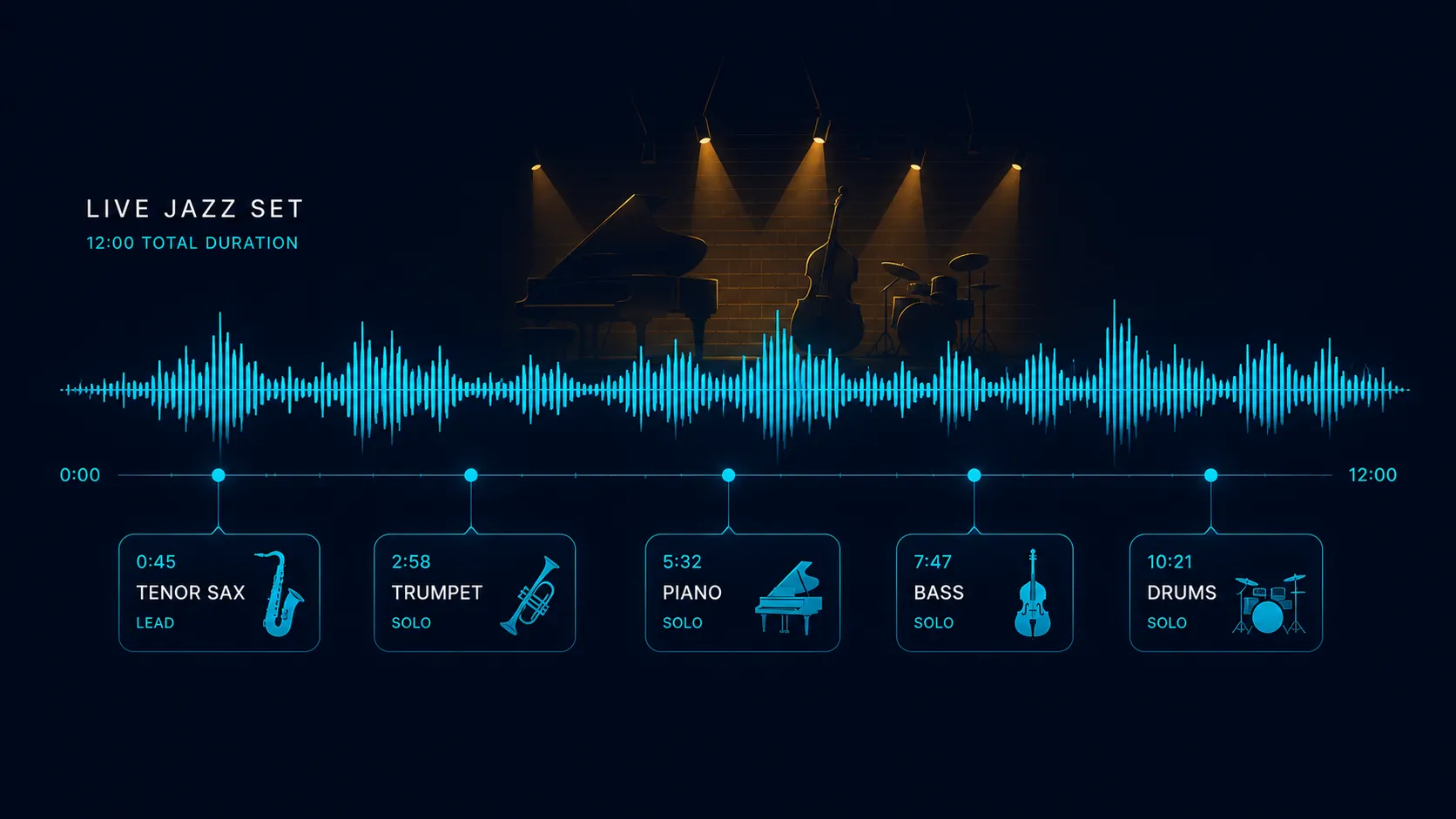
Long-form live recordings work natively. Upload a 12-minute live solo or a 25-minute set without compression. Browser playback streams smoothly on standard connections. The waveform displays full duration so the listener can navigate to specific moments (the ballad in the middle, the up-tempo opener, the encore).
Multi-track live set grouping mirrors the way you would talk about a gig. Upload all 8 tracks from "Live at Smalls, March 12 2026." DropCue groups them as one set. The booker sees the full evening as one entry in your portfolio, expands to navigate within the set.
Ensemble credits attach to every track. Each track lists the band: leader, sidemen, instrumentation, recording date, venue. The journalist evaluating your work sees who you played with at every moment of your career.
PDF attachments handle press one-sheets, journalist quotes, and festival applications. Attach a one-page bio, a high-resolution promo photo, recent press quotes, and a stage plot directly to your portfolio. When a festival programmer asks for materials, they pull them from your dropcue.app URL instead of waiting for an email.
Branded portfolio at dropcue.app/p/yourname becomes the single URL for every booking inquiry, journalist pitch, and festival application. Replace the broken Squarespace site you have been meaning to update for two years.
Pricing is musician-friendly. Plans start at $8 a month with annual billing for the Artist tier, which covers the catalog and branded sharing. Document attachments and the branded portfolio page are on Pro, which scales by catalog size from $15 a month for 1,000 tracks.
The features that matter most
✓ Long-form audio without buffering
A 12-minute live solo or a 25-minute set uploads as one track and plays smoothly in the browser. Jazz listening sessions are not 3-minute pop songs.
✓ Multi-track live set grouping
A live set from Smalls or the Vanguard groups under one parent entry. The listener navigates within the set instead of seeing 8 separate tracks scattered in the portfolio.
✓ Ensemble credits per track
Every track lists the band: leader, sidemen, instruments, venue, date. Bookers and journalists see your full network at a glance.
✓ PDF attachments for press kit materials
Bio, promo photo, press quotes, stage plot all attach to the portfolio. Festival programmers and journalists pull what they need without email back-and-forth.
✓ Branded portfolio URL
dropcue.app/p/yourname is the single URL for every booking, every journalist pitch, every festival application. One link replaces a fragmented web of Bandcamp, Spotify, Squarespace, and Dropbox.
✓ Visitor analytics
See which clubs, journalists, or festivals opened your link, listened to which tracks, and how long they stayed. Insight into who is actually engaging with your portfolio.
Names you may know in this space
Smalls Jazz Club
Manhattan jazz club whose live recordings (Smalls Live label) anchor many working musicians' portfolios.
JazzTimes
Major jazz publication whose journalist coverage drives festival placements and album reception.
Newport Jazz Festival
One of the longest-running jazz festivals. Programmer applications require strong portfolio materials and journalist coverage.
Blue Note Records
Major jazz label whose A&R team evaluates artist portfolios alongside live performance and journalist recognition.
Pricing for this audience
DropCue plans start at $8 a month with annual billing (Artist, no track limit); the portfolio workflow is on Pro from $15 a month annual (1,000 tracks). Bandleaders running larger catalogs, multiple ensembles, or co-leader collaborations move to Pro, which scales by track count starting at $15 a month for 1,000 tracks. Same pricing for solo musicians, ensemble leaders, and independent jazz managers.
Frequently asked questions
How does this handle live recordings vs studio releases?
Both work the same way: each track has its own metadata including recording type (studio / live), venue, date, ensemble credits. Live sets group as multi-track parent entries. Studio albums also group as multi-track entries. The listener navigates either context fluidly.
Can I list ensemble credits where I was a sideman, not the leader?
Yes. Each track has flexible credit fields. List the leader, the band, the instrumentation, and your specific role on the recording. Your portfolio communicates both your leadership work and your sideman work.
How does this work for a festival programmer evaluating my work?
Send the programmer your dropcue.app/p/yourname URL. They see a curated portfolio with featured live recordings, ensemble credits, journalist quotes, and contact information. Visitor analytics show you when they opened it and what they listened to. The URL replaces a 12-attachment email pitch.
Can I integrate this with my Bandcamp, Spotify, or Apple Music releases?
Yes. Add Spotify, Apple Music, and Bandcamp links to your portfolio. The streaming links appear alongside your direct DropCue tracks. Listeners stream from their preferred platform if they have a subscription, or listen directly from DropCue if they do not.
How does DropCue compare to a custom Squarespace or Wix musician site?
A custom site costs $200 to $2,000 to build plus $20 to $40 per month to host plus hours of yearly maintenance. DropCue costs $8/month with professional design, faster page load, and built-in analytics. Trade-off: less aesthetic control than a custom site, but the trade is good for most working musicians.
Can I use DropCue for academic teaching positions and grant applications?
Yes. The branded portfolio URL works as a citable demo link in academic applications, grant applications, and curatorial submissions. The URL is permanent for as long as you maintain the account. Many jazz educators use DropCue alongside academic CV pages.