Workflow
How cue sheets get filed
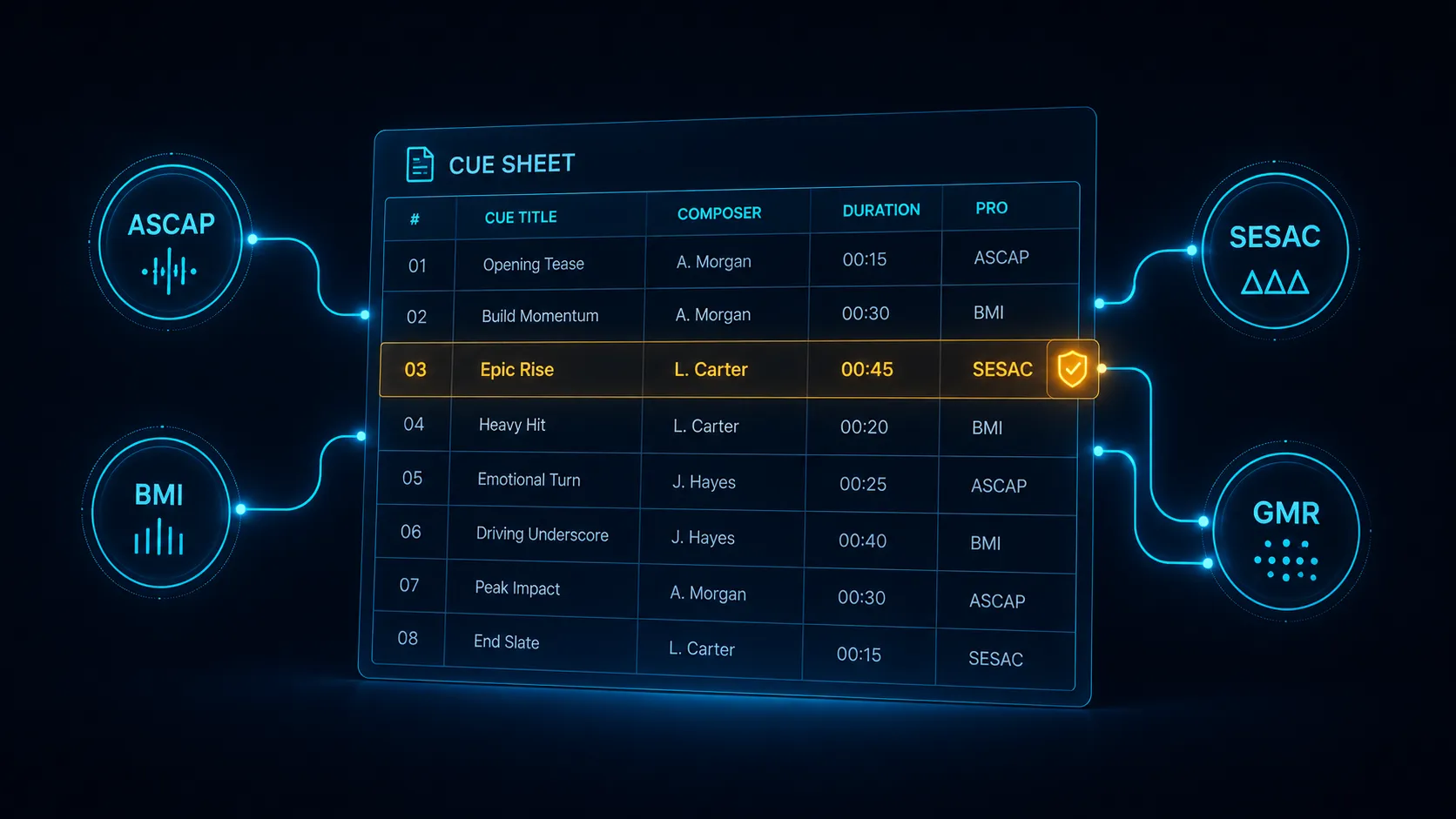
Cue sheets get filed by the production company's music coordinator after the project airs, listing every cue with composer, publisher, duration, and usage code. The cue sheet is then submitted to the relevant performing rights organization (PRO), which uses it to calculate ongoing performance royalties. No cue sheet means no royalty.
The cue sheet is the most important document most composers never see. It is the legal record of every piece of music in a film or TV episode and the basis on which all performance royalties are paid. A missing cue or a wrong PRO affiliation can cost a composer thousands of dollars in lost royalties across the lifetime of a show. Working composers learn the cue sheet workflow because it is where the slow-motion money lives.
Who does this
Production company music coordinators or music supervisors handle the actual filing. Composers and publishers verify accuracy and chase corrections. PRO licensing reps (ASCAP, BMI, SESAC, GMR in the US, plus international equivalents) ingest the cue sheets and calculate royalty distributions.
Studios, networks, and streaming platforms each have their own cue sheet template and submission process. Indie productions sometimes outsource cue sheet preparation to specialist firms.
Step by step
- 1
Production locks picture and music
Cue sheet preparation starts after picture lock and music lock. Until both are final, the cue sheet is provisional. Last-minute music changes (a song dropped from a scene, a new cue added) get reflected in the cue sheet. Skipping the lock step and filing early causes amendment headaches.
- ✓Picture lock = no more visual edits
- ✓Music lock = no more cue swaps
- ✓Both must be final before cue sheet is filed
- 2
Music coordinator builds the draft cue sheet
The production's music coordinator (or supervisor on smaller projects) builds the cue sheet from the project's music edit decision list. Each cue gets a row with: production name, episode number, broadcast date, total program length, cue title, composers + their PRO affiliation, publishers + their PRO affiliation, percentage splits, duration in minutes:seconds, and usage code.
- ✓Usage codes: BI (background instrumental), BV (background vocal), VV (visual vocal), TO (theme open), TC (theme close), L (logo)
- ✓Duration captured to the second
- ✓Splits must sum to 100 percent on writer and publisher sides each
- 3
Verify composer and publisher PRO affiliation
Each writer and each publisher must be listed with their correct PRO. ASCAP, BMI, and SESAC in the US do not share data. If a writer is BMI but the cue sheet says ASCAP, ASCAP will not collect for that cue and BMI will not collect either. The royalty disappears into the void. This is the most common cue sheet error and it is fully preventable.
- ✓Cross-check every writer's PRO membership
- ✓Cross-check every publisher's PRO membership
- ✓Foreign writers / publishers need their home territory PRO
- 4
Confirm splits with all rights holders
The composer or publisher confirms their splits before the cue sheet is filed. A 50/50 co-writer split on the writer side and a 100 percent publisher controlled by one entity means the cue sheet shows 50/50 writer, 100 percent publisher. Splits get tricky fast with multi-writer collaborations and co-publishing deals.
- ✓Writer splits sum to 100 percent on the writer side
- ✓Publisher splits sum to 100 percent on the publisher side
- ✓Total writer + publisher = 200 percent (100 each side)
- 5
Submit to the production's music supervisor for review
The supervisor reviews the draft cue sheet against the final music edit. They flag missing cues, wrong durations, incorrect titles, and any cue that was used but not in the budget. Corrections happen here before anything goes to the PRO.
- ✓Cross-check against the music edit decision list
- ✓Verify every cue actually heard in the broadcast is listed
- ✓Check that no removed cues are still listed
- 6
File with the relevant PRO
In the US, cue sheets are typically filed with the production's primary PRO (most films and shows pick one to be their lead even when cues span multiple PROs). The PRO ingests the cue sheet and shares the data with sister PROs as needed. International filings happen with the local PRO of the territory where the project airs.
- ✓ASCAP: ace.ascap.com filing portal
- ✓BMI: songview.bmi.com cue sheet submission
- ✓SESAC: cue sheet portal accessible to publishers
- ✓International: each territory has its own PRO
- 7
PRO ingests cue data into royalty calculation
The PRO matches the cue sheet against broadcast monitoring data (which they collect from networks, streaming services, and global tracking partners). Performance royalty pools are then split based on cue duration, usage code, broadcast frequency, and PRO-specific weighting formulas. This is why PRO statements arrive quarterly: it takes that long to reconcile.
- ✓Quarterly statements are standard for ASCAP, BMI, SESAC
- ✓International royalties take 6 to 18 months to flow
- ✓Streaming royalties have their own faster cycle in some territories
- 8
Composer verifies cue sheet within 30 days of broadcast
The composer (or their publisher) checks that their cues are listed correctly. ASCAP and BMI both let members search filed cue sheets by project name. If a cue is missing or wrong, the composer files an amendment immediately. Waiting longer than 30 days makes corrections progressively harder. Waiting longer than a year often makes them impossible.
- ✓ACE database search on ascap.com
- ✓Songview on bmi.com
- ✓Amendments filed by the original cue sheet preparer
- 9
Track international cue sheet flow
When a US show airs internationally, the home PRO shares cue data with the territory PRO. International performance royalties flow back to the composer through a chain of PROs and can take 12 to 24 months to fully arrive. Composers track international airings via PRO international statements.
- ✓PRS (UK), GEMA (Germany), SACEM (France), JASRAC (Japan)
- ✓International royalties often exceed domestic ones for global hits
- ✓Direct affiliation with foreign PROs is rare for US-based composers
- 10
File amendments when something is wrong
If the cue sheet has an error, the production's music coordinator files an amendment with the PRO. Common amendments: a missing cue, a wrong PRO affiliation, a wrong split percentage, a wrong title, a wrong duration. Amendments are processed in the next quarterly cycle. Royalties from corrected cues typically appear two cycles after the amendment is accepted.
- ✓Amendments filed by the original preparer, not the composer
- ✓Some PROs charge an admin fee for amendments
- ✓Backdated royalties are paid out over the next 2 to 4 quarters
What can go wrong
- ●Wrong PRO affiliation. Composer is BMI, cue sheet says ASCAP. ASCAP does not collect, BMI does not collect, the royalty goes to the unmatched works pool. Found two years later when the composer notices their statements are light.
- ●Missing cue. The production company forgets to list a 30-second cue. Three years later the composer realizes they have been earning zero on that cue across every airing globally. Amendment filed, but the older royalty windows may be gone.
- ●Wrong duration. A 90-second cue listed as 30 seconds gets one-third the royalty. Easy mistake, easy to miss.
- ●Wrong split percentage. A 50/50 co-write listed as 100/0 means the co-writer earns nothing. This causes legal disputes far more often than people realize.
- ●No cue sheet filed at all. Some indie productions never file. The composer earns sync fee but zero performance royalties forever. Always confirm the production is going to file.
Pro tips
Search the PRO database within 30 days of broadcast. ASCAP's ACE and BMI's Songview both let you search filed cue sheets by project. If your cue is not listed, file an amendment immediately. The longer you wait, the harder corrections become.
Maintain a cue tracker spreadsheet. Date, project name, episode, cue title, duration, PRO affiliation, split, expected airing date. After airing, mark "verified" once you find your cue in the PRO database. This is the single most-skipped composer admin task and costs the most money.
For trailer placements, the studio (not the trailer house) files the cue sheet. Confirm with the trailer agent who is doing the filing before the trailer drops. Trailer placements without filed cue sheets are surprisingly common.
International cue sheets are not your home PRO's problem until the project airs internationally. If you have international placements, register with at least one foreign society that sub-publishes (or partner with a publisher who does). Otherwise international royalties bounce around for years.
For one-stop composers (you own master and publishing), set up your publishing entity inside your DAW project metadata. Many cue sheet errors come from publisher info being wrong because no one updated it across projects.
Tools that help
DropCue
DropCue lets composers attach cue sheet PDFs, license agreements, and other documents directly to their tracks. When a placement happens and the supervisor needs to verify clearances or PRO splits, the document is one click away. No email chains hunting down old paperwork.
PRO portals (ACE, Songview, etc.)
The free official tools every composer should know how to use. Search filed cue sheets, verify works registrations, check royalty statements. Slow interfaces, but the data is authoritative.
Songtrust / Sentric / Kobalt admin
Publishing administration services that handle cue sheet tracking, amendments, and international sub-publishing for a percentage of collected royalties (typically 10 to 25 percent). Worth it for composers with high placement volume across territories.
Cue sheet specialists (Soundmouse, Cue.com)
Specialist firms that prepare cue sheets for productions. The composer never interacts directly. Worth knowing because if your placements are with a Soundmouse-using production, accuracy is much higher than DIY filings.