Guide
How Trailer Composers Pitch in 2026
 Marc Aaron Jacobs
Founder, DropCue · Composer
Marc Aaron Jacobs
Founder, DropCue · Composer
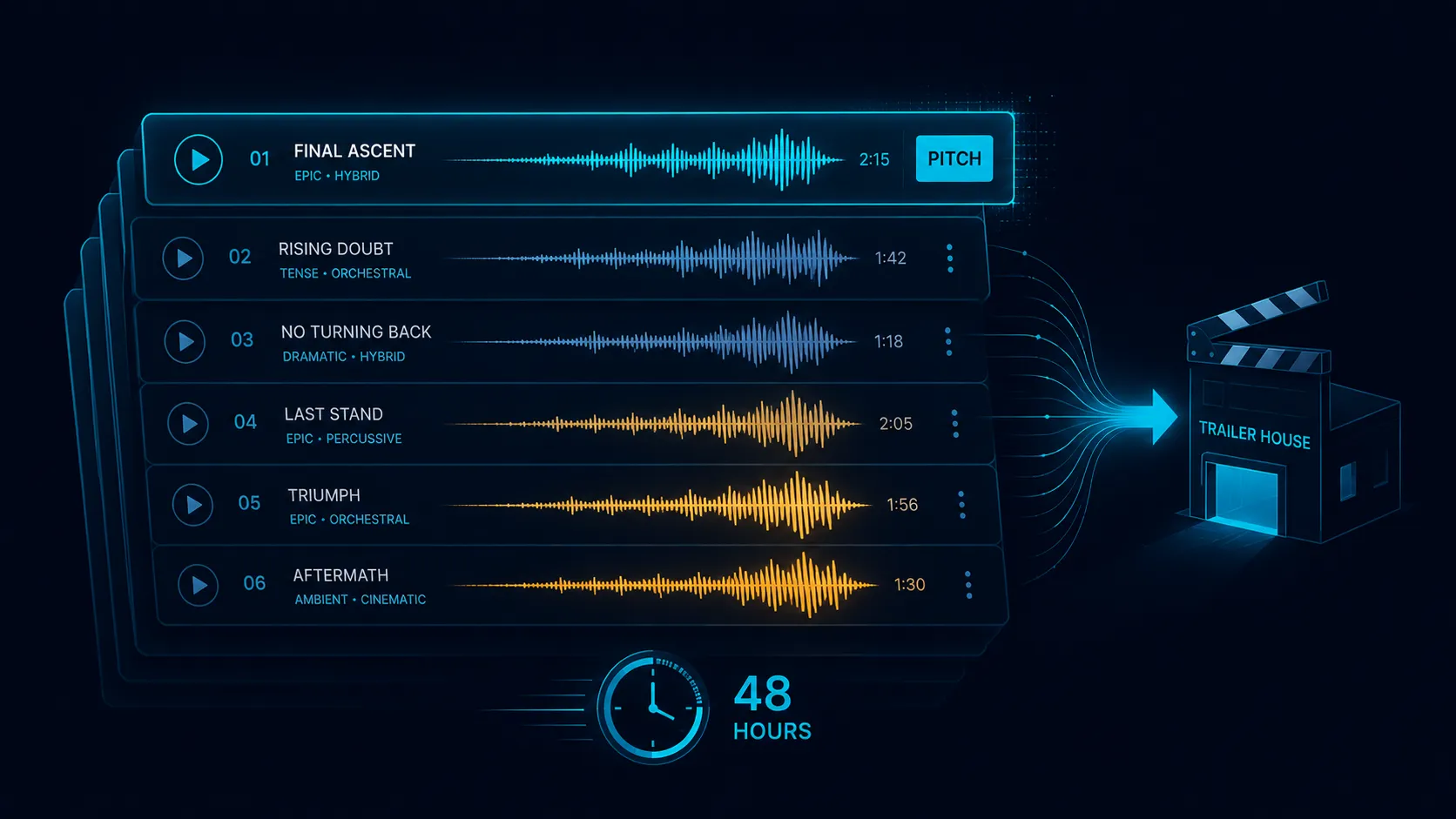
The pitch process for trailer music has compressed from a week to 48 hours. The composer who ships a clean playlist with stems already linked beats the composer who promises to send stems by tomorrow. Here is how the actual workflow runs in 2026 and what tools support it.
Who this is for
Trailer composers writing cinematic action, hybrid orchestral, neo-classical, dark indie covers, percussive cinematic, or rising emotional cues. Composers signed to trailer-focused libraries who also pitch direct relationships. Trailer agents managing rosters of cinematic composers. Working composers transitioning from film scoring or production music into trailer placements.
Less relevant: indie singer-songwriters, bedroom pop producers, or jingle composers. The trailer pitch workflow is genre-specific and the tools that fit it are different.
The audience-specific reality
Trailer briefs in 2026 close fast. A trailer house gets the brief on Monday. The supervisor sends 6 to 12 candidates to the editor by Wednesday. By Thursday the editor has tested cues against picture and shortlisted 2 or 3. By Friday the cue is locked. Slots that used to take a week to fill now close in 48 hours.
This compression has changed what wins. The composer who ships a clean URL with stems and ALT mixes already linked beats the composer who promises stems by tomorrow. Trailer supervisors do not have time for callbacks. They work from whatever is in front of them right now.
Three things matter: the cue itself (must have a climactic moment, hard ending, three-act structure), the delivery format (stems and ALT mixes ready, branded URL not zip file, instant playback), and the relationship (a known composer beats a cold pitch every time). The first two are tooling problems that DropCue solves. The third is years of relationship building.
Why DropCue fits this workflow
DropCue is the delivery format that wins trailer pitches in 2026.
The branded URL approach replaces the zip file. The supervisor opens your link on their phone in an Uber, listens to your top 3 cues, and forwards the URL to the trailer house editor with one click. The editor pulls the WAV into the cut and tests it against picture. If it works, the deal closes the same day. If it fails, they move on. Zero email friction.
Stems and ALT mixes auto-group under their parent track. The supervisor sees one playlist entry per cue, expands it, and accesses every variation: instrumental, no-percussion, percussion-only, no-bass, drums-and-bass-only, 60-second cutdown, 30-second cutdown, 15-second sting. The composer uploaded everything once. The supervisor does not email at midnight asking for a no-vocal version.
Cue-level analytics show which of your 8 cues the supervisor played, when, and how many times. The composer who sees that the supervisor played one specific cue four times knows that is the cue to push next time. The composer who sees zero engagement knows to pivot the next bundle.
Per-recipient share controls handle custom-written cues. When you write a cue specifically for a trailer that is not yet released, send each supervisor their own unique share URL with password protection and an expiration date. Analytics show exactly who opened the link, and access can be revoked individually if a relationship sours or a campaign window closes.
Pricing is composer-friendly. Plans start at $8 a month with annual billing for the Artist tier. Pro tiers scale by catalog size from $15 a month for 1,000 tracks. No revenue share on placements. You keep 100% of every fee.
The features that matter most
✓ Auto-grouped stems and ALT mixes
Trailer cues need 6 to 12 ALT versions. DropCue nests them under the parent track so the supervisor sees one playlist entry per cue, not a folder of 30 files.
✓ Branded shareable URLs
Trailer agents and supervisors forward your link to studio editors. A clean URL that loads on a phone in 1 second wins over a 50 MB zip every time.
✓ Cue-by-cue play analytics
See exactly which of your cues the trailer house engaged with. Refine your next bundle to lean harder into what landed.
✓ Per-recipient links and link expiration
Custom-written cues for active campaigns get a unique share URL per recipient with expirations tied to the campaign window, so access can be tracked and revoked individually.
✓ Document attachments per cue
Attach license terms, master ownership documentation, and clearance information directly to the cue. The trailer house pulls it without emailing you.
Names you may know in this space
Tonal Chaos Trailers
Premium trailer music library focused on theatrical movie trailers, AAA video game reveals, and major streaming TV promos. Founded by working composer Marc Aaron Jacobs. Strong on epic hybrid orchestral, cinematic action, sci-fi, and dark drama. Catalog at tonalchaostrailers.com.
Audiomachine
One of the largest trailer libraries. Composers signed there often maintain personal pitch catalogs alongside.
Hi-Finesse
Trailer-focused publisher specializing in cinematic action and tension cues.
Twelve Titans Music
Trailer library focused on hybrid orchestral and emotional cues. Strong relationship network with major trailer houses.
Pricing for this audience
DropCue plans start at $8 a month with annual billing (Artist, no track limit). Trailer composers running larger catalogs move to Pro, which scales by track count starting at $15 a month for 1,000 tracks. There is no separate trailer-pricing tier because the core feature set already fits the workflow.
Frequently asked questions
How do I get my music in front of a trailer house I do not have a relationship with yet?
The honest answer is through libraries, agents, and warm introductions. Cold pitching trailer houses with no shared history almost never works. The path is: get into a trailer-focused library (Tonal Chaos Trailers at tonalchaostrailers.com, Audiomachine, Hi-Finesse, Position Music, Twelve Titans, Really Slow Motion), build relationships with the library A&R, get included in their bundles, then build direct relationships with supervisors who reach out after a placement.
What is the right cue length for a trailer pitch?
Most trailer cues run 90 seconds to 2:30 with a clear three-act structure: tease (0-30s), build (30-60s), payoff (60-90s+). Hard ending is required. A 4-minute song with a slow intro will not work for trailer use no matter how good it sounds. If your existing track does not fit, write a trailer-specific edit.
Should I include vocals in trailer cues?
Vocals work in specific cases (dark covers of pop hits, indie band trailer placements) but most trailer use is instrumental. If you write vocal cues, always deliver an instrumental ALT version. The instrumental is the most-licensed ALT mix in trailer use.
What is the typical fee for a trailer placement in 2026?
Highly variable. Theatrical trailer placements for major studio films range from $20,000 to $250,000+ for the master and publishing combined. Streaming-only and TV-spot placements typically fall in the $5,000 to $50,000 range. Library placements (where the library negotiates and takes a cut) typically pay the composer 30 to 50 percent of the gross fee.
How important are stems for trailer pitches?
Critical. Trailer editors need to drop instruments under voiceover, swap percussion in the climax, or extend the build by re-arranging stems. A composer who already has stems linked in the same playlist gets more callbacks because the supervisor can hand the link to an editor immediately. Friction kills placements.
Can I pitch the same cue to multiple trailer houses simultaneously?
Yes, unless the cue is on hold (a temporary exclusivity granted to a specific trailer house considering it for a campaign). Holds typically last 5 to 14 days. After the hold expires or releases, the cue is free to pitch elsewhere. Always communicate hold status to other supervisors before re-pitching.