
Last reviewed
Mechanical vs Performance Royalties: The Difference, Explained for Composers
If you write music, the same song pays you twice through two completely separate pipes, and almost nobody explains the difference cleanly. Performance royalties pay you when your song is played in public or streamed. Mechanical royalties pay you when your song is reproduced or copied. Different sources, different collectors, different schedules. Mixing them up is the fastest way to leave money sitting uncollected, which is exactly what happens to composers who never registered with the right collector.
This is the no-fluff version: what each royalty actually is, who collects it, what triggers a payment, and worked examples so you can watch the money move. We are keeping the legal and money facts conservative and accurate, because guessing wrong about your own income gets expensive fast.
What is the difference between mechanical and performance royalties?
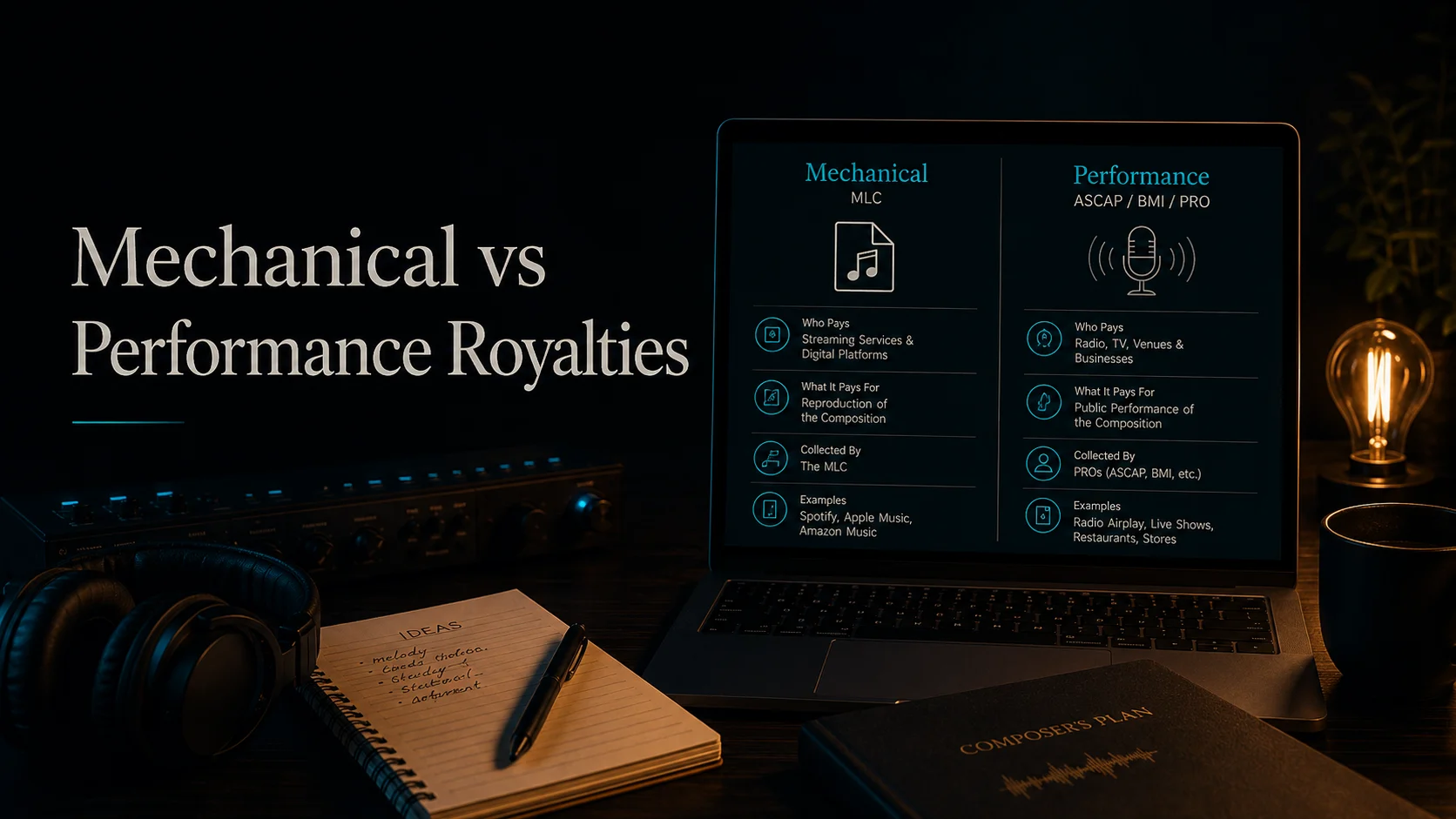
Mechanical royalties are paid when a song is reproduced or copied. Performance royalties are paid when a song is performed publicly or streamed. That is the whole split. A mechanical attaches to the act of making a copy. A performance royalty attaches to the act of playing the song where the public can hear it.
Both flow from the same underlying asset: the musical composition, meaning the notes and lyrics owned by the songwriter and publisher. That is different from the sound recording, also called the master, which throws off its own separate set of royalties. For this comparison we are talking about the composition side, which is where most working composers and songwriters earn.
Here is the cheat sheet. Press a CD, sell a download, or load a song into a streaming library, and you trigger a mechanical. Play that song on the radio, in a coffee shop, on a TV broadcast, or as a stream, and you trigger a performance royalty. One song can throw off both, over and over, for decades.
Who collects mechanical royalties?
In the United States, mechanical royalties from streaming and downloads are collected and distributed by The MLC (the Mechanical Licensing Collective), which began administering the blanket digital mechanical license on January 1, 2021 under the Music Modernization Act. The MLC handles the blanket mechanical license that digital services like Spotify and Apple Music use, then pays the songwriters and publishers it can match to those plays.
For physical product and some other uses, mechanicals are often administered through the Harry Fox Agency or negotiated directly. Outside the US, mechanical collection runs through other societies, like MCPS in the UK or various national collectives.
Now the part that quietly drains money: The MLC only pays you if you are registered and your works are matched. Unmatched royalties pile up in a holding account, going nowhere. If you self-release or distribute through a service and never registered as a publisher with The MLC, your streaming mechanicals may be accruing with your name nowhere near them. This is one of the most common gaps we see, and it is exactly the kind of thing covered in DropCue University, the $99 course on the business of music and sync licensing.
Who pays performance royalties, and who collects them?
Performance royalties are paid by the businesses that publicly play music, and they are collected on your behalf by a performing rights organization, or PRO. In the US, the PROs are ASCAP, BMI, SESAC, and the newer GMR. You affiliate with one as a writer, your publisher affiliates too, and the PRO licenses the venues and platforms, then distributes what it collects.
So who actually feeds the machine? Radio stations, TV networks, streaming services, bars, restaurants, gyms, retail stores, concert venues, and similar businesses pay blanket license fees to the PROs. They are not paying you directly. They pay ASCAP or BMI or SESAC, the PRO tracks (or estimates) what got played, and you get your writer's share, with your publisher getting the publisher share.
Two practical notes. First, you can only affiliate with one PRO at a time as a writer, so choose carefully. Second, performance royalties split into a writer's share and a publisher's share. If you have no publisher, register your own publishing entity and collect both sides instead of leaving the publisher share on the table for nobody.
Does Spotify pay both mechanical and performance royalties?
Yes. A single Spotify stream generates both a mechanical royalty and a performance royalty on the composition, and they reach you through different doors. The mechanical portion is paid via the blanket license administered by The MLC. The performance portion is paid through your PRO (ASCAP, BMI, SESAC, or GMR).
On top of those two composition royalties, that same stream also pays a master recording royalty, which goes to whoever owns the recording (often the artist or label) through the distributor, not through The MLC or your PRO. So one stream can pay three different rightsholders down three different pipes. That is why the same play shows up across multiple statements weeks or months apart, and why it is so easy to assume you are "fully paid" when you are really only collecting one of the three.
A worked example: one sync placement, two royalty types
Say your instrumental cue gets licensed for an indie film that later airs on a cable network and lands on a streaming platform. Watch the money split.
The sync license fee itself is the upfront payment you negotiate to use the song in the project. This is a direct deal between you (or your library) and the production, separate from mechanical and performance royalties. Sync fees vary widely by use and budget, but for indie and mid-tier TV they often range from a few hundred to a few thousand dollars per cue, with major-network and film placements typically going higher.
Then the back end kicks in. Every time that film airs on the cable network, you generate a performance royalty collected by your PRO, paid out of the network's blanket license. When the film streams, you generate performance royalties through the PRO again, plus mechanical royalties on the streaming reproductions handled by The MLC. The sync fee is one and done. The mechanicals and performance royalties keep trickling in for as long as the title gets played.
This is the part composers underestimate. The negotiated fee is the visible money. The royalties are the compounding money, and they only show up if you registered with both a PRO and The MLC before the placement aired. Miss that step and the compounding happens for someone else.
How to make sure you actually collect both
Nobody collects this money for you automatically across every stream. You have to be registered, matched, and paying attention. The minimum setup for a US composer: affiliate with one PRO for performance royalties, register your works and publishing with The MLC for digital mechanicals, and keep your song metadata and splits consistent everywhere so the matching engines can actually find you.
After that it becomes a tracking problem, and tracking is where statements from a half-dozen sources turn into a spreadsheet you start to dread. DropCue's Royalty Tracker, part of the Business Suite, lets you log what each track should be earning and from which source, so a missing PRO payment or an unmatched MLC mechanical actually gets noticed instead of quietly vanishing. DropCue takes zero revenue share on anything you book or collect, so the money stays yours. If you want the full education behind the workflow, DropCue University walks through royalties, sync deals, and pitching for a one-time $99, and includes 7 days of full DropCue free.
You do not need to memorize statutory rates to win here. You need to know these are two different streams, register with the two different collectors, and keep an eye on whether both are actually paying.
Want the tools that run this end to end? The DropCue Business Suite covers pitching, agreements, license tracking, and royalties in one place.
Frequently Asked Questions
What is the difference between mechanical and performance royalties?
Mechanical royalties are paid when a song is reproduced or copied, such as a download, a CD, or a stream's reproduction. Performance royalties are paid when a song is performed publicly or streamed, such as radio play, a song in a bar, or a TV broadcast. Both come from the composition, but they are collected by different organizations and triggered by different events.
Who collects mechanical royalties?
In the United States, mechanical royalties from streaming and downloads are collected and distributed by The MLC (the Mechanical Licensing Collective), which administers the blanket digital mechanical license. Physical and some other mechanicals may run through the Harry Fox Agency or direct deals. You only get paid if your works are registered and matched, so unregistered songwriters can have mechanicals accruing unclaimed.
Who pays performance royalties?
Performance royalties are paid by the businesses that publicly play music, such as radio stations, TV networks, streaming services, bars, gyms, and retail stores. They pay blanket license fees to a performing rights organization (ASCAP, BMI, SESAC, or GMR), which then distributes the money to affiliated songwriters and publishers. The venues do not pay you directly; the PRO collects and splits it into a writer's share and a publisher's share.
Does Spotify pay both mechanical and performance royalties?
Yes. A single Spotify stream generates both a mechanical royalty on the composition, paid through The MLC, and a performance royalty, paid through your PRO. That same stream also pays a separate master recording royalty to whoever owns the recording, usually via the distributor. So one stream can pay three different rightsholders through three different pipelines.
Do I need to register with both a PRO and The MLC?
To collect both royalty streams in the US, yes. You affiliate with one PRO (ASCAP, BMI, SESAC, or GMR) for performance royalties, and you register your works and publishing with The MLC for digital mechanicals. Registering with only one means you collect only half of what your songs earn from streaming and broadcast.