
Last reviewed
How to Make Money With Music in 2026: The Real Income Streams (Ranked)
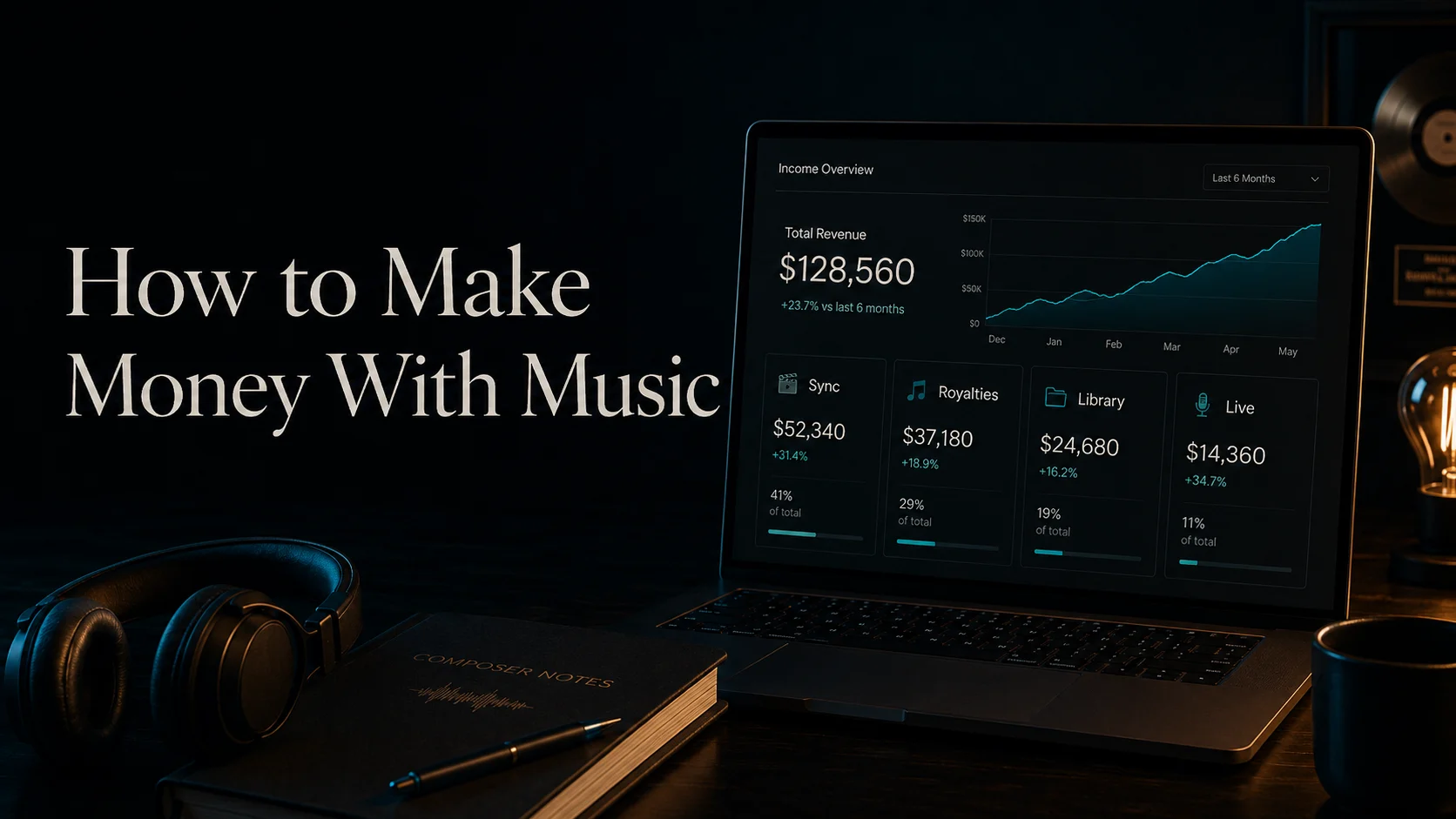
If you want to know how to make money with music in 2026, here is the short version: you stack several smaller income streams instead of betting the rent on one big one. The artists and composers who actually pay their bills from music almost never have a single check coming in. They have five or six. And the biggest, steadiest one for most working composers is sync and licensing, which means getting your music placed in film, TV, ads, games, trailers, and the bottomless content machine that is YouTube and streaming originals.
This is a real rundown, not a \"go viral and brands will find you\" fantasy. We weight it toward sync and licensing because that is where the money is most predictable and where independent composers can actually compete. Then we cover royalties, library and production music, direct pitching, live performance, and teaching, with realistic ranges for each.
Sync and licensing: the most reliable income for working composers
Sync licensing is when a music supervisor or producer pays to use your track in visual media. Two payments come with it. The sync fee is the upfront license for the recording and the composition, paid by the production. Then there are backend performance royalties that pay out every time the show or ad airs or streams.
Sync fees swing wildly by usage. A small indie film or a YouTube creator might license a track for a few hundred dollars. A regional ad runs from roughly $2,000 to $15,000. A national TV ad, a Netflix or HBO series placement, or a trailer can range from $10,000 into six figures for a major spot. Most working composers live in the middle: a steady drip of $500 to $5,000 placements that add up across a catalog.
Here is the part nobody mentions. Sync is a volume and relationships game. One placement is luck. A career is built on pitching consistently, tracking every conversation, and following up. That is exactly where most composers quietly bleed money, and where DropCue's Pitch Pipeline earns its keep. It treats every pitch like a CRM deal, so you know which supervisor has track three from your cinematic playlist, who ghosted, and who is overdue for a nudge. A sync agency takes 30 to 50 percent of every fee. DropCue takes zero. You keep 100 percent of what you book.
Music royalties: the slow, compounding paycheck
Royalties are the income that keeps paying long after the work is done, which is why understanding them sits at the center of how composers get paid. The catch is there are several types, they come from different places, and money goes uncollected constantly.
The main buckets:
- Performance royalties for the composition, collected by your PRO. In the US that is ASCAP, BMI, or SESAC. These pay when your music is publicly performed, broadcast, or streamed.
- Mechanical royalties for the composition on streams and downloads, collected in the US by The MLC.
- Digital performance royalties for the sound recording on non-interactive streams like Pandora and SiriusXM, collected by SoundExchange.
- Sync backend, the performance royalties triggered by your placements airing.
A solo composer who writes and records their own music can be owed all of these at once, from three or four different organizations, on a quarterly delay. Songtrust and similar admins exist precisely because tracking it by hand is a slow form of misery. If you would rather own your data than hand over a percentage forever, DropCue's Royalty Tracker lets you log every statement and placement in one place, so you can see what each track has actually earned and chase what is missing.
Library and production music: scale over prestige
Production music libraries license pre-cleared tracks to editors and producers who need music fast. Think Musicbed, Artlist, and Marmoset on the curated end, and big catalog libraries on the volume end. The trade is simple. You give up the thrill of a custom score for the chance to earn passively across hundreds of uses.
Per-track payouts are often modest, sometimes a revenue share or a flat fee plus backend. The composers who win here treat it like inventory. They write to briefs, deliver clean stems and alternate edits, and tag everything obsessively so it gets found in search. A catalog of 300 well-tagged tracks pulling small, frequent placements can quietly outperform one prestige score a year.
Direct pitching and client work: the highest margin if you own the relationship
Direct work means you are the one talking to the supervisor, the brand, the indie director, or the game studio. No middleman, no commission, your rate. It is the highest-margin path because you keep everything, but you have to find the opportunities and run the business side yourself.
Finding the work is half the battle. DropCue's Market Scanner surfaces film and TV music opportunities and open briefs, so you are not refreshing forums and praying. From there the rest of the Business Suite handles the parts composers usually dread: generating a clean sync license or music agreement, tracking clients and licenses, and keeping the pipeline organized. The whole point is to make owning your pitching workflow less painful than handing 40 percent to someone else.
Live performance and teaching: the floor under everything
Live performance still pays, especially for performing artists rather than media composers. Function gigs, weddings, corporate events, session work, and touring can range from a couple hundred dollars a show to thousands for established acts. It is inconsistent and physically demanding, but it pays in cash and builds an audience that feeds every other stream.
Teaching is the quiet earner nearly everyone underrates. Private lessons, online courses, production coaching, and Berklee-style adjacent education can run $40 to $150 an hour, and a single online course can sell for years. The same skills that make you a good composer make you a credible teacher, and the income smooths out the months when placements go quiet.
How to make money with music when you are starting from zero
If you are early, do not try to run all six at once. Pick the income stream that matches what you already have. Got a catalog? Lean into sync and library placements. Got students or an audience? Lean into teaching and live. Then learn the business mechanics so you stop leaving money on the table.
That is the gap DropCue University is built to close. It is a one-time $99 course on the actual business of music and sync licensing: how deals are structured, how to read a license, how to pitch supervisors, and how the royalty machine really works. Buyers also get 7 days of full DropCue free, so you can wire up your pitch pipeline and royalty tracking while the lessons are fresh. Knowing how to make money with music is one skill. Building the system that collects it is the other.
For the full picture, read our complete sync licensing guide.
Want the tools that run this end to end? The DropCue Business Suite covers pitching, agreements, license tracking, and royalties in one place.
Frequently Asked Questions
What are the main ways musicians make money?
The main ways musicians make money are sync and licensing (placing music in film, TV, ads, and games), royalties (performance, mechanical, and digital from PROs, The MLC, and SoundExchange), production and library music, direct client and pitching work, live performance, and teaching. Most working musicians combine several of these rather than leaning on one. For independent composers, sync and licensing tends to be the most predictable, because a single placement can pay an upfront fee plus ongoing backend royalties.
Can you make a living from sync licensing?
Yes, many composers make a living from sync licensing, but almost never from a single placement. It is a volume and relationships game. Sync fees often range from a few hundred dollars for small indie or YouTube uses to $2,000 to $15,000 for regional ads, and well into five or six figures for national ads, major series, or trailers. A sustainable sync career usually means a deep catalog, consistent pitching to music supervisors, and disciplined follow-up, plus the backend performance royalties each placement generates over time.
How do composers get paid?
Composers get paid through two main channels. First, upfront fees: sync licenses for placements, commission fees for custom scores, and flat or revenue-share deals from production libraries. Second, royalties that pay over time: performance royalties from a PRO like ASCAP, BMI, or SESAC, mechanical royalties from The MLC, and sound recording royalties from SoundExchange. Because these come from different organizations on a quarterly delay, composers often leave money uncollected. Tracking placements and statements in one place is how you catch what is owed.
What type of music makes the most money?
No single genre is guaranteed to make the most money, but certain styles are in steady commercial demand. Cinematic, ambient, corporate, and \"tension and drama\" cues place constantly in trailers, ads, and TV, which is why they dominate production libraries. Mainstream pop and hip hop can earn large sync fees and streaming royalties when a track breaks, but that is high variance. For reliable income, composers who write versatile, well-produced, easily licensable music to actual briefs tend to out-earn those chasing one viral hit.