Guide
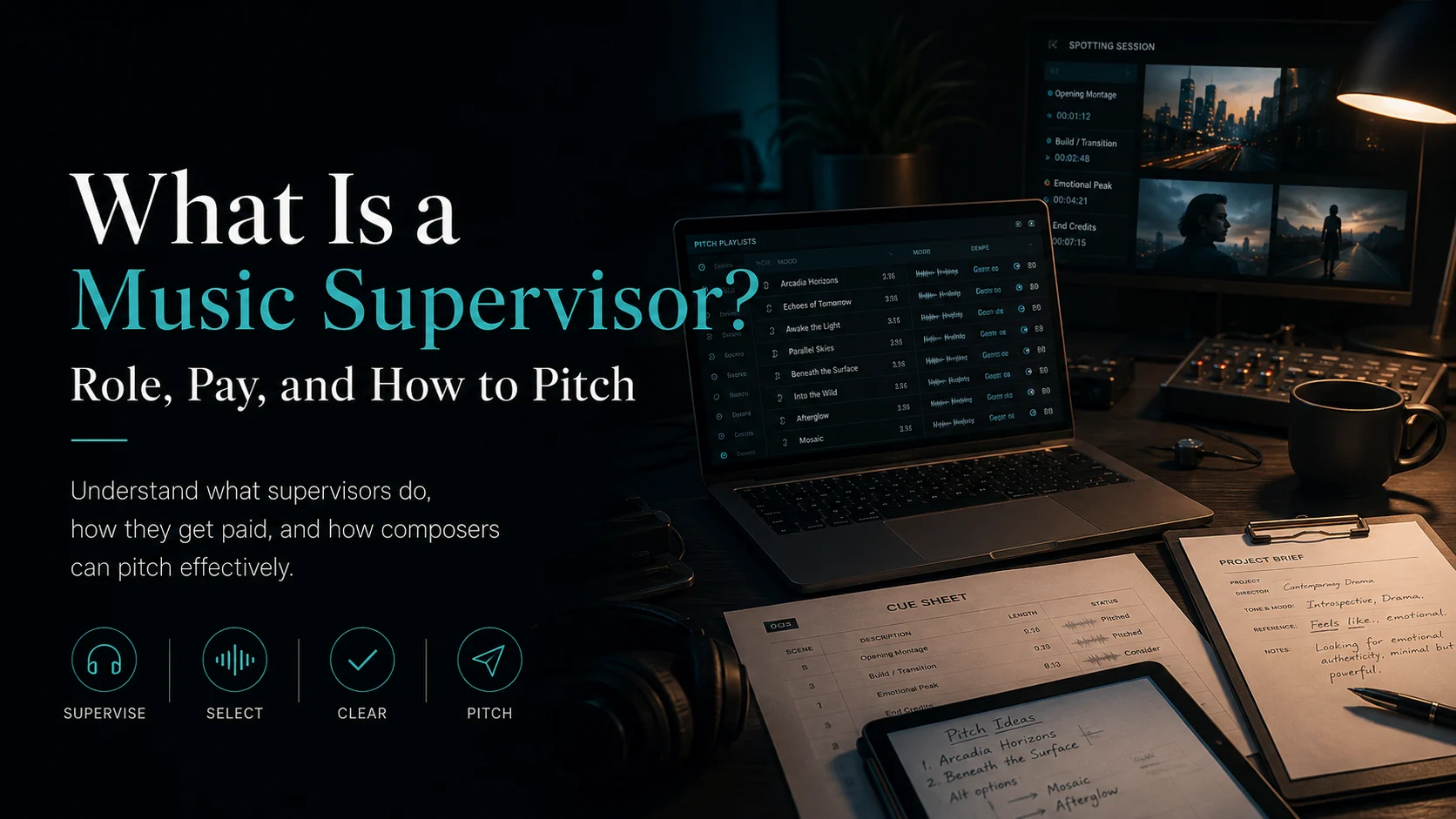
What Is a Music Supervisor? Role, Pay, and How to Pitch
 Marc Aaron Jacobs
Founder, DropCue · Composer
Marc Aaron Jacobs
Founder, DropCue · Composer
A music supervisor is the person who decides which songs and cues land in a film, TV show, ad, trailer, or game. This page breaks down what they actually do, how they pick music, and the realistic ways a composer or artist gets on their radar.
Watch: DropCue for Music Supervisors: Free Catalog Search, Clearance Info, Shortlists and Briefs
Watch how music supervisors search, clear and shortlist music in DropCue. Free for verified supervisors.
Who this is for
This page is for composers, songwriters, and artists who keep hearing \"you should get your music in front of a supervisor\" and want to know what that actually means before they fire off a single email.
It is also for production-library writers, sync agents, and self-managing bands who are tired of guessing who is on the other end of a placement. Pitch with some idea of how the decision really gets made, and your odds improve.
Ever wonder why your \"perfect for that scene\" track got ignored? Or whether music supervision is a job you could move into yourself? You are in the right place. We will cover the role, the money, the path in, and the specific way music actually reaches a music supervisor's inbox.
The audience-specific reality
A music supervisor sits at the intersection of creative taste, budget reality, and legal clearance. On any given project, they are the person a director, showrunner, or ad agency trusts to translate \"I want this scene to feel like a slow heartbreak\" into an actual licensed piece of music that fits the picture, fits the budget, and is cleared to use. They work across film, scripted and unscripted TV, advertising, trailers, video games, and increasingly branded social content.
The job is far less about discovering the next hit and far more about solving constraints. A supervisor juggles a music budget that might be a few hundred dollars for a small indie scene or six figures for a marquee needle-drop. They have to clear both the master (the recording, usually owned by a label or the artist) and the publishing (the composition, controlled by songwriters and publishers). A song nobody can clear in time is useless, no matter how perfect it sounds. So supervisors lean hard on people who can deliver clean, pre-cleared, one-stop tracks fast: production libraries, sync agencies, and trusted independent composers who own or control their own rights.
For composers and artists, here is the practical takeaway. Getting \"on a supervisor's radar\" is not one lucky email. It is showing up as a low-friction, reliable source of music that fits what they cut, with rights that clear easily, delivered in a way that respects how busy they are. The supervisors worth knowing are buried in submissions. The composers who get placed are the ones who made the supervisor's job easier, not harder. That is a workflow problem as much as a creative one, which is exactly where an organized catalog and a tracked outreach process start to matter.
Why DropCue fits this workflow
Knowing what a music supervisor does is step one. Actually getting in front of them, repeatedly, without it turning into a graveyard of spreadsheets and lost email threads is the part that trips composers up. DropCue handles that second part.
DropCue University ($99, one-time) teaches the business of sync licensing and how to pitch supervisors the way people who actually land placements do it: how to read a brief, how to package a track so it clears in one stop, how to follow up without becoming the person they dread, and how to build the kind of relationship that makes a supervisor open your next email. Buyers also get 7 days of full DropCue free to put it into practice.
Once you start reaching out, the DropCue Pitch Pipeline tool turns \"wait, did I ever hear back from that supervisor?\" into a real CRM for your music. Log every supervisor and contact, track what you sent and when, set follow-up reminders, and see your whole outreach pipeline in one view instead of buried across your sent folder. Pair that with DropCue's branded, shareable playlist links and listener analytics, and you can send a supervisor a clean, professional set of tracks and actually see whether they listened. DropCue takes zero cut of any placement or fee you book. You keep 100%.
The features that matter most
✓ DropCue University ($99 course)
Teaches the real business of getting placements: how supervisors read briefs, what one-stop clearance means, and how to pitch without getting ignored. The 7-day full-access trial bonus lets you practice on a real catalog right away.
✓ Pitch Pipeline (CRM for music pitches)
Supervisors are buried in submissions and almost never reply on the first try. The Pipeline logs every supervisor, every send, and every follow-up reminder so warm leads stop dying in your sent folder.
✓ Branded shareable playlist links
Send a supervisor a clean, professional set of cleared tracks at one link instead of a pile of attachments. That low-friction delivery is exactly what busy supervisors prefer.
✓ Listener analytics
See whether a supervisor actually opened and played your tracks, so your follow-up is informed instead of a hopeful shot in the dark.
✓ Zero revenue share on placements
DropCue takes no commission on any sync fee or placement you book. Agencies grab 20 to 50 percent. You keep 100 percent of what you earn.
Names you may know in this space
ASCAP
A US performing rights organization (PRO) that collects performance royalties for songwriters and publishers, central to how composition rights are tracked and cleared.
BMI
A major US PRO supervisors and composers interact with when clearing and registering the publishing side of a placement.
SESAC
A third US performing rights organization, smaller and invitation-based, part of the rights landscape supervisors navigate.
Guild of Music Supervisors
The professional organization for music supervisors, a useful reference point for anyone researching the role or the path into it.
Marmoset
A music licensing house and library that supplies pre-cleared, one-stop tracks to supervisors, an example of the trusted sources composers often reach supervisors through.
Pricing for this audience
[DropCue University](/university-access) is a one-time $99 purchase that includes the full sync and music-business course plus 7 days of complete DropCue access to apply it. Want to keep your catalog and run the Pitch Pipeline long term? DropCue plans stay simple: Artist is $8/mo billed annually (or $10/mo monthly) with no track limit, and Pro scales by catalog size from $15/mo annually for 1,000 tracks up to $69/mo annually for 20,000 tracks. Across every plan, DropCue takes zero revenue share on any placement or fee you book, so a single sync placement covers the cost many times over.
Frequently asked questions
What does a music supervisor do?
A music supervisor selects, licenses, and clears the music used in a film, TV show, ad, trailer, or game. They translate a director's or showrunner's creative direction into actual licensed songs and cues, work within a fixed music budget, and handle the legal clearance of both the master recording and the underlying composition so the music can legally be used on screen.
Do music supervisors make good money?
Music supervision can pay well for established supervisors, but income varies widely by medium and experience. Working supervisors often earn a project fee or a salary on staff at a network, studio, or agency, while early-career and freelance supervisors can make far less and work project to project. Big-budget film and prestige TV pay more than indie projects, unscripted TV, or small-budget ads, so earnings depend heavily on the kind of work a supervisor lands.
What qualifications do you need to be a music supervisor?
There is no required license or degree to become a music supervisor. What matters is deep music knowledge, a strong grip on music licensing and rights clearance, organizational skill, and relationships across labels, publishers, libraries, and PROs like ASCAP, BMI, and SESAC. Many supervisors come up through assistant or coordinator roles, music libraries, or the post-production world, and the Guild of Music Supervisors is a useful industry reference point for the profession.
Is it hard to become a music supervisor?
Yes, it is a competitive field with relatively few full-time roles, and most people break in by working their way up rather than starting at the top. The common path is assisting an established supervisor or working in a music department, music library, or post house, building both clearance experience and a network over several years. It is less about a single qualification and more about proving you can find the right music, on budget, cleared on time, again and again.
How do you get music to a music supervisor?
The most reliable way to get music to a supervisor is to be an easy-to-clear, low-friction source they already trust, not a cold attachment in their inbox. In practice that means having one-stop tracks where you control both the master and publishing, sending a tightly curated link instead of a dump of files, responding fast to briefs, and following up like a professional. Many composers also reach supervisors indirectly through production libraries and sync agencies. DropCue University teaches this pitch workflow, and the Pitch Pipeline tool helps you track every supervisor and follow-up so warm leads do not slip through the cracks.
How does a music supervisor choose which song to use?
A supervisor chooses a song based on three things at once: how well it fits the scene creatively, whether it fits the music budget, and whether the rights can actually be cleared in time. A perfect-sounding track that is too expensive or impossible to clear gets cut in favor of one that hits the emotion and is easy to license, which is why pre-cleared, one-stop music from trusted sources is so attractive to supervisors.
Keep reading
- →DropCue University: learn to pitch music supervisors and land sync placements ($99)
- →DropCue Business Suite: the full toolkit for working composers
- →Track every supervisor you pitch with the DropCue Pitch Pipeline
- →Find film and TV music opportunities with Market Scanner
- →Sync licensing: the complete guide
- →How to become a music supervisor