
Last reviewed
How to Get Sync Placements: A Composer's Playbook That Actually Works
Here is the part nobody tells you about how to get sync placements: it is a sales process wearing a creative costume. Writing a great cue is the cover charge, not the payout. The composers who actually land music in film, TV, ads, trailers, and games treat their catalog like a product, their metadata like a search index, and their pitching like a pipeline they work every week. This playbook covers all four, in order, so you can stop spraying tracks into inboxes and start building relationships that pay.
The good news: none of this needs a label, a manager, or a famous co-write. It needs prep, the right contacts, a clean pitch, and the patience to follow up. Let's break down each step.
Prep your catalog before you pitch anything
Most rejected pitches die on the loading screen, not the listen. A supervisor on a deadline opens your link, sees a wall of untitled tracks, and bounces. So before you contact a single person, get your catalog placement-ready.
Three things matter most. First, broadcast-ready files: a full mix, an instrumental, and ideally stems for every track you plan to pitch. Editors cut to picture, and a vocal they cannot duck is a track they cannot use. Second, clean WAVs at 48kHz/24-bit, properly trimmed, no clipping. That 48kHz sample rate is the standard for film and broadcast, so deliver to it rather than the 44.1kHz you bounce for streaming. Third, a focused selection. Pitch the 10 tracks that fit the brief, not your entire 800-cue library. Curation tells them you actually read the project.
This is also where you decide what you can legally license. If a track has uncleared samples or a co-writer who never signed off on a one-stop, leave it out. Supervisors love a "one-stop" (master and publishing controlled by the same party) because it means one signature and zero clearance nightmares.
Get your metadata right or get skipped
Metadata is how your music gets found, both by humans searching a library and by the AI-driven catalog tools that increasingly do the first-pass filtering. Thin metadata is the single most common reason great cues never surface. Nobody can shortlist a track they cannot find.
For every track, tag: BPM, key, genre and sub-genre, mood (think "tense," "hopeful," "menacing," not just "happy"), instrumentation, vocals or instrumental, energy arc, and a few "sounds like" reference points without naming copyrighted artists in a way that implies endorsement. Write a one-line description that reads like a scene: "slow-building piano over pulsing synths, lands on a triumphant brass swell at 1:40." That sentence is what a music supervisor skims, and it is exactly the liftable detail that gets your track shortlisted.
Keep your splits and publishing info attached to the file too. When a supervisor wants to license fast, the deals that close are the ones where the paperwork is already half done. DropCue lets you store BPM, key, descriptions, and licensing details right on each track and share them through a branded portfolio link, so the person on the other end gets the music and the data in one place.
Find the right contacts: supervisors, libraries, and agencies
You can have a flawless catalog and still go nowhere if you are pitching the wrong people. There are three doors into sync, and most working composers walk through all three.
Music supervisors choose music for a specific show, film, ad, or trailer. They are the highest-value contacts and the hardest to reach cold. The Guild of Music Supervisors lists members, and IMDb plus end credits tell you who supervised projects in your lane. Follow them, engage with their work, and pitch something that fits an actual show they are working on.
Production music libraries (think Musicbed, Artlist, Marmoset, and hundreds of smaller boutique catalogs) license tracks at scale to editors and brands. They are more accessible than top supervisors, and many have open submission pages. The tradeoff: non-exclusive libraries take a cut and you compete with thousands of cues, so read each one's exclusivity and rate terms before you sign anything.
Sync agencies and pitch services represent your catalog to their network for a percentage of placements. A good one earns its cut. A bad one ties up your tracks for years and pitches nothing.
Here is where owning your workflow pays off. When you pitch through a library or agency, you are renting their relationships and splitting your fee. When you build and pitch your own catalog with a tool like DropCue's Market Scanner, you surface film and TV music opportunities and briefs yourself, pitch directly, and keep 100% of any fee you book. DropCue takes zero revenue share. For composers who would rather build an asset than feed someone else's, that is the whole ballgame.
Pitch the right way (and stop sending attachments)
A clean pitch follows a simple shape. Lead with relevance: name the project or the type of project, and why your music fits. Send a streamable link, never a raw attachment that clogs an inbox. Include three to five hand-picked tracks, not a 40-cue dump. Note that everything is one-stop and ready to clear. Close with a low-friction ask: "Happy to send stems or write to picture if useful."
Keep the email short. Supervisors get hundreds a week. The subject line should reference the show or the brief, the body should run three sentences, and the link should open instantly on mobile. If your portfolio takes ten seconds to load or shows a broken player, you already lost.
One more rule: respect the brief. If they asked for "upbeat indie-folk, no vocals, under 90 seconds," do not send your cinematic orchestral epic because you are proud of it. The fastest way to get blacklisted is to prove you do not listen.
Track every follow-up like a pipeline
This is the step almost everyone skips, and it is where placements actually come from. Sync is a relationship business with long timelines. A supervisor who passes today might need exactly your track in eight months, and they will not remember you unless you stay in light, professional contact.
Treat it like a sales CRM. Log who you pitched, what you sent, the date, their response, and the next touch. Follow up once after a week or two if there is no reply, then move on without pestering. When you write a new cue that fits someone you have talked to, that is your reason to reconnect. The composers who place consistently are not the most talented in the room. They are the most organized.
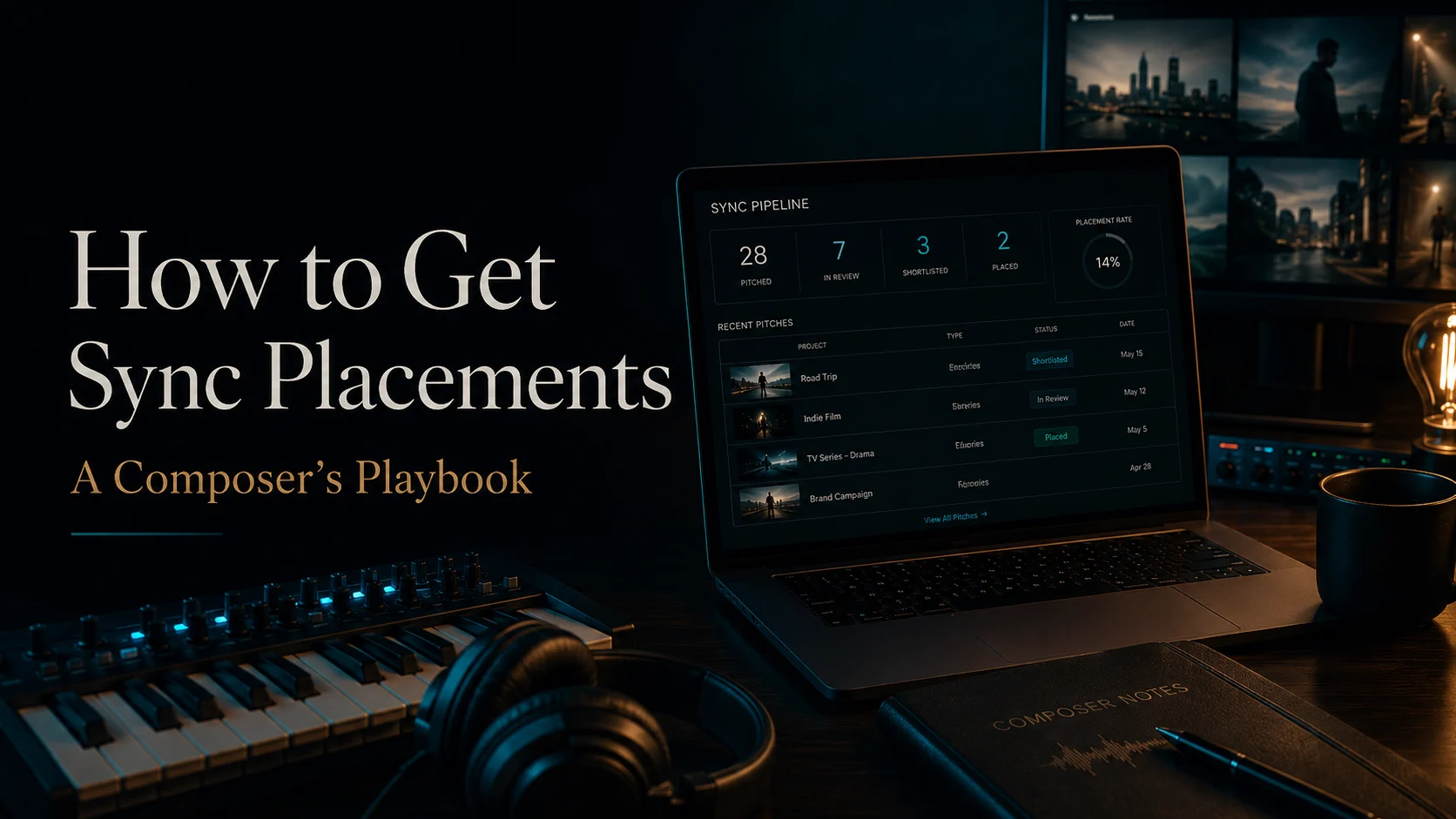
DropCue's Pitch Pipeline is built for exactly this: track every pitch like a CRM, see what is pending versus passed versus placed, and never let a warm contact go cold. Pair it with the Royalty Tracker once placements start landing and you have a closed loop from pitch to payment.
If you want the full business framework behind all of this, DropCue University is a one-time $99 course on the business of music and sync licensing, and it includes 7 days of full DropCue access so you can build your catalog and pipeline as you learn.
For the full picture, read our complete sync licensing guide.
Want the tools that run this end to end? The DropCue Business Suite covers pitching, agreements, license tracking, and royalties in one place.
Frequently Asked Questions
How do you get sync placements?
You get sync placements by preparing a clean, well-tagged catalog of broadcast-ready tracks, finding the right contacts (music supervisors, production libraries, and sync agencies), pitching a small curated selection that fits a specific brief, and tracking follow-ups over time. Sync is a relationship business, so consistent, organized outreach beats one-off blasts every time. Most placements come from a contact who passed earlier and circled back when the right project appeared.
What is a sync placement?
A sync placement is when your music is licensed to be "synchronized" with visual media: a film, TV show, ad, trailer, video game, or online video. The license grants the producer the right to use your composition and recording with picture. A placement typically involves two rights, the sync license for the song and the master use license for the recording, and you get paid an upfront fee plus, in many cases, ongoing performance royalties when the content airs.
How much does a sync placement pay?
Sync fees vary widely by usage, budget, and exclusivity. Background cues in indie projects or non-exclusive libraries can pay anywhere from a few dollars to a few hundred. A featured placement in a national TV ad or a major film can range from several thousand to six figures. On top of the upfront fee, broadcast and streaming uses generate performance royalties collected through your PRO (ASCAP, BMI, or SESAC) and your publishing administrator. Because the range is so wide, owning your pitching workflow and keeping 100% of the fee matters: with DropCue there is no revenue share on placements you book yourself.
Where do I find sync licensing opportunities?
You find sync licensing opportunities through music supervisor relationships (the Guild of Music Supervisors directory and project credits are good starting points), production library submission pages (Musicbed, Artlist, Marmoset, and many boutiques), sync agencies, and active briefs posted by supervisors and music teams. DropCue's Market Scanner surfaces film and TV music opportunities and briefs in one place so you can pitch directly and skip the middleman cut.