
Last reviewed
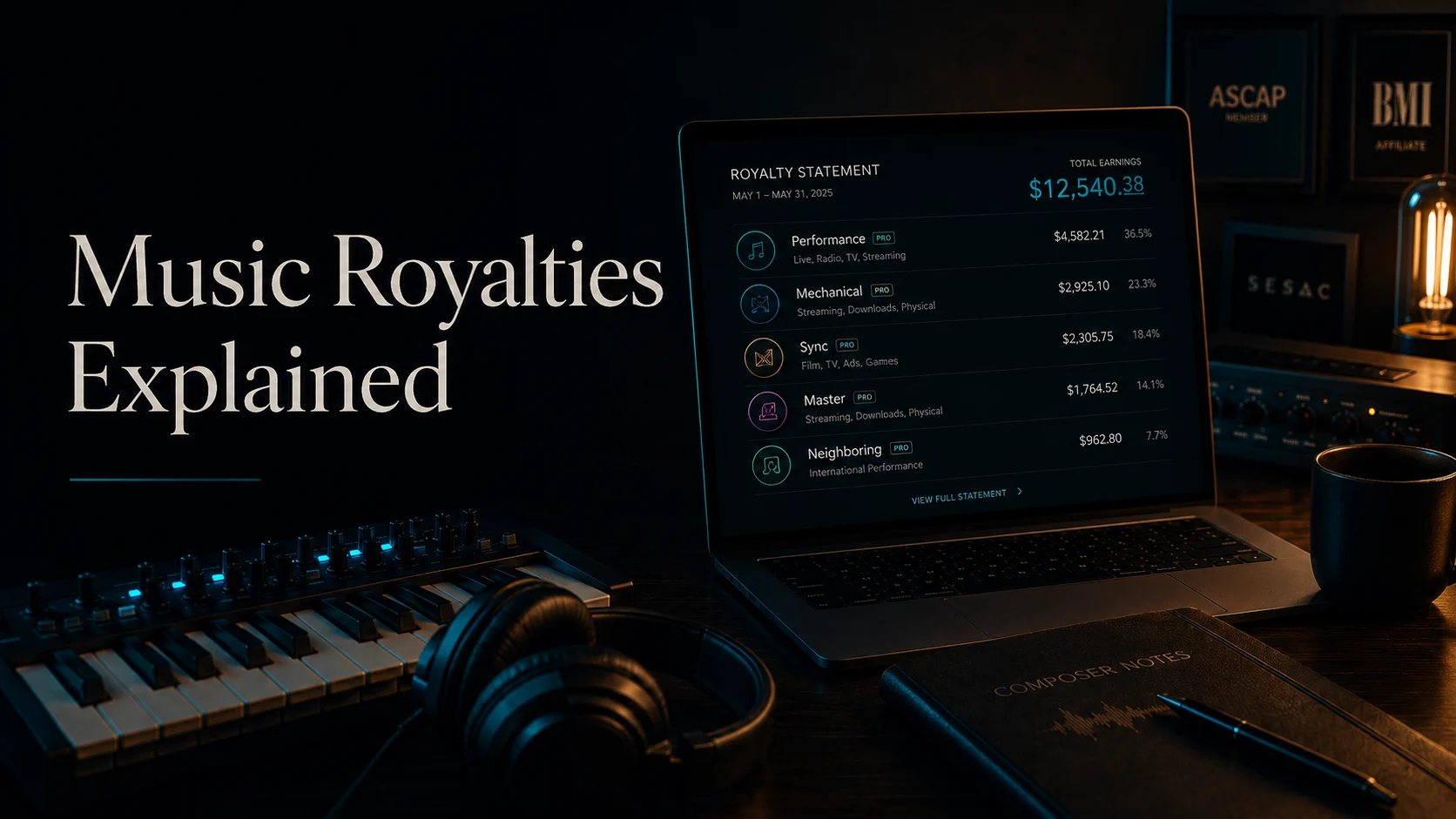
Music Royalties Explained: The 5 Types Every Composer Should Know
If you write music for a living, "music royalties explained" is the search you run right before you suspect you've been underpaid. You're probably right. The royalty system is a patchwork of overlapping rights, competing collection societies, and money that passes through three or four doors before it ever reaches you. Miss a single registration and a check just quietly never shows up.
Here's what nobody tells you on day one: there is no single "music royalty." There are several distinct kinds, each triggered by a different use of your song, each paid by a different party, and each collected by a different organization. Once you can name them, you can chase them. Below is the clear, accurate version, written for composers and sync writers who need to collect, not pass a music-business exam.
The two copyrights behind every royalty
Before the types, get the split straight. Every recorded song contains two separate copyrights:
1. The composition (also called the "song" or "publishing" side) is the melody, chords, and lyrics. This is the part you, the songwriter or composer, own. 2. The master recording (the "sound recording") is the specific captured performance. Whoever paid for or owns the recording controls this one.
Almost every royalty type traces back to one of these two copyrights. A lot of "where's my money" panic is just someone collecting on the composition side while forgetting the master side exists, or the reverse.
The 5 main types of music royalties
Mechanical royalties
A mechanical royalty is generated whenever a copy of your composition gets reproduced. That covers physical sales, downloads, and interactive streams on platforms like Spotify and Apple Music. In the US the streaming-mechanical rate is set by a statutory formula, and The MLC (Mechanical Licensing Collective) collects and distributes those streaming mechanicals to songwriters and publishers. The payer is whoever makes the copy, the streaming service or the record label.
Performance royalties
A performance royalty kicks in when your composition is performed publicly: radio, TV broadcast, a venue, a bar, a gym, or the public-performance slice of a stream. These get collected by Performing Rights Organizations (PROs). In the US that's ASCAP, BMI, or SESAC (and the newer GMR). They license the businesses doing the performing, collect blanket fees, and pay you twice: a writer's share that comes straight to you, and a publisher's share. No publisher? Register a self-publishing entity and claim that side too. It's your money sitting on the table.
Sync (synchronization) royalties
A sync royalty, or more accurately a sync fee, is what you're paid when your music gets paired with a visual: a film scene, a TV episode, an ad, a trailer, a video game, a YouTube creator's video. Sync is the odd one out, because it isn't really a recurring "royalty" in the trickle sense. It's usually negotiated as an upfront fee. Fees swing wildly by use and budget, often a few hundred dollars for a small online placement and climbing into five or six figures for a national ad or a major film cue. And here's the good part: a single placement also generates performance royalties on the back end when the show airs. So one sync deal often pays you twice: the upfront fee, then PRO money down the line.
Master / neighbouring royalties
Own your master recording? Then you also collect on the recording side. For non-interactive digital performance (think internet radio, Pandora's non-interactive tier, SiriusXM), SoundExchange collects a separate digital performance royalty and pays the rights owner and performers directly. Outside the US, this same category goes by neighbouring rights, and plenty of countries pay performers and master owners for broadcast and public performance. A lot of American composers leave neighbouring-rights money sitting abroad, never claimed, because they never registered with a foreign society or signed with an agent.
Print royalties
The oldest type, and the smallest for most modern composers. Print royalties come from sheet music and printed or digital arrangements of your composition. If a publisher prints and sells the score, you get a cut. Niche for sync writers, real money for choral, educational, and concert composers.
Who pays music royalties, and who collects them
Quick map, because this is exactly where people get lost:
- Mechanical: paid by streaming services and labels, collected by The MLC (US streaming) or directly through your distributor or publisher.
- Performance: paid by broadcasters, venues, and streaming services, collected by your PRO (ASCAP/BMI/SESAC).
- Sync: paid by the production, brand, studio, or library that licenses the cue, usually negotiated directly or through your sync agent or library.
- Master digital performance: paid by webcasters and satellite radio, collected by SoundExchange.
- Neighbouring rights (outside US): collected by foreign societies, often through a neighbouring-rights agent.
Notice that no single entity sees all of it. That's the structural reason composers lose money. Nobody hands you a master dashboard. You have to build one.
How are music royalties calculated?
There's no one formula, which is precisely why this stays confusing. Streaming mechanicals follow a statutory rate based on a percentage of service revenue, divided across total streams. Performance royalties run on a PRO's weighting system: a primetime network broadcast is worth far more "performance credits" than a 3 a.m. cable rerun, and your payout reflects that. Sync is pure negotiation, driven by media type, territory, term, and exclusivity. SoundExchange pays the master owner 50%, the featured performer 45%, and non-featured performers 5%. The practical takeaway: your per-stream or per-play number is tiny, so accuracy and scale beat any single placement.
Want the full mechanics drilled in with real examples and contract walkthroughs? DropCue University is our $99 one-time course on the business of music and sync licensing. Buyers also get 7 days of full DropCue free, so you can wire up your catalog while the concepts are still fresh.
How a composer actually makes sure they get paid
Knowing the types is step one. Collecting is the job. Here's the checklist that closes the leaks:
1. Affiliate with a PRO. Register every cue. Unregistered works earn performance royalties that get held or quietly redistributed to other writers. 2. Register with The MLC (or confirm your distributor or publisher does it) so your streaming mechanicals aren't rotting in the unmatched pool. 3. Register your masters with SoundExchange if you own recordings, and look into a neighbouring-rights agent for foreign income. 4. Get your cue sheets filed. A sync placement only pays performance royalties if the production's cue sheet lists you correctly. This is the single biggest leak in sync, and it's almost always avoidable. 5. Track every placement and every expected payment in one place. This is where most composers fall apart, because the money lands months later from four different sources.
That last point is the gap DropCue closes. The Royalty Tracker in our Business Suite lets you log each placement, tag which royalty types it should generate, and watch what's actually landed versus what's still owed. It's the master dashboard the industry never bothered to give you. And because DropCue takes zero revenue share on anything you book or earn, you keep 100% of every fee and every royalty. For composers who'd rather own their pitching and payment workflow than rent it from a middleman, that's the whole point.
Want the tools that run this end to end? The DropCue Business Suite covers pitching, agreements, license tracking, and royalties in one place.
Frequently Asked Questions
What are the 4 types of music royalties?
The four most commonly cited types are mechanical, performance, sync, and master (digital performance / neighbouring) royalties. Many breakdowns add a fifth, print royalties, from sheet music and arrangements. Mechanical royalties come from reproductions and streams, performance royalties from public plays, sync from pairing music with visuals, and master royalties from the recording itself.
Who pays music royalties?
Different parties pay different types. Streaming services and record labels pay mechanical royalties. Broadcasters, venues, and streaming services pay performance royalties (collected by your PRO). Film studios, TV productions, brands, and game makers pay sync fees. Webcasters and satellite radio pay master digital-performance royalties through SoundExchange. No single payer covers all royalty types, which is why composers have to register with multiple organizations.
How are music royalties calculated?
It depends on the type. Streaming mechanicals use a statutory rate based on a percentage of service revenue split across total streams. Performance royalties use a PRO weighting system where primetime and network plays earn more credits than off-peak ones. Sync fees are negotiated case by case based on media, territory, term, and exclusivity. There is no universal formula, so accurate registration and tracking matter more than any single rate.
Are royalties paid every time a song is played?
Performance royalties are generated each time a song is publicly played or streamed, but you're not paid instantly per play. PROs and collection societies pool usage data and pay out on a quarterly or periodic schedule, often months after the plays happen. Sync is different: it's typically a one-time upfront fee, though the placement then generates ongoing performance royalties every time the show or ad airs.
How long do music royalties last?
Royalties last as long as the underlying copyright is in effect. In the US, copyright generally runs for the life of the author plus 70 years, and royalties keep flowing to the rights holder (and then their estate or heirs) throughout that term. As long as your music keeps getting streamed, broadcast, or licensed, it keeps generating royalties, which is why keeping your registrations and contact info current matters for decades.