
Last reviewed
How to License Music for Film and TV: A Practical Guide for Both Sides
If you want to know how to license music for film, here is the short version: you need permission from two different owners, you need it in writing before the film is finished, and the price depends entirely on how famous the song is and where the film will play. That holds whether you are a director trying to drop a real song into a scene, or a composer trying to get your own music placed and paid. This guide covers both sides, because the same paperwork sits in the middle of every deal.
Music licensing for film and TV trips people up because the word "song" quietly hides two separate legal assets. There is the composition (the notes and lyrics, owned by the songwriter and publisher) and the recording (the specific master you actually hear, usually owned by a label or the artist). Use a song without clearing both and you are exposed, no matter how short the clip is. There is no "under 30 seconds is free" rule. That myth has cost more than one indie film its distribution deal.
What licenses do you need to use a song in a film?
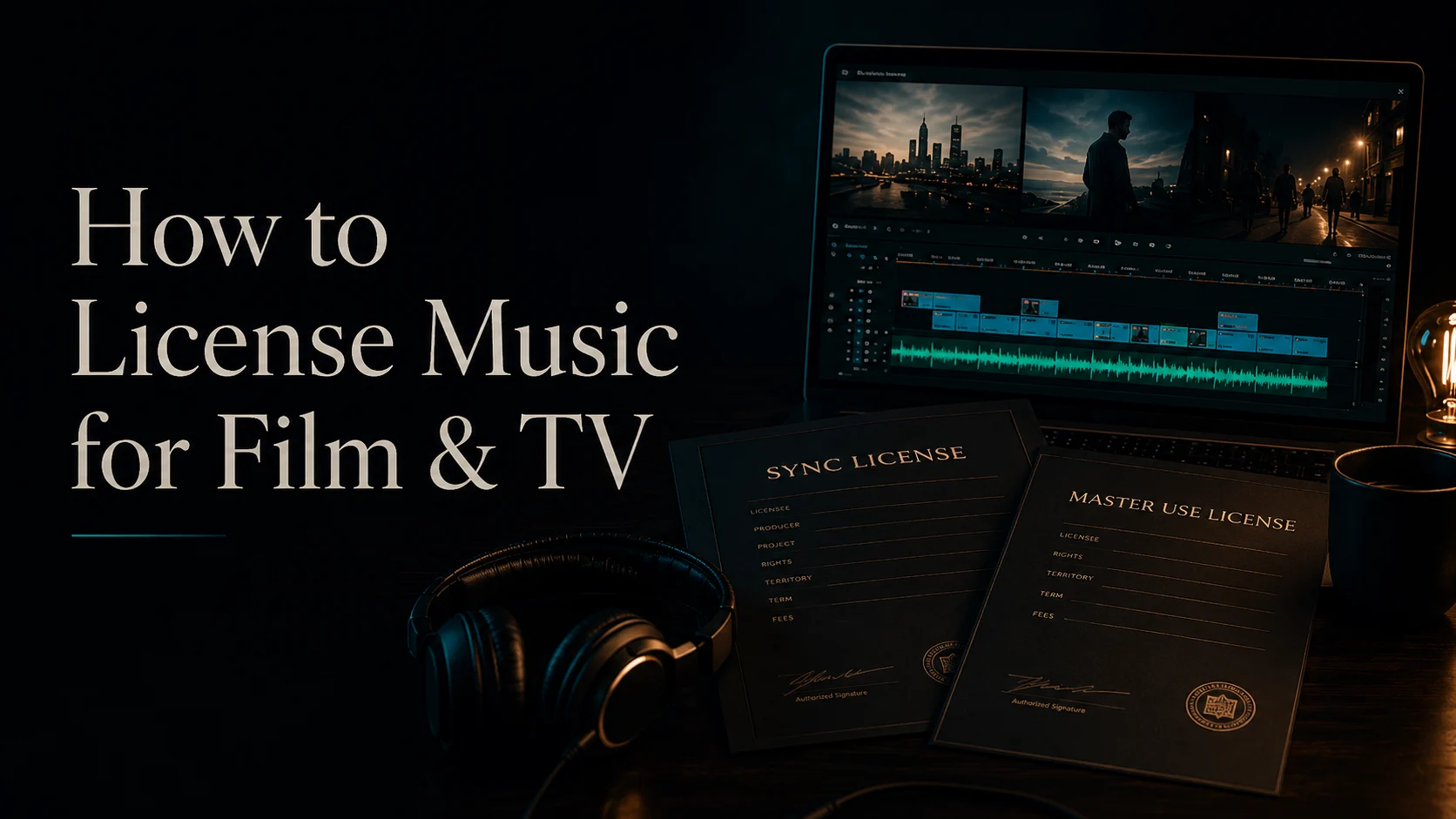
You need two: a synchronization license (sync) and a master use license. The sync license comes from the publisher or songwriter and covers the underlying composition. The master use license comes from whoever owns the sound recording, often a record label. Both have to be cleared for the same song before you can legally pair it with picture.
It works this way because copyright splits ownership. One person might have written the song while a completely different company recorded and owns the master. Clearing one without the other is like buying a car and only paying for the engine. If you cannot clear both, you have two fallbacks: license a different recording (a cover or re-record of the same composition, which still needs the sync but a new, cheaper master), or commission original music from a composer who can grant both rights in one signature. That second path is why so many filmmakers skip famous songs entirely and work with composers and production libraries instead.
What is the difference between a sync license and a master use license?
A sync license grants the right to synchronize a musical composition with visual media. A master use license grants the right to use a specific sound recording of that composition. Sync covers the song as written, master covers the song as recorded. You almost always need both, issued by two different parties.
Here is where it gets practical. If you license the composition of a well-known song but record your own version with a session band, you need the sync but not the original master. You create a new master that you control. This is exactly how trailers and ads use "soundalike" or fully re-recorded versions of recognizable songs at a fraction of the cost. The composition rights holder still gets paid through the sync, but you have sidestepped the label's master fee. Understanding this split is the single most useful thing a filmmaker can learn, and it is one of the core modules in DropCue University, our course on the business of sync licensing.
How much does it cost to license a song for film?
It varies enormously. Licensing a well-known commercial song for a film can run from a few thousand dollars to six figures per side, and you pay both the sync side and the master side. Production library or independent composer tracks are far cheaper, often a few hundred to a few thousand dollars, sometimes royalty-free under a blanket subscription.
The number comes down to a handful of factors music supervisors weigh every day:
- Song popularity. A current top-40 hit costs dramatically more than a catalog track from a working composer.
- Usage and placement. Background instrumental in one scene is cheaper than a featured vocal over the opening titles.
- Media and term. Festival-only and a few years costs less than "all media, in perpetuity, worldwide" for a Netflix or HBO release.
- Territory. Domestic-only is cheaper than worldwide.
- Exclusivity. Most sync deals are non-exclusive, which keeps prices sane.
For budget-conscious productions, libraries like Musicbed, Artlist, and Marmoset offer pre-cleared catalogs where one fee covers both sides. The trade-off is you are not getting that specific famous record, but you are also not spending three months chasing two sets of approvals.
How do you legally use copyrighted music in a film?
Get written permission from both the composition owner and the master owner before the film locks. Identify who owns each side (a PRO like ASCAP, BMI, or SESAC can help you find the publisher; the label is usually credited on the release), request a quote describing your exact usage, then sign a license that spells out term, territory, media, and fee.
The clearance workflow runs in order. First, identify both rights holders. Second, send a clearance request that states the project, the scene, the duration, the media (festival, streaming, theatrical), the territory, and the term. Third, negotiate the fee for each side separately. Fourth, get a signed sync license and a signed master use license in hand. Fifth, keep those documents on file for the entire life of the project, because distributors and errors-and-omissions insurers will ask for them.
Do not rely on a verbal yes. And "I'll take it down if they complain" is not a plan, it is a liability waiting for a lawyer. Distribution platforms and E&O insurance both require proof of clearance, and one unlicensed track can pull a finished film off every platform it is on. If drafting the paperwork feels intimidating, our Agreement Generator produces clean sync and master use agreement drafts you can adapt, so you negotiate from a real document instead of a blank page.
How composers and artists get their music licensed
Now flip the table. If you are the one who wants your music in film and TV, your job is to be findable, pitchable, and easy to clear. The composers who land placements are not always the best writers. They are the ones who control both the composition and the master (so they can clear in one signature), keep their catalog tagged and organized, and pitch consistently to the right people.
The realistic path looks like this. Build a catalog you fully own. Register with a PRO (ASCAP, BMI, or SESAC) so your performance royalties actually reach you, and consider an administrator like Songtrust to collect globally. Then pitch: to music supervisors, to libraries, to ad agencies, to anyone who needs cleared music on a deadline. The Guild of Music Supervisors is a useful map of who actually places music in this industry.
The part most composers get wrong is the pitching itself. They blast tracks into inboxes, never follow up, and have no idea which supervisor heard what. That is where a system beats hustle. A Pitch Pipeline lets you track every track you have sent, to whom, for which project, and what came back, the same way a salesperson runs a CRM. Pair that with a branded portfolio link, listener analytics, and timestamped feedback, and you stop guessing.
Why composers should own their pitching workflow
Plenty of sync licensing companies and libraries will represent your music, and many take a cut of every fee, often 50 percent of the sync, the master, or both. That is a fair trade if they are doing the placing. It is a lousy trade if you are doing the work and they are just hosting your files.
DropCue is built for the composer who wants to own the workflow and keep 100 percent of every fee they book. We take zero revenue share on placements. You host your catalog, share branded playlist links, draft your own agreements, track pitches, and manage clients and royalties in one place. Next to handing half your income to a library, or paying double for a tool like DISCO, that is the strongest position a composer can be in. You own the music, you own the relationships, and you keep the money. Premium plans start at $15/mo, and the whole business suite is included. Start at dropcue.app/signup and pair it with DropCue University if you want the licensing fundamentals locked down first.
For the full picture, read our complete sync licensing guide.
Want the tools that run this end to end? The DropCue Business Suite covers pitching, agreements, license tracking, and royalties in one place.
Frequently Asked Questions
How much does it cost to license a song for film?
It varies widely. Licensing a well-known commercial song can range from a few thousand dollars to six figures per side, and you pay both the sync (composition) and master (recording) sides separately. Independent composer and production library tracks are far cheaper, often a few hundred to a few thousand dollars, with some libraries offering blanket royalty-free fees that cover both sides at once. Price depends on the song's popularity, how it is used, the media, the territory, and the length of the term.
What licenses do you need to use a song in a film?
You need two licenses: a synchronization (sync) license for the musical composition, granted by the songwriter or publisher, and a master use license for the specific sound recording, granted by the label or recording owner. Both must be cleared for the same song before you pair it with picture. There is no exemption for short clips, so clearing only one side leaves you legally exposed.
What is the difference between a sync license and a master use license?
A sync license covers the underlying composition (the notes and lyrics) and comes from the publisher. A master use license covers the specific recording you want to use and comes from whoever owns that master, usually a label. You typically need both. If you re-record your own version of a song, you still need the sync license but create a new master you control, which is how trailers and ads use recognizable songs more affordably.
How do you legally use copyrighted music in a film?
Get written permission from both the composition owner and the master owner before the film locks. Identify each rights holder (a PRO like ASCAP, BMI, or SESAC can help locate the publisher), send a clearance request describing your exact usage, negotiate the fee for each side, and sign a sync license plus a master use license. Keep both documents on file, since distributors and E&O insurers require proof of clearance.
How can a composer get their music licensed for film and TV?
Own both the composition and master so you can clear in one signature, register with a PRO so royalties reach you, keep your catalog tagged and organized, and pitch consistently to music supervisors, libraries, and agencies. Composers who treat pitching like a sales process, tracking who heard what and following up, land more placements than those who blast files and hope. Tools like DropCue's Pitch Pipeline and branded portfolios make that workflow manageable while you keep 100 percent of every fee.