
Last reviewed
How Much Does Sync Licensing Pay? A Realistic Fee Breakdown by Placement
If you are asking how much does sync licensing pay, the accurate answer is the one nobody wants: it depends on the placement, and the spread is enormous. A student film might pay you nothing, or a token $50. A national TV ad can pay five figures. A major studio film or a video game lands somewhere in between, and a hit trailer placement can change your whole year. Sync pays in two layers that constantly get confused: the upfront sync fee (the negotiated license payment) and the backend performance royalties (collected later by your PRO when the cue actually airs). Knowing both layers is the difference between feeling underpaid and knowing exactly what a deal is worth.
This is a working composer's breakdown, not a fantasy chart. The ranges below are typical and hedged on purpose. Real deals swing on usage, term, territory, and how badly a music supervisor wants your track at 4pm on a Friday.
How much does sync licensing pay by placement type?
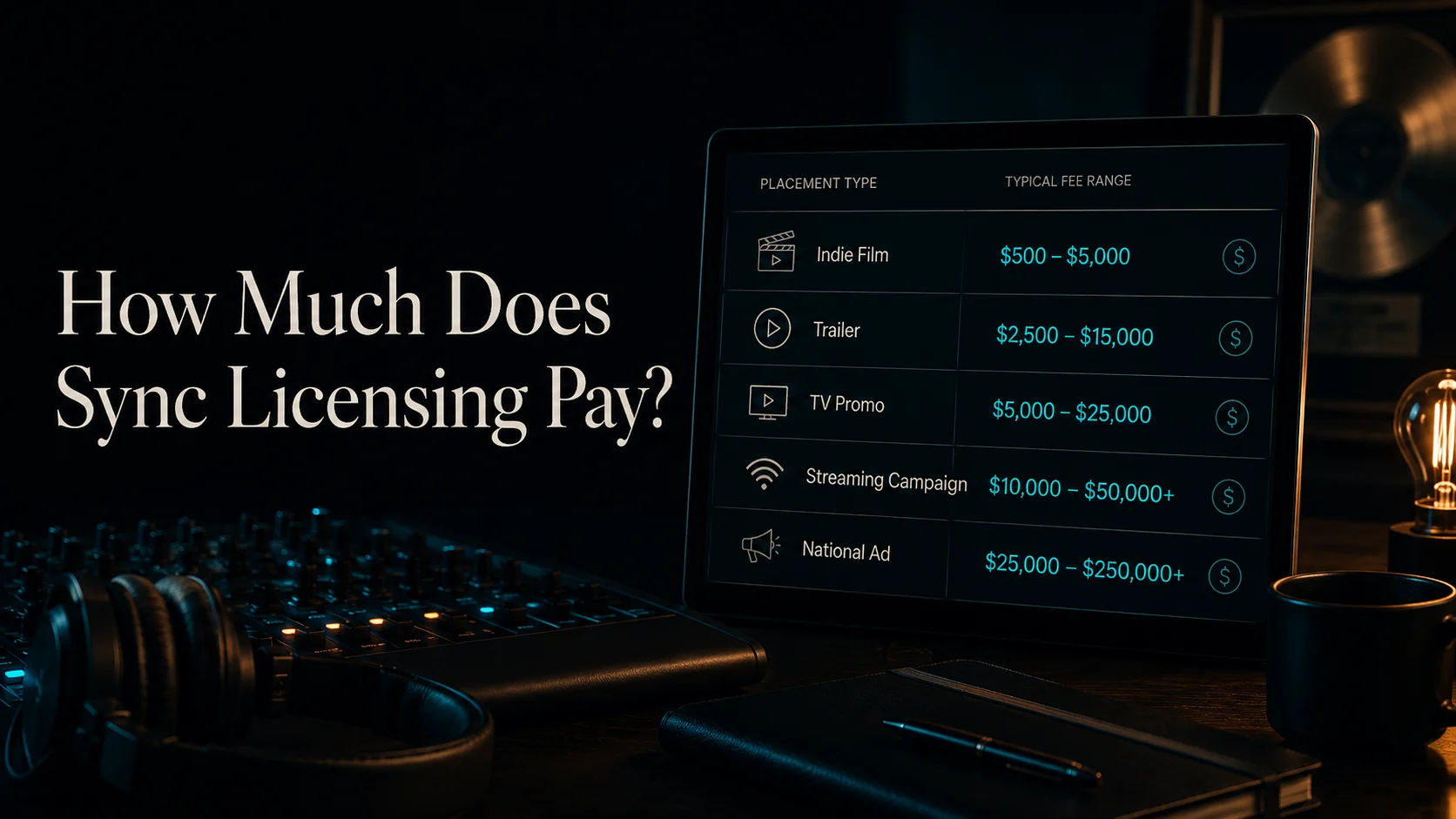
Here is a realistic look at sync fees by where the music lands. These are upfront sync fee ranges for a single placement, and they assume an indie or working-composer level rather than a chart-topping master that commands premium negotiation.
- Student film: Often $0 to a few hundred dollars. Many are royalty-free or "for credit." The real payoff is the relationship and the festival exposure, not the check.
- Indie film / web series: Frequently up to $2,000 per cue, depending on budget and how prominent the placement is. Background cues sit at the low end, a featured needle-drop at the high end.
- Local or regional ad: Often $1,000 to $5,000. National advertising is a different universe (see below).
- National TV ad: This is where sync gets serious. Fees run roughly $10,000 to $100,000 or more, with the top end for a major brand campaign with a long term and broad territory, and every airing pays performance royalties on top. Library or buyout tracks pay far less.
- Network or cable TV (scripted/reality): Background cues often pay a modest sync fee, sometimes $500 to $2,500. But the backend performance royalties are frequently where the real money lives.
- Streaming originals (Netflix, HBO, etc.): Sync fees vary widely by budget and prominence. Featured songs can command thousands; background instrumental cues run lower. Streaming backend pays differently than broadcast (more on that in the FAQ).
- Major studio film: A featured song placement can range from the low thousands to well over six figures for a marquee artist. A working composer's instrumental cue lands far lower, but a theatrical credit carries weight.
- Movie trailer: Trailers are their own market. Fees can range from a few thousand to mid-five figures or more for a well-cut, high-profile trailer, because the music is doing most of the emotional lifting.
- Video games: Often $500 to several thousand per track for indie titles, with AAA productions paying more. Games frequently use buyouts (one flat fee, no backend), which changes the math entirely.
The pattern is simple: bigger budget, broader term and territory, more featured the music, higher the fee.
Sync fee vs. backend royalties: where the money actually splits
This is the part that trips up most composers. A single placement usually pays in two separate streams.
The sync fee (sometimes split into a "synchronization" license for the composition and a "master use" license for the recording) is the upfront, negotiated payment. If you wrote, performed, and own your recording, you collect both sides of that fee.
The backend is the performance royalty generated every time the cue is publicly performed (broadcast, in theaters, sometimes streamed). Your performing rights organization collects it. In the U.S. that is ASCAP, BMI, or SESAC. They pay the writer's share directly to you and the publisher's share to your publisher. Self-publish and you keep both. Cue sheets filed by the production are what trigger these payments, which is exactly why chasing cue sheets is worth your time.
Here is the strategic reality: a low or even free sync fee can still be worth taking if the backend is strong. A recurring cue on a network show that runs in syndication for years can out-earn a one-time five-figure sync fee. Flip it around, and a buyout deal (common in games, corporate, and some library work) pays one flat fee with zero backend, so the sync fee has to stand entirely on its own.
Tracking which deals carry backend and which are buyouts is precisely the kind of thing composers lose money on when it lives in a spreadsheet they stopped updating in March. DropCue's Royalty Tracker was built so you can log every placement, tag the deal type, and see what is sync fee versus what should be coming back from your PRO. You keep 100% of everything you book. DropCue takes zero revenue share on any fee or royalty you earn.
What actually drives the number
Two placements in the same medium can pay wildly different fees. The levers that move the price:
- Usage and prominence: A featured vocal needle-drop over a key scene beats a background instrumental bed under dialogue every time.
- Term: A one-year license costs less than perpetuity. "In perpetuity" should cost meaningfully more.
- Territory: "U.S. only" is cheaper than "worldwide." Worldwide all-media in perpetuity is the priciest license you can grant, so price it that way.
- Media: "All media now known or hereafter devised" is a broad grant. Limited to "festival use" or "web only" is narrow and cheaper.
- Exclusivity: Exclusive use (the buyer locks the track from other licenses) commands a premium over non-exclusive.
- Production budget and clout: A Super Bowl spot and a regional furniture ad are not the same negotiation, even for the same song.
- Whether you control the master: Own your recording and you collect master-use fees too, not just the composition side.
How to know if an offer is fair (and pitch like a business)
Your single biggest piece of leverage is knowing the range before you reply. If a music supervisor offers $300 for a national ad with a perpetual worldwide license, knowing the typical fee tells you to push back. If they offer $1,500 for a featured indie film cue, that is a strong deal worth taking.
This is the gap most composers fall into. They are brilliant at writing music and improvising on price. Learning the business side, what to charge, how to read a license, how to negotiate term and territory, is what separates a hobby from income. DropCue University is a one-time $99 course on exactly this: the business of music and sync licensing, written for composers who want to stop guessing. Buyers also get a 7-day full DropCue trial, so you can run your whole pitching workflow in one place.
Because here is the thing about sync income: the fee only matters if you are pitching enough to land deals and tracking enough to collect everything you are owed. Composers who own their pitching workflow, their catalog, their playlists, their pipeline, and their royalties consistently leave less on the table than the ones routing everything through an agency that takes a cut.
For the full picture, read our complete sync licensing guide.
Want the tools that run this end to end? The DropCue Business Suite covers pitching, agreements, license tracking, and royalties in one place.
Frequently Asked Questions
How much do you make from sync licensing?
It varies enormously by placement. A single sync deal can pay anywhere from $0 (student films, some library and royalty-free deals) to six figures (a national TV ad with a major brand). Most working composers earn across many smaller placements in indie film, TV background cues, and ads, often $250 to a few thousand per cue, plus backend performance royalties collected later through ASCAP, BMI, or SESAC. Total annual income depends far more on the volume of placements and consistent royalty collection than on any single big check.
How much does a sync license cost?
For the buyer, a sync license can cost from nothing on a student or royalty-free track to six figures for a featured song in a national campaign or major film. Typical working ranges run roughly $0 to $2,000 for indie film cues, $500 to $2,500 for TV background, and $10,000 to $100,000 or more for national advertising. The price is driven by usage, prominence, term, territory, media, and exclusivity. A worldwide, all-media, in-perpetuity, exclusive license costs the most.
Do you get royalties from sync placements?
Often yes, but not always. Most broadcast TV, cable, and theatrical placements generate backend performance royalties that your PRO (ASCAP, BMI, or SESAC) collects and pays out when the cue airs, on top of the upfront sync fee. The exception is buyout deals, common in video games, corporate, and some library work, where you accept one flat fee and waive all backend. Filed cue sheets are what trigger performance royalties, so confirming the production submits them is essential.
What is a typical sync licensing fee?
A typical sync fee for a working composer falls in the hundreds to low thousands per cue for indie film, TV background, and web content. Featured placements, national ads, trailers, and major studio films pay far more, sometimes tens of thousands or more. There is no single standard number because the fee depends on usage, term, territory, media scope, and exclusivity. The reliable rule: broader rights and more prominent use mean a higher fee.