Last reviewed
AI Mix Analysis for Composers: Better Mixes
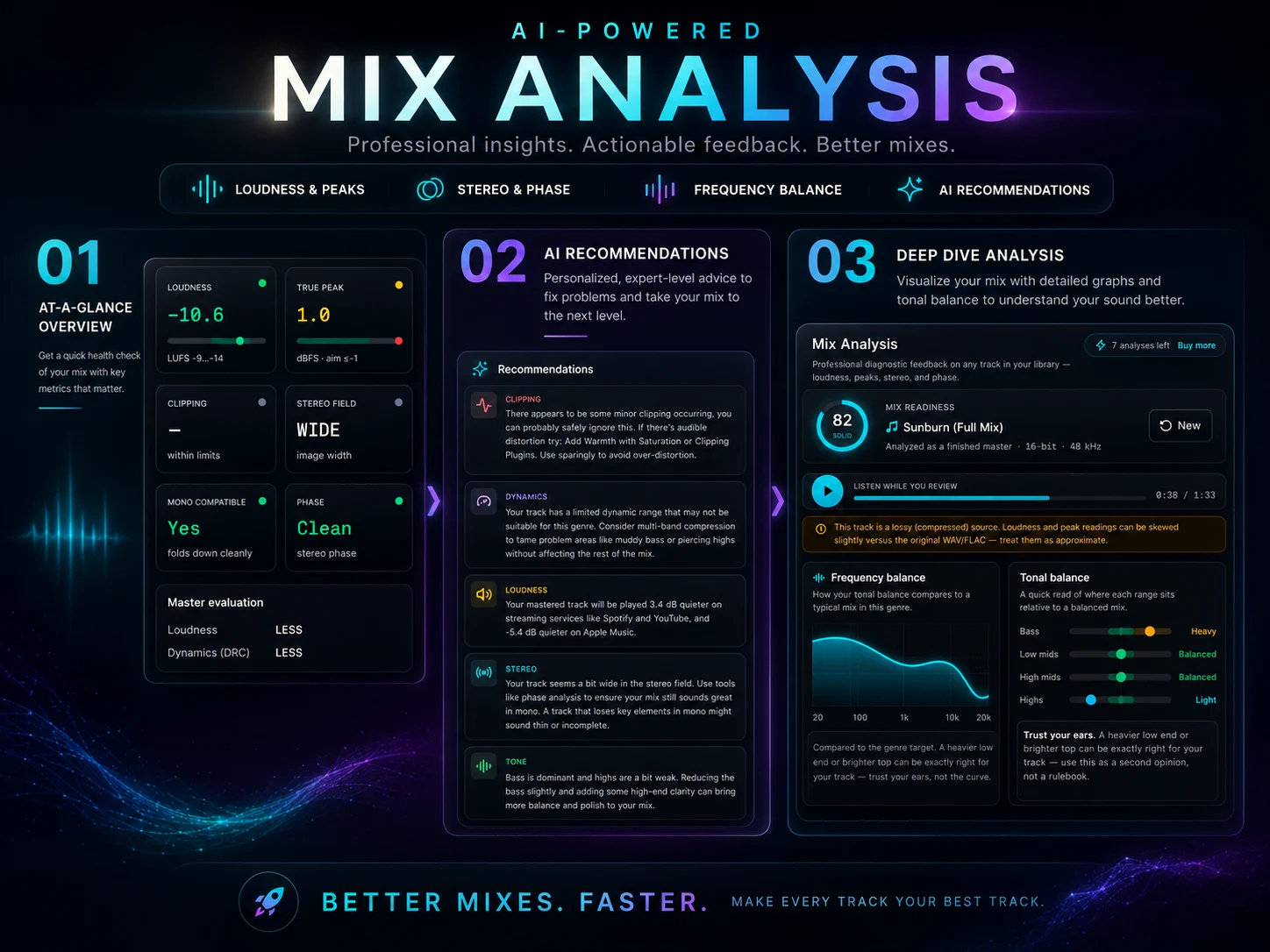
Every composer knows the doubt. The mix sounds great in your session, on your headphones, after hours of listening. But is it actually competitive? Will it sit next to commercial references when a supervisor drops it into a cue? Most of us answer that by bouncing between a loudness meter, a spectrum analyzer, and our own tired ears, and still never feel sure.
DropCue now answers it directly. AI Mix Analysis gives you professional, diagnostic feedback on any track in your library, then explains what to fix in plain language, all in the same place your catalog already lives. It is one more tool in everything DropCue gives composers to turn a finished track into a placement.
What Mix Analysis reads
Mix Analysis looks at four things that decide whether a mix holds up, and turns them into one clear read:
- Loudness and peaks. Integrated LUFS, true peak, and clipping, all measured to the ITU-R BS.1770 standard, the same one streaming services use. You see whether your track lands at a streaming-ready level without distorting.
- Stereo and phase. Stereo width, mono compatibility, and left/right correlation, so you know your mix survives on a phone speaker, a club system, and everything in between.
- Frequency balance. An eight-band tonal read compared to a typical mix in your genre, with a frequency curve that shows where your low end, mids, and highs are heavy, balanced, or light.
- AI recommendations. Personalized, expert-level advice that names the issue and gives you a concrete way to address it, covering clipping, dynamics, loudness, stereo, and tone.
How does Mix Analysis work?
You pick any track in your library and run an analysis. In seconds you get a mix readiness score and an at-a-glance overview: loudness, true peak, clipping, stereo field, mono compatibility, and phase, each with a clear status. Below that, the AI recommendations explain what is worth fixing and why, in language that reads like a mentor, not a manual. Finally, the deep-dive view shows your frequency-balance curve and a tonal-balance read against the genre reference.
You can listen while you review, so the numbers always connect back to what you are actually hearing.
Is the tonal balance a hard rule?
No, and this matters. The genre comparison is a helpful second opinion, not a rulebook. A heavier low end or a brighter top can be exactly right for your track. Mix Analysis is there to catch the things you cannot hear after the tenth listen, not to flatten your sound into a template. Trust your ears; use the curve as a sanity check.
How accurate is it?
Loudness and peaks are measured to the same broadcast standard streaming platforms use. One honest caveat: if you analyze a lossy (compressed) source like an MP3, the loudness and peak readings can be slightly skewed versus the original WAV or FLAC. Mix Analysis flags that for you and treats those readings as approximate, so you are never misled.
Does it change my track?
Never. Mix Analysis is read-only. It measures and advises, but it does not touch your original file. It pairs naturally with AI Mastering: analyze a mix to see where it stands, then master it to a release-ready level when it is ready to pitch.
What does Mix Analysis cost?
Pro members get 10 free analyses to start. After that, you can buy one-time packs that never expire: 20 analyses for $4.99 or 50 for $9.99. Artist members can buy packs too. See the full DropCue pricing, which is still less than half of what other platforms charge — the side-by-side comparison lays out exactly what is included.
Who is Mix Analysis for?
Composers, producers, and sync writers who want to know a mix is finished and competitive before it goes to a supervisor or a brief, without juggling a DAW and a stack of metering plugins. A clean mix is only half the job — pair it with complete, accurate metadata and you have a track that is genuinely ready to pitch. If you are building toward steady placements, see our guide on how to build a sync licensing career.
Mix Analysis answers the technical question: is this mix clean. It cannot answer the other one — would a supervisor actually place this cue. For that, a track review from a working supervisor and publisher reads the composition, arrangement, production, mix, sync-readiness, and metadata, then tells you plainly whether it is ready to pitch.
Ready to know exactly where your mix stands? Try Mix Analysis on DropCue.