Last reviewed
DropCue vs DISCO.ac: Honest Comparison ($8 vs $29.99)
DropCue vs DISCO.ac: An Honest Feature Comparison ($8 vs $29.99)
If you pitch music for a living, you've probably used DISCO. For years it was basically the only game in town, and the music industry has a long tradition of putting up with mediocre tools because everyone else is putting up with the same mediocre tools.
That's how you end up paying $29.99/month (and realistically closer to $69 once the add-ons kick in) for a platform whose interface looks like it lost a fight with a 2015 dashboard.
DropCue launched because we thought music professionals deserved a music sharing tool that didn't require a finance review every quarter. This post is a feature-by-feature comparison of DropCue vs DISCO.ac in 2026. We'll point out where we've pulled ahead, where DISCO still has a structural lead, and how to decide which DISCO alternative actually matches your workflow.
Disclosure: DropCue is our product. DISCO's pricing below comes from their own pricing page, checked August 2026.
DISCO.ac Pricing vs DropCue Pricing: The Most Obvious Difference
Let's start with what most people notice first.
DISCO charges $29.99/month for its base plan. That gets you playlist creation, basic sharing, and a limited number of tracks. If you want discovery features (the ability to receive pitches from others), that's an extra $10/month add-on. Need watermarking for your tracks? That's another $29/month add-on. A fully-loaded account can easily run $69/month — nearly $830 a year.
They also removed their lower-tier Lite plan in recent years, which frustrated a lot of independent publishers and composers who didn't need the full feature set but suddenly had no professional entry point.
DropCue offers three straightforward plans (Studio adds the Business Suite and DropCue University on top of Pro, from $33/month or $29/month billed annually):
- Artist at $8/month (billed annually) — playlist creation, sharing, analytics, and no track limit.
- Pro from $19/month ($15/month billed annually) — 5 tiers from 1,000 to 20,000 tracks, sections, password protection, download controls, document attachments, and priority support.
No add-ons. No surprise fees. Everything in the plan is included in the plan.
Related: See the full cost breakdown of music pitching platforms in 2026
User Interface and Experience
This is where personal preference plays a role, but we've heard the same feedback from hundreds of users.
DISCO has accumulated features over many years, and the interface reflects that history. Navigation can feel cluttered, especially for new users. Finding specific settings, managing playlists, or understanding where uploaded tracks live requires a learning curve. Power users eventually adapt, but onboarding new team members or less technical clients creates friction.
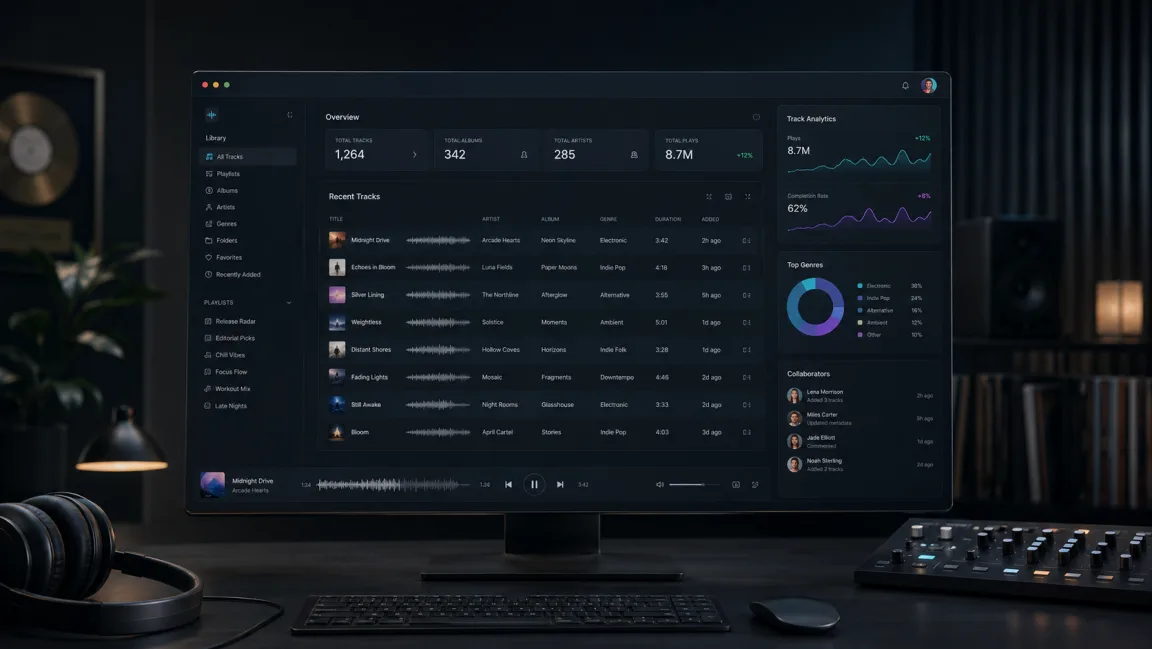
DropCue was designed from scratch in 2025 with a single guiding principle: if a feature can't be understood in five seconds, it needs to be redesigned. Our dashboard is clean and minimal. Creating a playlist, adding sections, setting permissions, and sharing a link takes under two minutes from a cold start.
We hear "I set it up in my first coffee break" more than any other piece of feedback.
Analytics and Tracking
Both platforms offer analytics, but the depth and presentation differ.
DISCO provides play counts and basic engagement data. The analytics interface works, but it can feel like an afterthought — data is sometimes buried behind multiple clicks, and export options are limited.
DropCue treats analytics as a first-class feature. See how analytics changed one composer's sync licensing business for a real-world example of what this data unlocks. Every shared playlist tracks:
- Total and unique plays per track
- Listener location (country-level)
- Time spent on each track (not just "played" vs. "not played")
- Which sections listeners engage with most
- Download activity (when enabled)
- Link open rates
All of this is accessible from a single analytics dashboard with no extra clicks. You can see at a glance which tracks are generating interest and which are being skipped — critical intelligence when you're following up with a music supervisor.
Related: How analytics changed one composer's sync licensing business
Playlist Sections
Organizing a pitch into logical sections is fundamental to professional music delivery.
DISCO supports sections, but the implementation can be rigid. Reordering content, adding notes between sections, and customizing presentation requires patience.
DropCue was built around the concept of sections from day one. You can create titled sections with descriptions, drag-and-drop reorder tracks within and across sections, and add contextual notes that help supervisors understand why you've grouped tracks the way you have. Think of it as building a narrative for your pitch, not just dumping tracks into a folder.
Password Protection and Access Controls
Controlling who can access your music is non-negotiable in sync licensing.
DISCO offers password protection, though the setup process involves multiple screens and settings that aren't always intuitive.
DropCue lets you toggle password protection with a single click when creating or editing a playlist link. You set the password, share the link, and you're done. You can also set expiration dates on links, limit the number of times a link can be opened, and revoke access instantly. Every access event is logged in your analytics.
Download Controls
Sometimes a supervisor needs to download a track for an edit. Sometimes you absolutely do not want them to.
DISCO provides download toggles, but granular control (per-track vs. per-playlist) can be inconsistent depending on your plan tier.
DropCue Pro gives you download controls at both the playlist level and the individual track level. You can allow downloads for some tracks (the ones cleared for the project) while keeping others stream-only. This is particularly useful for pitches that include both licensed-ready tracks and reference tracks.
Inbox and Submissions
This is an area where we'll be upfront: DISCO has a larger established network for discovery and inbound submissions. If you're a music supervisor who receives hundreds of pitches through that platform's ecosystem, the network effect is real.
DropCue started with outbound pitching — helping you create and share playlists with your existing contacts — and now includes a submission inbox on every paid plan, supervisor discovery, and briefs you can pitch against. We designed the inbox and submission features to avoid the noise problem that plagues high-volume submission systems (where supervisors are overwhelmed and most pitches go unheard).
We believe a curated, quality-first approach to submissions will serve both sides better. But we acknowledge that if inbound discovery through an existing network is your primary workflow today, the incumbent platform has an advantage here.
Document Attachments
Pitching music often requires more than audio. Cue sheets, one-sheets, licensing terms, artist bios — these documents are part of the package.
DISCO has limited support for attaching documents to playlists, often requiring workarounds.
DropCue Pro lets you attach PDFs and documents directly to any playlist or section. A supervisor reviewing your pitch can access the one-sheet, the licensing terms, and the audio all in one place. No separate emails, no hunting through attachments.
AI Lyrics Transcription
Supervisors reviewing vocal tracks need to see the lyrics — for content clearance, brand safety, and context with dialogue. Manually transcribing lyrics for every track in a catalog is tedious work that most composers skip, which means supervisors either transcribe by ear or move on.
DISCO does not offer any transcription tools.
DropCue Pro includes one-click AI lyrics transcription powered by OpenAI Whisper. Click a button on any track and get a full lyric sheet in seconds. Pro users get 15 transcriptions per month included, with additional credit packs available for larger catalogs. It's a small feature that removes a real bottleneck in the licensing process.
Transcoding and Upload Reliability
A recurring pain point we hear from users switching to DropCue is transcoding issues on the other platform. Tracks that don't process correctly, uploads that hang, audio quality that degrades after transcoding — these are frustrations that erode trust, especially when you're sending music to a high-profile supervisor.
DropCue uses a modern audio pipeline built on current cloud infrastructure. Uploads process quickly, transcoding preserves quality, and if something does go wrong, you get a clear error message instead of a silent failure. We support WAV, AIFF, MP3, and FLAC audio uploads on all plans, and Pro users can also upload video files (MP4, MOV, WebM) directly into playlists.
Support and Responsiveness
DISCO has a support team, but response times can be slow — particularly for users on lower-tier plans. We've heard reports of multi-day waits for responses to billing and technical issues.
DropCue is a smaller team, and that's actually an advantage right now. Our average support response time is under four hours. Pro users get priority support with responses typically within one hour during business hours. You're talking to people who built the product, not reading from a script.
Everything Else That Comes With It
The sections above cover the features people compare head to head. This is the rest of what a DropCue plan includes, and where DISCO genuinely wins.
| Capability | DropCue | DISCO |
|---|---|---|
| Catalog discovery by supervisors | Yes, when you enable it | Yes, larger network |
| Pitch against posted briefs | Yes, music briefs | No |
| Submission inbox | All paid plans | Plus and above |
| Email campaigns to your contacts | All paid plans | Email Creator, Plus and above |
| Password protection | Pro and above | Pro and above |
| Expiring links | All paid plans | Pro and above |
| Timestamped waveform comments | Yes | No |
| EPK builder | Included | No |
| Public portfolio page | Included | No |
| Embeddable player | Included | No |
| Audio snippets | Included | No |
| AI stem separation | Included | No |
| AI mastering | Included | No |
| AI cover art | Included | No |
| AI lyrics transcription | Included | Yes |
| AI mix analysis | Included | No |
| WAV to AIFF conversion | Yes | Yes |
| Team seats | Pro and Studio | Two seats on Artist, more above |
| Business Suite | Studio: pitch pipeline, royalty tracker, agreement generator, client and license tracker, market scanner | No |
| DropCue University | Studio: 61 lessons | No |
| Supervisor track review | $20 per track, written by a working supervisor | No |
Two things worth saying plainly. DISCO has automatic tagging and DropCue does not, so if you want a machine to tag a large back catalogue for you, that is a real point in DISCO's favour. And DISCO's supervisor network is bigger, because it has been the default for longer.
Everything in the DropCue column is included at the stated plan. There are no add-on fees at any tier.
The Honest Summary
| Feature | DISCO | DropCue |
|---|---|---|
| Add-on fees | Yes ($10-29/mo each) | None |
| UI simplicity | Complex, legacy | Clean, modern |
| Analytics depth | Basic | Detailed |
| Sections | Supported | First-class |
| Password protection | Multi-step setup | One-click |
| Download controls | Plan-dependent | Per-track granular |
| Document attachments | Limited | Full support (Pro) |
| AI lyrics transcription | Not available | One-click, 15 free/mo (Pro) |
| Upload reliability | Inconsistent reports | Modern pipeline |
| Support response | Slower, tiered | Fast, personal |
Who Should Stay with DISCO?
If inbound submissions through an established network are critical to your daily workflow, and you need that ecosystem today, the incumbent platform still has that advantage. We respect that.
Who Should Switch to DropCue?
If you primarily create and share playlists with your own contacts — publishers, sync agents, composers, music libraries — and you want a faster, cleaner, more modern tool built for your workflow, DropCue is built for you.
For a step-by-step guide to moving your catalog over, see how to switch from DISCO to DropCue.
New: Keep Your Remaining DISCO Months When You Switch
The most common reason people stay on DISCO past the point of wanting to leave is the math. They renewed for the year three months ago. Switching now means writing off nine months of paid-up DISCO. So they wait.
We built a way around this. Sign up for an annual DropCue plan, send us your DISCO receipt with your renewal date, and we add the months you have left on DISCO to the end of your DropCue subscription. Free. Up to 6 months.
The math: pay for a year of DropCue today. Send us the receipt that shows your DISCO renews in nine months. Your DropCue renewal moves nine months forward. You get 21 months of DropCue for the price of 12. The DISCO months you already paid for don't go to waste.
Switch from DISCO and keep your remaining months →
You don't have to upload the receipt before paying. You have 30 days from your DropCue signup to send it in. We verify, push your renewal date back, and email you the confirmation.
Related: Best DISCO alternatives in 2026
See DropCue in Action
Watch a 60-second walkthrough of the platform — from uploading tracks to sharing playlists and tracking analytics.
Frequently Asked Questions
Is DropCue a real DISCO alternative?
Yes. DropCue covers the same core workflow as DISCO — building playlists, sharing them with music supervisors, tracking who listens — with every feature included at a fraction of the cost. It also includes features DISCO charges extra for (advanced analytics) or doesn't offer at all (timestamped waveform comments, AI lyrics transcription, public portfolio pages, auto-grouped alt mixes). Most DISCO users who switch find that everything they actually used on DISCO is available on DropCue, often in a clearer interface.
How much does DISCO.ac actually cost?
DISCO advertises starting plans at $10-27/month, but the realistic cost for a working music professional is closer to $50-66/month once you add the Discovery Suite ($10/mo) and watermarking ($29/mo) — both essential features for sync work. That's roughly $828/year for a fully-loaded account. DropCue's most-comparable Pro plan is $15-19/month with no add-ons.
Can I import my DISCO catalog into DropCue?
Yes. DropCue offers a self-service CSV metadata import that maps spreadsheet columns to track fields (title, artist, BPM, key, tags, mood). Audio files need to be re-uploaded since DISCO does not provide bulk audio export, but the metadata transfer typically takes 10-15 minutes for a working catalog. There is no support ticket required.
Is DropCue secure for unreleased music?
Yes. Every shared playlist supports password protection, per-track download controls, expiration dates, and per-recipient share URLs with full access analytics. You control exactly who can hear what, for how long, and whether they can download, and you see exactly who opened each link. Industry-standard encryption is used for storage and transfer.
What if I switch and don't like DropCue?
DropCue offers a 7-day free trial of full Pro features with no credit card required, so you can test the entire workflow before committing. If you do subscribe and want to leave, you can cancel anytime — no annual lock-in on monthly plans. We also publish complete data export tools so your catalog is yours, not the platform's.
Does DropCue have a marketplace where supervisors find me?
Yes. Turn discoverability on and approved music supervisors can browse your full catalog, not just the playlists you send them. Supervisors and the DropCue team also post music briefs, and composers on a paid plan with discovery enabled can pitch tracks straight from their catalog against those briefs.
The real difference is scale, not capability. DISCO has been the category default for years, so more supervisors are already working inside it day to day. If being found passively is central to how you get hired, that head start is worth weighing.