Guide
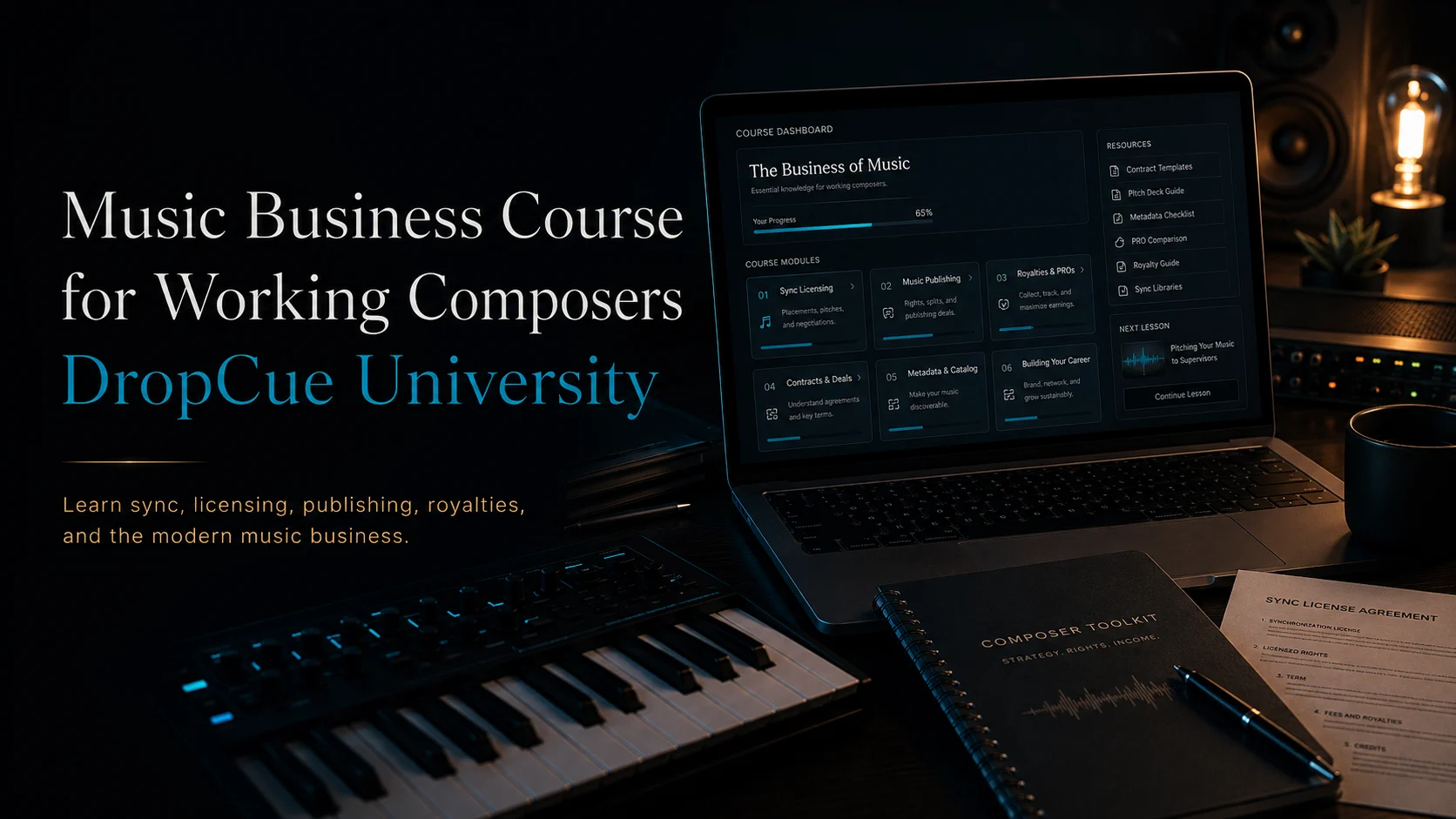
Music Business Course for Working Composers: DropCue University
 Marc Aaron Jacobs
Founder, DropCue · Composer
Marc Aaron Jacobs
Founder, DropCue · Composer
Skip the four-year degree and the bloated $1,000 online course. DropCue University is a $99 one-time music business course that teaches the parts composers actually get paid for: sync, licensing, royalties, pitching, and contracts.
Who this is for
This music business course is for composers and producers who can land a cue but freeze the second money, paperwork, or a supervisor's inbox shows up. You can score a scene in your sleep. You cannot say whether you just gave away your publishing, what a sync fee should be, or who actually cuts the check when your track airs.
It is for self-taught musicians who never went to Berklee and have no plans to take on student debt to learn the difference between a master and a composition. It is for the bedroom composer uploading to libraries with no clue how the back-end royalties flow. And it is for the working sync writer who has placements but has never read a license closely enough to know what rights they signed away.
If you want the business of music explained by people who pitch and license for a living, in plain language, with zero weeks of music history electives, this is built for you.
The audience-specific reality
Here is the gap nobody warns composers about. The skill that gets you hired (writing music) and the skill that gets you paid (understanding rights, royalties, and deals) are two completely different things, and almost nobody teaches the second one to working musicians in a form they can use. A traditional music business degree can run tens of thousands of dollars and spends a big chunk of that on theory, ensemble, and general-education credits that have nothing to do with closing a sync deal. Generic online courses swing the other way, charging hundreds to a thousand-plus dollars for motivational fluff and PDFs that were outdated two years ago.
Meanwhile the actual money in modern composing lives in sync licensing, and it is more fragmented than ever. When your music gets placed in a Netflix show, an HBO trailer, or a brand ad, the payment splits across several streams: an upfront sync fee, performance royalties collected by your PRO (ASCAP, BMI, or SESAC), mechanical royalties handled by The MLC for streams, and neighboring or master-use considerations on the recording side. SoundExchange covers digital performance of the recording. Songtrust and services like it exist for one reason, which is that publishing administration confuses people. Miss who pays what, and you cannot price a deal, cannot spot a bad clause, and cannot tell when a library is quietly taking more than its share.
That is the real-world problem a focused music business course solves. Not a credential to frame. A working knowledge of how the money moves, so the next time a supervisor or library sends a contract, you read it like someone who has done this before.
Why DropCue fits this workflow
DropCue University is a $99 one-time music business course taught by people who pitch, license, and track royalties for a living, not academics with tenure. It covers the five things that actually move a composing career forward: how sync licensing works end to end, how to read and negotiate a music license, how the royalty streams (performance, mechanical, sync, neighboring) actually pay out, how to pitch your catalog to supervisors and libraries without sounding like spam, and how contracts allocate rights so you stop signing away things you never meant to.
Here is what sets it apart from any other music business course: it is wired straight into the tools you use the same week you learn the concept. Every buyer also gets 7 days of full DropCue free, so the lesson on tracking pitches connects to the actual Pitch Pipeline CRM, the lesson on contracts connects to the Agreement Generator that drafts sync and license agreements, and the lesson on royalties connects to the Royalty Tracker. You do not just hear how the business works. You get the workspace to run it.
And the promise under all of it: DropCue takes zero revenue share on anything you book. No commission on placements, no cut of your sync fees. You learn the business, you do the business, you keep 100 percent of the money. That is the whole point of owning your pitching workflow instead of renting it from a library that skims off the top.
The features that matter most
✓ DropCue University ($99 one-time course)
Teaches sync, licensing, royalties, pitching, and contracts in plain language, without the tens of thousands of dollars and unrelated electives of a music business degree.
✓ 7 days of full DropCue free (course bonus)
You apply each lesson in the real platform the same week you learn it, so the contract module connects to real agreements and the royalty module connects to a real tracker.
✓ Agreement Generator
The contracts lesson stops being abstract. Generate a sync or music license agreement and see exactly where rights, term, and fee live in a real document.
✓ Pitch Pipeline (CRM)
The pitching module plugs straight into a CRM that tracks every supervisor and library you contact, so 'follow up' becomes a system instead of a sticky note you lost.
✓ Royalty Tracker
After you learn how performance, mechanical, and sync royalties pay out, you track yours in one place instead of guessing what The MLC or your PRO owes you.
✓ Zero revenue share on your placements
You keep 100 percent of every fee you book. The course teaches you to own your pitching workflow instead of handing a library a permanent cut.
Names you may know in this space
ASCAP
One of the U.S. performing rights organizations that collects performance royalties when your music is publicly performed or broadcast.
BMI
A performing rights organization composers affiliate with to collect performance royalties on their compositions.
The MLC
The Mechanical Licensing Collective, which collects and distributes mechanical royalties for streams and downloads in the U.S.
SoundExchange
Collects digital performance royalties for the sound recording side, relevant to composers who own their masters.
Berklee
A well-known music college whose degree path costs vastly more than a focused $99 sync-business course.
Pricing for this audience
DropCue University is $99 one-time, and that price covers the full course plus 7 days of complete DropCue access so you can run what you learn. Compare that to a music business degree that can cost tens of thousands of dollars over years, or generic online music business courses that often charge several hundred to over a thousand dollars for thinner material. Want to keep using the platform after the trial? The plans stay simple: Artist is $8/mo billed annually (no track limit), Pro plans start at $15/mo annually and scale up to $69/mo by catalog size. Across every tier, DropCue takes zero commission on the placements and fees you book, so the course pays for itself the first time you price a sync deal correctly.
Frequently asked questions
Is a music business course worth it?
A music business course is worth it when it teaches the parts of the industry that directly affect your income: sync licensing, royalty streams, pitching, and contracts. A focused, affordable course like DropCue University ($99 one-time) pays for itself the first time it stops you from underpricing a sync deal or signing away your publishing. The poor value comes from expensive general programs that bury practical business skills under theory and history credits you will never use as a working composer.
What do you learn in a music business course?
A good music business course covers how you actually get paid: sync licensing, the royalty streams (performance royalties through ASCAP, BMI, or SESAC, mechanicals through The MLC, plus sync and neighboring rights), how to pitch your catalog to supervisors and libraries, and how to read and negotiate music contracts. DropCue University zeroes in on exactly these five areas and connects each one to a working tool, so you learn how a license is structured and then generate one, learn how royalties pay out and then track them.
How much does a music business course cost?
Cost ranges widely. A music business degree can run into the tens of thousands of dollars over several years, while standalone online courses typically range from a couple hundred to over a thousand dollars. DropCue University is $99 one-time and includes 7 days of full DropCue access, which puts a practical, sync-focused education at a fraction of the typical price.
Do you need a degree to work in the music business?
No, you do not need a degree to work in the music business. Most working sync composers, library writers, and producers are self-taught or learned on the job, and supervisors hire based on the music and your reliability, not your transcript. What you do need is working knowledge of licensing, royalties, and contracts so you can price deals and protect your rights. A targeted course gives you that far faster and cheaper than a four-year program.
Who is DropCue University for?
DropCue University is for composers and producers who can write music but freeze on the business side: sync deals, royalty splits, pitching, and contracts. It is built for self-taught musicians and working sync writers who want practical, money-focused training without a degree, and who want to own their pitching workflow and keep 100 percent of their fees.
Does DropCue take a cut of my placements or sync fees?
No. DropCue takes zero revenue share and charges no commission on any placement or fee you book. You keep 100 percent of your money. The platform makes money on flat subscriptions and the one-time University course, not by skimming your deals, which is the opposite of how many libraries operate.