Guide
Music Licensing Contract: What It Must Include
 Marc Aaron Jacobs
Founder, DropCue · Composer
Marc Aaron Jacobs
Founder, DropCue · Composer
A music licensing contract says who can use your music, where, for how long, and for how much. Here is exactly what belongs in one, in plain language, so you stop guessing on the clauses that quietly decide whether you keep your rights.
Who this is for
This guide is for composers, songwriters, producers, and small production libraries who license their own music and would rather understand the paperwork than forward a mystery PDF every time a placement lands.
It is also for the independent sync licensor who just got an email from a video editor, a wedding filmmaker, a brand, or a YouTuber asking to "use your track." Now you need an actual music licensing contract that protects the master, defines the use, and gets a check cut. You do not need a law degree to read this. You do need to know which eight or nine sections decide whether you keep your rights or quietly hand them over.
If you are on the buyer side, a filmmaker or agency producer or supervisor, this page also tells you what a clean license should grant you, so you do not pay for music you cannot legally air.
The audience-specific reality
Most music gets licensed without anyone in the room reading the contract closely. A composer sends a WAV, a producer replies "approved," money moves, and the agreement is a template someone pulled off a forum in 2014. That works right up until it does not. A track shows up in a region it was never cleared for. An exclusive grant quietly blocks the composer from licensing the same cue to anyone else. A "buyout" turns out to mean the composer signed away the master entirely.
A music licensing contract is not really one thing. There are usually two rights at play. The composition, meaning the underlying song, melody, and lyrics, and the master recording, meaning the specific recorded version. Whoever wrote the song controls the composition. Whoever owns the recording controls the master. A single sync placement in a film or ad typically needs both cleared, which is why you see a sync license and a master use license referenced together. If you wrote and recorded the track yourself, you control both, and one agreement can cover both grants.
The fee side is just as muddy. Sync fees swing wildly by use. A small indie short or a student film might pay a few hundred dollars or be a free festival-rights deal. A regional ad or streaming-series cue often lands in the low four figures. A national TV campaign or major-film placement can run well into five or six figures. Anyone quoting you a single "standard rate" is guessing. The contract is where the actual number, and the actual scope it buys, gets pinned down. Get the scope wrong and you have either undercharged for a national broadcast or blocked yourself from re-licensing a cue you could have sold ten more times.
Why DropCue fits this workflow
Reading what a music licensing contract needs is one thing. Producing a clean one on demand, for a real deal, without paying a lawyer to fill in a template, is another. DropCue's Agreement Generator builds sync and music license agreements from the same clause structure this page walks through. You pick the use, the term, the territory, the media, the exclusivity, and the fee. It hands back a complete agreement with the parties, grant of rights, warranties, and credit language already in place.
It is part of the DropCue Business Suite, the toolset built for composers who want to run pitching, paperwork, and follow-through themselves instead of handing a cut to an agency. The Clients and License Tracker keeps every executed agreement in one place: who it covers, what it grants, when the term ends. So the exclusive cue you licensed last year does not get accidentally re-pitched into a conflict. And because DropCue takes zero revenue share on any deal you close, the fee you negotiate in that contract is the fee you keep. All of it.
Want the deeper version of how licensing actually works, the money, the rights, the negotiation? DropCue University is a one-time course on the business of music and sync licensing that pairs well with generating your first real agreement.
The features that matter most
✓ Agreement Generator
Builds a complete sync or music license agreement with the parties, grant of rights, term, territory, media, exclusivity, fee, and credit clauses already structured. You go from 'approved' email to signable contract in minutes instead of editing a borrowed template at midnight.
✓ Clients and License Tracker
Stores every executed agreement with its scope and term-end date, so you never re-pitch a cue you already licensed exclusively, and you can see at a glance which placements are about to expire or renew.
✓ Pitch Pipeline
Tracks each pitch like a CRM from first send to signed deal, so the moment a supervisor says yes, the contract step is already in your workflow instead of an afterthought you scramble for.
✓ DropCue University
A one-time course on sync licensing and the business of music, so the clauses in your contract, from territory to exclusivity to master use, are decisions you make on purpose instead of whatever the other side sent over.
✓ Zero revenue share
DropCue takes no commission on placements or fees you book, so the number you write into the fee section of the agreement is the number that lands in your account.
Names you may know in this space
ASCAP
One of the U.S. performing rights organizations that collects performance royalties for songwriters and publishers, separate from the sync and master use fees negotiated in a licensing contract.
BMI
A major U.S. performing rights organization; a composer's PRO affiliation is relevant background to licensing but does not replace the sync and master use grants written into the contract itself.
Netflix
An example of a streaming buyer whose placements typically require both a sync license and a master use license cleared, often with broad territory and long-term grants.
Pricing for this audience
The Agreement Generator, Clients and License Tracker, and Pitch Pipeline are part of the DropCue [Business Suite](/business-suite). DropCue's catalog plans start with Artist at $8/mo billed annually (or $10/mo monthly) with no track limit, and Pro plans scale by catalog size from $15/mo annually for 1,000 tracks up to $69/mo annually for 20,000 tracks. DropCue University, the course on the business of sync licensing, is $99 one-time and includes a bonus of 7 days of full DropCue free, so you can generate real agreements while you learn. Across all of it, DropCue takes zero revenue share, so every fee you negotiate in a contract stays yours.
Frequently asked questions
What should a music license agreement include?
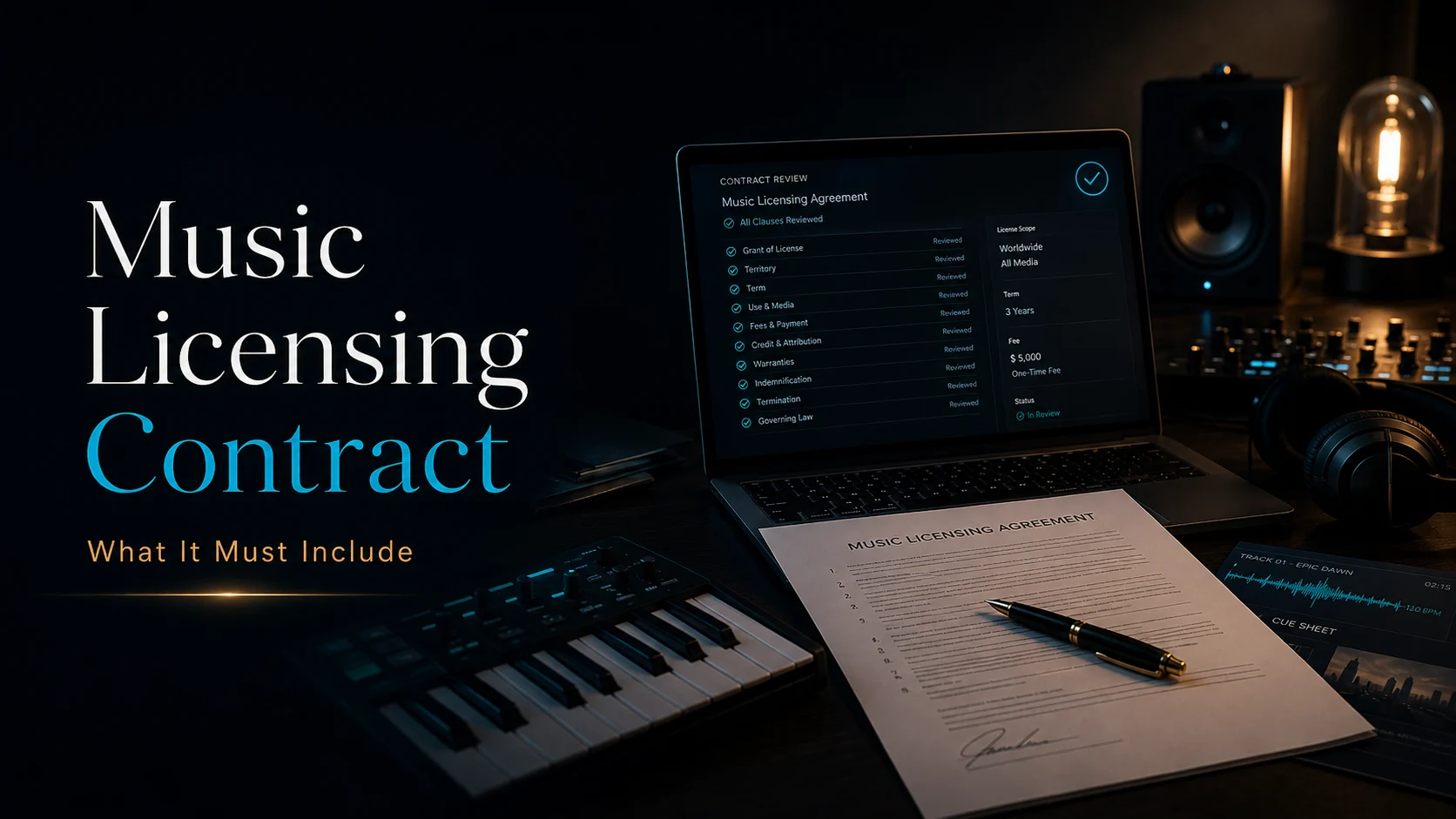
A music license agreement should include the parties, the grant of rights, the term, the territory, the permitted media, whether the license is exclusive or non-exclusive, the fee, the credit, and the warranties. The parties name who is licensing and who is receiving. The grant of rights defines exactly what they can do with the music. The term is how long the license lasts, the territory is where it applies, and the media lists the platforms or formats. Exclusivity says whether you can also license the same track elsewhere, the fee is the payment, the credit is how you are named, and the warranties confirm you actually have the rights you are granting. Leave any one of these vague and you have a dispute waiting to happen.
What is a sync license agreement?
A sync license agreement grants permission to synchronize a piece of music with visual media, such as a film, TV show, ad, video game, or YouTube video. It covers the composition, meaning the underlying song. For a placement using a specific recording, a sync license is typically paired with a master use license, which covers the recording itself. If you wrote and recorded the track yourself you control both, so a single agreement can grant both. The sync agreement should still spell out the term, territory, media, exclusivity, and fee, because 'permission to use the song' means nothing until you define where, how long, and on what platforms.
How do you write a music licensing contract?
You write a music licensing contract by working through each required section in order: identify the parties, define the grant of rights, set the term and territory, list the permitted media, state whether the license is exclusive or non-exclusive, fix the fee and payment terms, specify the credit, and include warranties confirming you own the rights you are granting. Start from a structured template rather than a blank page so you do not drop a clause, then fill in the specifics for the actual deal. DropCue's Agreement Generator does exactly this, building a complete agreement from those sections so the structure is never the part you get wrong.
What is the difference between a master use license and a sync license?
A sync license covers the composition, the underlying song, melody, and lyrics, while a master use license covers a specific master recording of that song. A film or ad using a particular recorded version usually needs both, because the songwriter controls the composition and the recording owner controls the master. If you wrote and recorded the track yourself, you own both rights, so one agreement can grant the sync and the master use together. The distinction matters most when the songwriter and the recording owner are different people, which is when a buyer has to clear two separate licenses for one placement.
Do I need a lawyer to write a music licensing contract?
For most independent sync deals you do not need a lawyer to draft the contract, but you should understand every clause you sign. A well-structured template that covers the parties, grant of rights, term, territory, media, exclusivity, fee, credit, and warranties handles the large majority of straightforward placements. Bring in a lawyer for high-value deals, unusual grants like a full buyout or rights assignment, or anything where the language is doing something you do not fully understand. Generating a clean agreement from a known structure means the lawyer, when you do use one, is reviewing rather than building from scratch.
What does "all media now known or hereafter devised" mean in a music licensing agreement?
It grants the right to use the music in every distribution format that exists today and any invented later. Paired with "worldwide" and "in perpetuity" it is the broadest grant possible. That is standard for a feature film, and the fee should reflect it. For a commercial or a corporate video, a defined media list (broadcast, online, in-store) and a one-year term are normal and should cost less. A perpetual all-media buyout at a one-year price is the clause to push back on first.
What is an MFN clause in a music license?
Most favored nations. If any other music in the same production is licensed for the same type of use at a higher fee or on better terms, yours rises to match. It protects a composer who signs early from being underpaid relative to a bigger name cleared later. It is common in film and TV and rarely offered unless you ask for it.
Why does a music licensing contract need a cue sheet clause?
Performance royalties for broadcast and streaming are paid from cue sheets, the documents a producer files with the PROs listing every cue, its writers, publishers, and timing. Without a clause obligating the producer to file one and send you a copy, the show can air for years while ASCAP, BMI, or SESAC has no record it happened. Ask for the obligation and for the copy.
Keep reading
- →Sync licensing rates by project type (2026 fee table)
- →Generate a sync or music license agreement in minutes
- →DropCue Business Suite: the full toolkit for working composers
- →Track every executed license and its term in one place
- →Learn the business of sync licensing with DropCue University
- →Sync licensing explained for composers
- →How to license music for film and TV