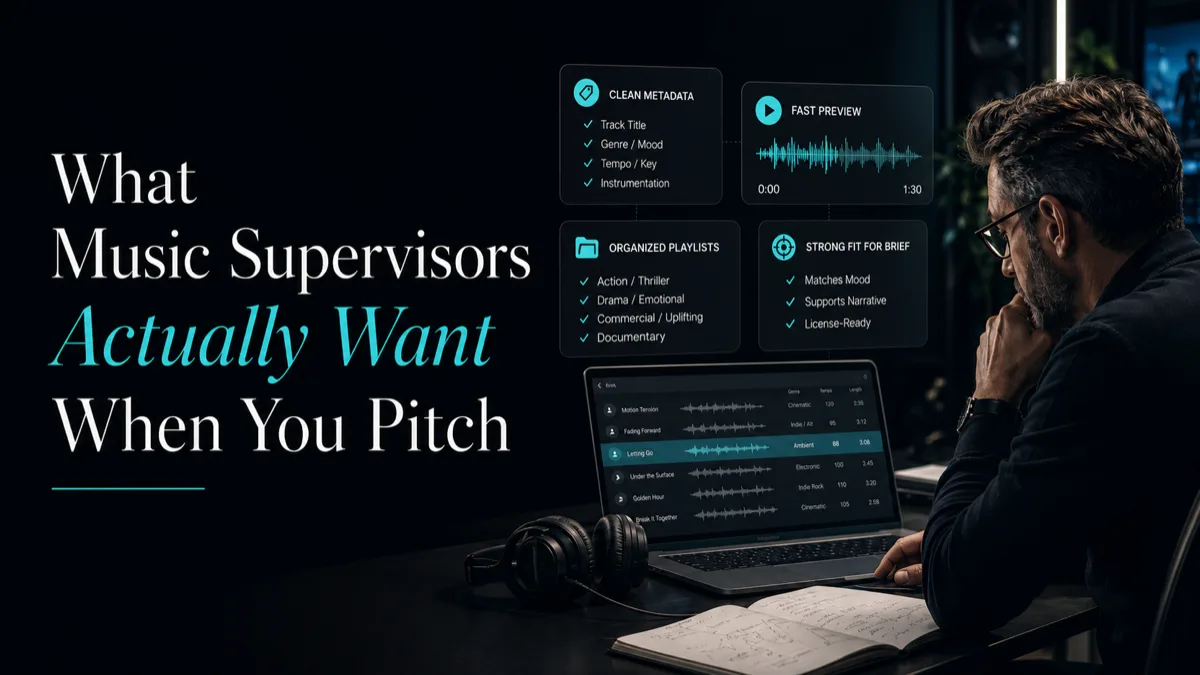

What Music Supervisors Actually Want When You Pitch
What Music Supervisors Actually Want When You Pitch
There's a significant gap between how most people pitch music and what music supervisors actually want to receive. That gap costs you placements. Closing it doesn't require insider connections or a bigger catalog — it requires understanding the job from the other side of the inbox.
We've spent time talking to working music supervisors across film, television, advertising, and games. Their feedback is remarkably consistent. Here's what they actually care about, and how to structure your pitches accordingly. For a step-by-step pitching playbook, see how to pitch music supervisors in 2026.
Quality Over Quantity, Always
This comes up in every single conversation with every single supervisor. Every one.
"I'd rather receive five perfect tracks than fifty decent ones."
When you send a massive playlist, you're not demonstrating the depth of your catalog — you're demonstrating that you don't know which tracks fit the brief. That's the opposite of the value you're supposed to provide.
A supervisor's time is the scarcest resource in the sync chain. They may be working on multiple shows, reviewing pitches from dozens of sources, and attending spotting sessions back to back. When your pitch requires them to sift through forty tracks to find the three that work, you've just given them unpaid labor. They won't thank you for it. They'll remember the experience the next time your name appears in their inbox.
The rule: If you can't explain in one sentence why each track belongs in the pitch, it doesn't belong in the pitch. Eight to twelve tracks is the sweet spot for most briefs. Sometimes fewer.
Metadata Matters More Than You Think
Sloppy metadata is the fastest way to get mentally filed under "amateur."
Supervisors need:
- Accurate track titles (not "Final Mix v3 (2)" — clean it up before you send it)
- Artist and composer credits (complete and correctly spelled)
- Duration (critical for timing to picture)
- Tempo / BPM (useful for editing)
- Genre and mood tags (helps them search and filter)
- Instrumental availability (does an instrumental version exist? Say so.)
- ISRC codes (for cleared tracks, this speeds up the licensing process)
When a supervisor finds a track they want to use, the clock starts ticking. Missing metadata creates delays, delays create frustration, and frustration means they might use someone else's track that was easier to clear.
Clean metadata is a competitive advantage. It signals that you run a professional operation and that working with you will be efficient.
Related: Music metadata that gets you sync placements: the complete checklist
Organization Is a Signal
How you organize your pitch tells a supervisor how you think.
A flat list of tracks with no structure says: "I searched my catalog for the keyword in your brief and sent everything that came up."
A playlist organized into thoughtful sections says: "I read your brief carefully, I understood the emotional arc you described, and I've grouped my suggestions by how they serve different moments in the project."
The second approach gets placements. The first gets ignored.
Practical organization strategies:
- By scene or moment: "Opening Montage," "Confrontation Scene," "Resolution / End Credits"
- By energy level: "High Energy," "Mid-Tempo," "Low and Atmospheric"
- By approach: "Contemporary Vocal Options," "Instrumental Underscore," "Left-Field / Unexpected"
Add a brief note to each section explaining your thinking. Two or three sentences is enough. "These tracks have a driving, propulsive quality that could work under the chase sequence you described. The second track has a tempo shift at 0:45 that might align with the edit point."
This level of thought takes an extra fifteen minutes. It can be the difference between a placement and a pass.
On DropCue, sections with descriptions are a core workflow feature. You title each section, add context, and organize tracks within them using drag-and-drop. The supervisor sees a structured, navigable pitch.
Professional Presentation Builds Trust
Supervisors work with people they trust. Trust is built through consistent professionalism, and presentation is part of that equation.
A playlist that arrives in a branded, clean, well-designed player tells a supervisor that you take your work seriously. It doesn't need to be flashy — it needs to be polished.
What professional presentation includes:
- Your logo and branding on the playlist page
- A clean player that works on desktop and mobile without issues
- No broken links, buffering problems, or transcoding artifacts
- Clear track information visible without extra clicks
- Password protection for sensitive material (and a password shared separately)
What it does not include:
- A Dropbox or Google Drive link with a folder of MP3s
- A SoundCloud playlist set to private with a share link
- An email with six attachments and the subject line "Music for your project!!"
The bar isn't high. But a surprising number of people still don't clear it.
Follow-Up Etiquette
The follow-up is where most pitches either convert or die. Get it wrong, and you damage the relationship. Get it right, and you stay top of mind.
Wait before following up. Give the supervisor at least three to five business days before your first follow-up. They're busy. They'll listen when they can. Pinging them the next morning makes you look impatient, not diligent.
Use analytics to time it right. If your sharing platform provides analytics, use them. If you can see that the supervisor opened the link and listened for eight minutes yesterday, a follow-up today is well-timed and relevant. If they haven't opened it yet, wait.
DropCue's analytics show you exactly when a link was opened, how long the listener spent, and which tracks received the most plays. This turns your follow-up from a guess into a data-informed conversation.
Keep the follow-up brief. "Hi [Name], just checking if you had a chance to review the playlist I sent for [Project Name]. Happy to adjust the selection if the direction has shifted. The link is [here] if you need it again."
That's it. Don't re-pitch. Don't send additional tracks unprompted. Don't ask if they "liked" the music. Be professional, be helpful, and be brief.
Know when to stop. If you've followed up twice with no response, stop. The supervisor has your pitch. If they need it, they know where to find it (especially if the link is still active — another reason expiration dates should be set thoughtfully, not aggressively). Continuing to follow up after two attempts crosses the line from diligent to annoying.
Related: How to follow up after a music pitch without being annoying
The Meta-Lesson: Make Their Job Easier
Every piece of advice in this post comes back to one principle: your job is to make the supervisor's job easier.
- Curated playlists make selection easier.
- Clean metadata makes clearance easier.
- Organized sections make navigation easier.
- Professional presentation makes decision-making easier.
- Smart follow-ups make communication easier.
When you consistently make a supervisor's job easier, you become someone they want to work with. That's how you build a career in sync, not by having the biggest catalog or the flashiest pitch, but by being the person who always makes the process smooth.
Tools Built for This Workflow
DropCue was designed around every principle in this post. Sections with descriptions, clean presentation, granular analytics, access controls, document attachments, and a player that works flawlessly on every device. It delivers premium capabilities at transparent, working-pro pricing — see the real cost of DISCO.ac vs DropCue to understand the full pricing picture.
See It in Action
60 seconds. Every feature included. Transparent pricing.