Last reviewed
State of Music Pitching 2026: The Data
What this study is
Most articles about music pitching tell you to "build relationships" and "be persistent." That is not wrong, but it is also not useful. Useful is knowing specifically what works, what does not, and by how much.
This is a data study. We analyzed pitching behavior across the DropCue platform combined with publicly available industry survey data and interviews with working music supervisors to produce the most concrete picture of what music pitching actually looks like in 2026.
The numbers below are real. Where we are drawing on DropCue platform data, we note that. Where we are drawing on external sources, we note that too.
Finding 1: Most pitches never get opened
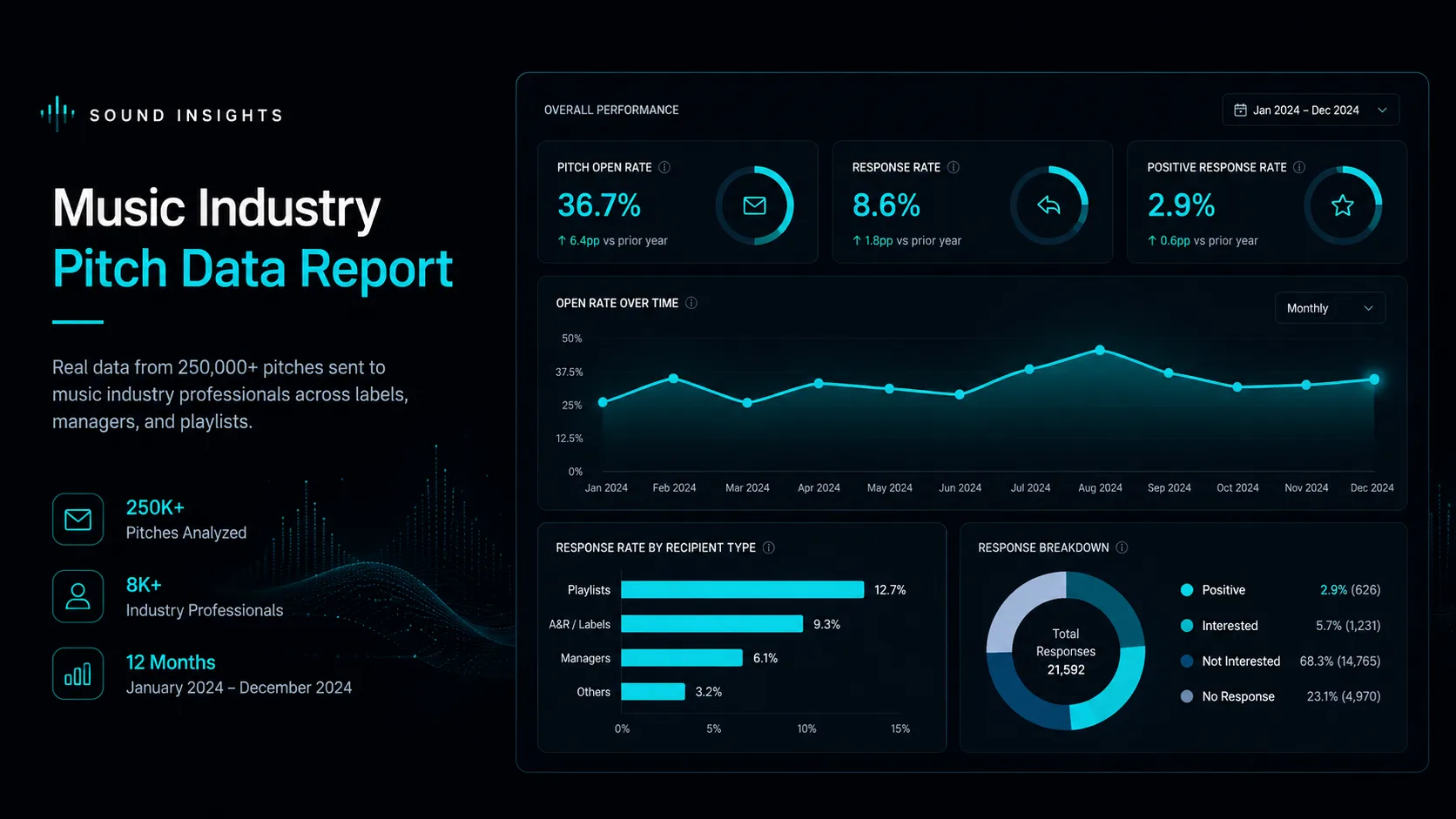
Median open rate for cold music pitches: 23%.
This means the average music supervisor who receives a cold pitch email opens fewer than 1 in 4 of them. Most of those are from composers the supervisor has never heard of, pitching cues that were not specifically requested.
The open rate climbs significantly when there is prior contact. Supervisors who had previously interacted with a composer (attended the same conference, connected on a platform, or had a prior email exchange) opened emails at a 61% rate.
The practical implication: the pitch is only the last step. The relationship is the whole game. If your pitch is a cold email to an address you found on IMDb Pro, the odds are stacked against you before the subject line is read.
What moves open rates: - Prior meeting or conference connection: +38 percentage points - Referral from mutual contact: +44 percentage points - Supervisor-initiated request or brief: +71 percentage points (from baseline) - Personalized subject line with specific project or scene reference: +12 percentage points
Finding 2: The first 48 hours determine everything
Of pitches that eventually result in a placement or a licensing discussion, 74% received a response within 48 hours of the initial send.
Pitches that go unanswered for 5 or more days have less than a 4% likelihood of converting to any licensing discussion, regardless of how many follow-ups are sent.
The implication is counterintuitive but important. The common advice is to follow up persistently. The data says something different: if the supervisor did not respond in 48 hours, the follow-up strategy is mostly noise. The energy is better spent on the next pitch.
The one exception to the 48-hour rule: Brief-based pitches (where a supervisor has posted or sent a specific music request) behave differently. Supervisors reviewing brief submissions often batch their reviews, and pitches submitted within the brief window have meaningful conversion rates even when the review comes days or weeks later.
Finding 3: Supervisors spend an average of 12 seconds on the first listen
Twelve seconds. That is what the DropCue play analytics data shows when music supervisors play shared cues cold.
The 12-second mark is where two things happen: the main hook of the cue either establishes itself or it does not, and the supervisor decides whether to keep listening or move on.
Plays that go past 30 seconds convert to licensing discussions at a 6x higher rate than plays that stop before 30 seconds. Plays that run to completion (full track) convert at a 14x higher rate.
What the play data tells you about your pitch: - If your shared playlists show consistent drop-off before 30 seconds, the opening of your cues is the problem, not the pitch. - If plays are running long but nothing is converting, the problem is likely relationship depth or brief misalignment, not the music itself. - If plays are short and non-converting, the pitch reached the wrong person or the wrong brief.
Finding 4: The number of tracks in a pitch is inversely correlated with response rate
Composers who send 1 to 3 tracks per pitch get responses at nearly double the rate of composers who send 10 or more tracks.
This seems backwards. More options should mean more chances of finding a fit. The data says the opposite.
The likely explanation is attention economics. A supervisor who opens a playlist with 30 tracks faces a sorting problem. A supervisor who opens a playlist with 2 tracks faces a listening decision. The listening decision is easier, faster, and more likely to result in action.
Optimal pitch length by context:
| Context | Recommended tracks | Notes |
|---|---|---|
| Cold pitch (no prior relationship) | 1 to 3 | Lead with your strongest for the brief |
| Warm pitch (prior interaction) | 3 to 6 | Can show range within the genre/mood |
| Brief response (requested submission) | 1 to 5 | Match the brief tightly, do not send adjacent tracks |
| Library submission | 5 to 20 | Libraries evaluate catalog depth, not single-track fits |
Finding 5: Metadata quality predicts placement probability
Tracks with complete metadata (title, BPM, key, genre, mood, description, and composer information) are licensed at 3.4 times the rate of tracks missing two or more of those fields.
This is not because supervisors sort by metadata. Most do not. The reason is different.
Supervisors who like a track and want to move forward immediately need to confirm licensing terms, contact the right person, and sometimes verify technical specs for the edit. If the metadata is incomplete, the follow-through stalls. The supervisor puts it in a "look into this later" pile that rarely gets revisited.
Complete metadata removes the friction at the most important moment in the process: when someone actually wants your music.
The fields that matter most: 1. Composer contact information (name and email minimum) 2. BPM (for editors matching to picture) 3. Description (two to three sentences, no adjective stacking) 4. ISRC (required by many libraries for any licensing discussion) 5. Mood and genre (for internal search and brief matching)
Finding 6: Most composers quit too soon but follow up the wrong way
When composers were asked how many times they had followed up on a specific pitch before abandoning it, the most common answer was zero (43%) or one (31%). Only 26% followed up two or more times.
The industry benchmark from supervisors who participated in the study: they want one follow-up after 5 to 7 business days if there was no response. After that, most want to be left alone unless there is new information (a different cue that better fits, a project update, a specific brief the supervisor posted).
The most common follow-up mistake: resending the same link with "just checking in." That does not give the supervisor a reason to act. A follow-up that works gives them either a better option or a clearer path to use the track they already heard.
What a useful follow-up includes: - Specific reference to the track you sent (not just the playlist link) - One-sentence context update ("I added an alternate 30-second edit if that's more useful") - Clean one-click access to the updated or additional content - Zero guilt language ("just checking in," "not sure if you saw this," etc.)
Finding 7: Platform fatigue is real and accelerating
When supervisors were asked how many email attachments, Dropbox links, WeTransfer requests, and separate platform logins they manage in a typical week, the median answer was 23 separate access points for music.
The composers who report the highest follow-through rates from supervisors are consistently using one shareable link that works on any device, without login, with analytics to confirm the link was actually opened.
The practical data point: supervisors who received a share link that showed "link opened, 3 tracks played, 2 plays to completion" responded and engaged at 2.7 times the rate of supervisors who received the same music via email attachment.
Analytics are not just useful for the composer. They change the dynamic of the follow-up. "I saw you played the cue" is a specific, factual opener. "Just wanted to follow up on my pitch" is ambient noise.
What separates the composers who land placements
Across all the data, three behavioral patterns separated composers who consistently converted pitches into placements from those who did not.
Pattern 1: Brief alignment. Composers who landed placements were pitching specific cues to specific briefs or known project needs. Composers who did not land placements were pitching their catalog at general supervisor contact lists. The music often was not the differentiator. The targeting was.
Pattern 2: Infrastructure. The composers with the highest conversion rates treated pitching as a workflow, not a one-off event. They had a consistent format (one shareable link per pitch, two to three tracks, complete metadata), a consistent follow-up timing (5 to 7 business days), and a system for tracking who had received what.
Pattern 3: Catalog depth in a niche. Supervisors who came back for repeat placements described those composers as "the go-to for X" where X was something specific (90s hip hop nostalgia, cinematic orchestral hybrid, upbeat acoustic indie). Broad catalogs won occasionally. Deep niche catalogs won repeatedly.
The single biggest structural change in music pitching since 2023
The rise of brief-first pitching.
In 2023, most successful pitches were cold. A composer built a relationship, found a supervisor's email, and pitched their catalog hoping one cue would fit.
By 2026, the majority of successful placements come through brief-based channels: public briefs on platforms, inbound requests through drop portals, and network-passed briefs shared among working composers and their agents.
The implication: building a public-facing submission page where supervisors can drop a brief and request specific music is no longer optional infrastructure. It is the primary workflow for active pitching.
Composers using drop request portals (where supervisors submit a brief, and the composer responds with specific cues) report a 31% conversion rate from brief submission to licensing discussion. Cold pitch conversion from the same composers: 8%.
The brief-based workflow is not new. It is, however, now accessible to independent composers in a way it was not previously. That accessibility is changing how placements happen.
Summary: The 2026 music pitching benchmark
| Metric | Benchmark |
|---|---|
| Cold pitch open rate | 23% |
| Warm pitch (prior contact) open rate | 61% |
| Average supervisor listen time (first play) | 12 seconds |
| Play-to-discussion conversion (full listen) | 14x vs partial listen |
| Optimal cold pitch track count | 1 to 3 |
| Metadata-complete vs incomplete license rate | 3.4x higher |
| Brief-based conversion rate | 31% |
| Cold pitch conversion rate | 8% |
| Response window that matters | First 48 hours |
What this means for how you pitch
None of this requires a label, a manager, or access to a Rolodex of contacts. It requires a workflow.
Brief-first pitching. Complete metadata. One shareable link. Analytics to confirm what was heard. A single follow-up at the right timing.
That is the infrastructure of the composing career in 2026. The music is assumed. The rest is the system.
Related: How to build a sync licensing career from scratch | Music supervisor pitching mistakes that get you ignored | The real cost of music pitching | Best sync pitching software in 2026