Guide
The Best Highnote Alternative for Pitching Music in 2026
 Marc Aaron Jacobs
Founder, DropCue · Composer
Marc Aaron Jacobs
Founder, DropCue · Composer
Highnote sells you terabytes. Sync composers do not have a terabyte problem, they have a ten thousand cue problem, and those are priced very differently. Here is where each tool actually lands.
Who this is for
Composers and libraries on Highnote whose catalog has grown past a few hundred cues, or who have started pitching supervisors rather than only trading mixes with a collaborator. If you have hit Highnote's 500-track Indie ceiling and found the next step up is priced against storage you do not need, this page is about that specific problem.
Stay on Highnote if your work is session-shaped: album projects, mix revisions with an engineer, label playback, anything where the files are large, the count is small, and the conversation matters more than the catalog. Highnote is good at that and DropCue is not trying to replace it.
Worth knowing before you switch: the features that make DropCue a pitching tool, meaning the searchable catalog, timestamped comments, full analytics, alt-mix nesting, and the public portfolio, begin on Pro at $15 a month, not on the $8 Artist plan. Artist is uncapped sharing with password protection and expiring links. If you are comparing against Highnote Indie at $4.99, compare it to Artist; if you are comparing against what this page describes, compare it to Pro.
The audience-specific reality
Highnote and DropCue both let you send music privately and get comments back, and on that narrow job Highnote is good. The divergence is in how each one counts what you have.
Highnote's published tiers are built around storage. The free Starter plan caps you at 15 tracks with 50GB, Indie is $4.99 a month for 500 tracks with 1TB, and Studio is $19.99 a month for unlimited tracks with 5TB. Read those numbers as a working sync composer and the shape is odd: 1TB is an enormous amount of space, but 500 tracks is a small catalog. A composer with 4,000 finished cues at 40MB each is using maybe 160GB, a sixth of the Indie allowance, while being four thousand tracks past its track cap. You end up paying for storage you will never touch to solve a counting problem.
That is not a flaw in Highnote so much as a sign of who it was built for. Storage-shaped pricing fits sessions: a mix engineer with 80GB of multitracks across a dozen album projects, a label sharing masters, a producer moving stems. Sync catalogs are the opposite shape, enormous in count and modest in bytes, and they get taxed by that model rather than served by it.
The second difference is what happens after someone listens. Highnote's job finishes when the comment comes back. A sync pitch does not finish there. The supervisor who likes your cue needs to know who controls it, who the writers are, what the splits are, and how to clear it, and none of that lives in a sharing tool.
Why DropCue fits this workflow
DropCue counts tracks, not terabytes. Pro starts at $15 a month for 1,000 tracks and the graduated tiers run up to 20,000, so the thing that scales with your bill is the thing that actually grows: how many cues you have written. A composer adding 40 cues a month knows what that costs them a year from now.
Alt mixes and stems do not each consume a slot. Upload a master with its instrumental, TV mix, three cutdowns, and a stem set, and they nest under the parent as one catalog entry rather than eight. In a genre where full alt coverage is the difference between a cue earning once and earning across several placement types, a tool that charges per file punishes exactly the behaviour that makes you money.
The catalog is searchable against a brief. Filter by genre, mood, BPM, key, instrumentation, and vocal status, and a request for dark hybrid action under 120 BPM with no vocal returns a shortlist you can send in one link. A folder of spaces cannot answer that question no matter how well organised the folders are.
Rights data travels with the cue. Each track carries its writers with their PRO affiliation, IPI number, and split percentage, and the same for publishers. When a supervisor asks who controls the track, the answer is attached to the track. This is the part no sharing tool has, and it is usually the reason a promising conversation stalls.
Then the pitching layer on top: licensing links so an interested supervisor can clear the cue without another email, a branded portfolio and EPK at your own URL, and per-recipient analytics showing which cues each person played and when.
The features that matter most
✓ Priced by track count, not storage
Highnote Indie gives you 1TB and stops at 500 tracks. A 4,000-cue sync catalog is roughly 160GB and four thousand tracks, so the storage is wasted and the cap is the binding constraint. DropCue Pro starts at 1,000 tracks and scales to 20,000.
✓ Alt mixes nest instead of counting separately
A master with an instrumental, a TV mix, three cutdowns, and stems is one catalog entry, not eight. Full alt coverage is how a cue earns across multiple placement types, so it should not be the thing that pushes you into a higher tier.
✓ Brief-shaped search
Filter by genre, mood, BPM, key, instrumentation, and vocal status to answer a supervisor brief in one pass. Spaces and folders cannot be queried that way however carefully they are named.
✓ Writer and publisher splits on the track
Each cue carries its writers and publishers with PRO affiliation, IPI number, and percentage split. When a supervisor asks who controls it, the answer is already attached rather than in a spreadsheet on your desktop.
✓ Licensing links and a public portfolio
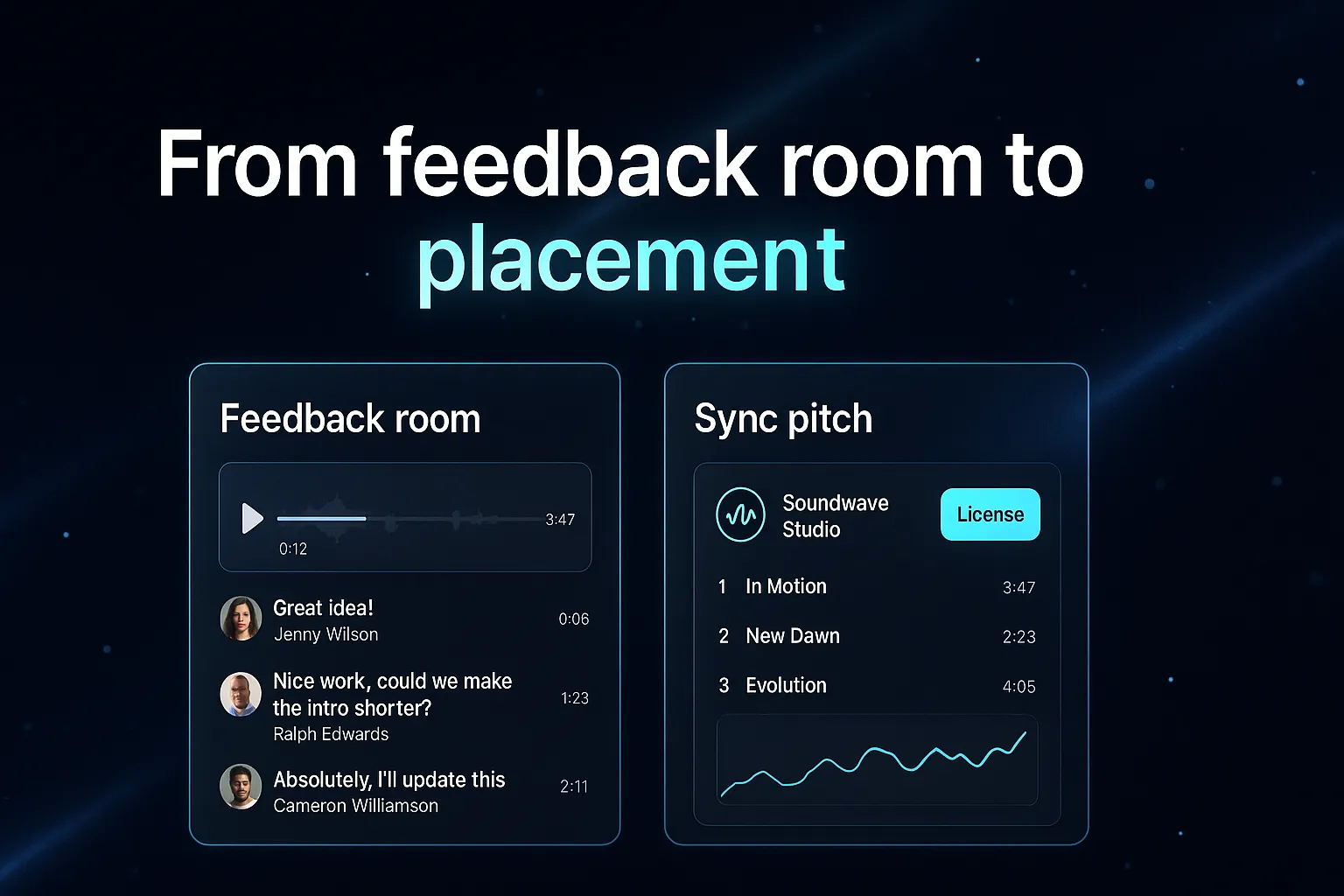
A private space ends at the listen. A License button lets an interested supervisor clear the cue without another email, and a portfolio at your own URL is something you can put in a signature or a pitch.
Names you may know in this space
Highnote
Private music sharing and review built on Dropbox infrastructure, with spaces, time-stamped comments, and version control. Published plans run from a free 15-track tier through Indie at $4.99 a month for 500 tracks and 1TB, up to Studio at $19.99 for unlimited tracks and 5TB. Storage-led pricing that suits session work more than catalog work.
Dropbox
The infrastructure Highnote is built on, and still the default way most composers send music. Fine for delivery, but it has no concept of a track: no metadata, no splits, no search against a brief, and no signal about whether anyone listened.
Tonal Chaos Trailers
A Los Angeles trailer music library founded by DropCue founder Marc Aaron Jacobs. A catalog of this shape is exactly the case that breaks storage-priced tools: thousands of cues, each with a full set of alt mixes and stems, none of them individually large.
Pricing for this audience
Compare like for like. Highnote Indie is $4.99 a month for 500 tracks and 1TB; DropCue Artist is $8 a month with annual billing and no track limit, and at that tier you get password protection and expiring links but not the catalog, comments, analytics, alt nesting, or portfolio described on this page. Those begin on Pro at $15 a month for 1,000 tracks, with graduated tiers up to 20,000. Against Highnote Studio at $19.99 for unlimited tracks and 5TB, DropCue Pro is the cheaper option for most sync catalogs and the more expensive one if you genuinely need terabytes, which is the honest way to read it: you are choosing which resource you are paying for, and for a cue library it is almost never the disk space.
Frequently asked questions
Is DropCue cheaper than Highnote?
It depends on which resource you are short of. Highnote Indie is $4.99 a month for 500 tracks and 1TB; DropCue Artist is $8 with no track limit. At the top, Highnote Studio is $19.99 for unlimited tracks and 5TB while DropCue Pro is $15 for 1,000 tracks with graduated tiers to 20,000. The only case where Highnote's numbers come out ahead is if you genuinely need multiple terabytes, which for a cue library almost never happens: 4,000 finished cues is roughly 160GB. For the catalogs this is actually about, DropCue is both cheaper and the right shape, because you are paying for tracks instead of renting disk you will never fill.
I hit Highnote's 500-track cap. What actually changes on DropCue?
Two things. Your alt mixes and stems stop counting as separate tracks, since they nest under the parent cue, which alone can cut a catalog by half or more. And the ceiling moves to 1,000 on Pro with tiers up to 20,000, so the next cap is a long way off rather than one productive quarter away.
Does DropCue have timestamped feedback like Highnote?
Yes, on Pro. Timestamped comments on shared playlists are a Pro feature, along with full analytics and the catalog. The $8 Artist tier covers uncapped sharing with password protection and expiring links but not those, so if timestamped feedback is the reason you use Highnote, compare it against DropCue Pro at $15 rather than Artist.
What can DropCue do that a sharing tool structurally cannot?
Hold the rights data. Each cue carries its writers and publishers with PRO affiliation, IPI number, and split percentage, so when a supervisor asks who controls the track the answer is attached to it. Sharing tools deliver a file and end there, which is why a promising conversation so often stalls at the paperwork rather than at the music.
Can I move my catalog from Highnote to DropCue?
Yes. Upload your files and DropCue reads embedded BWAV and ID3 metadata to populate title, ISRC, BPM, key, and writer fields, groups alt mixes under their parent by filename, and builds the searchable catalog from there. A few thousand cues import in an evening. Highnote does not export splits or licensing data because it never stored them, so that part you fill in once.