Guide
How Sync Agencies Pitch Supervisors in 2026
 Marc Aaron Jacobs
Founder, DropCue · Composer
Marc Aaron Jacobs
Founder, DropCue · Composer
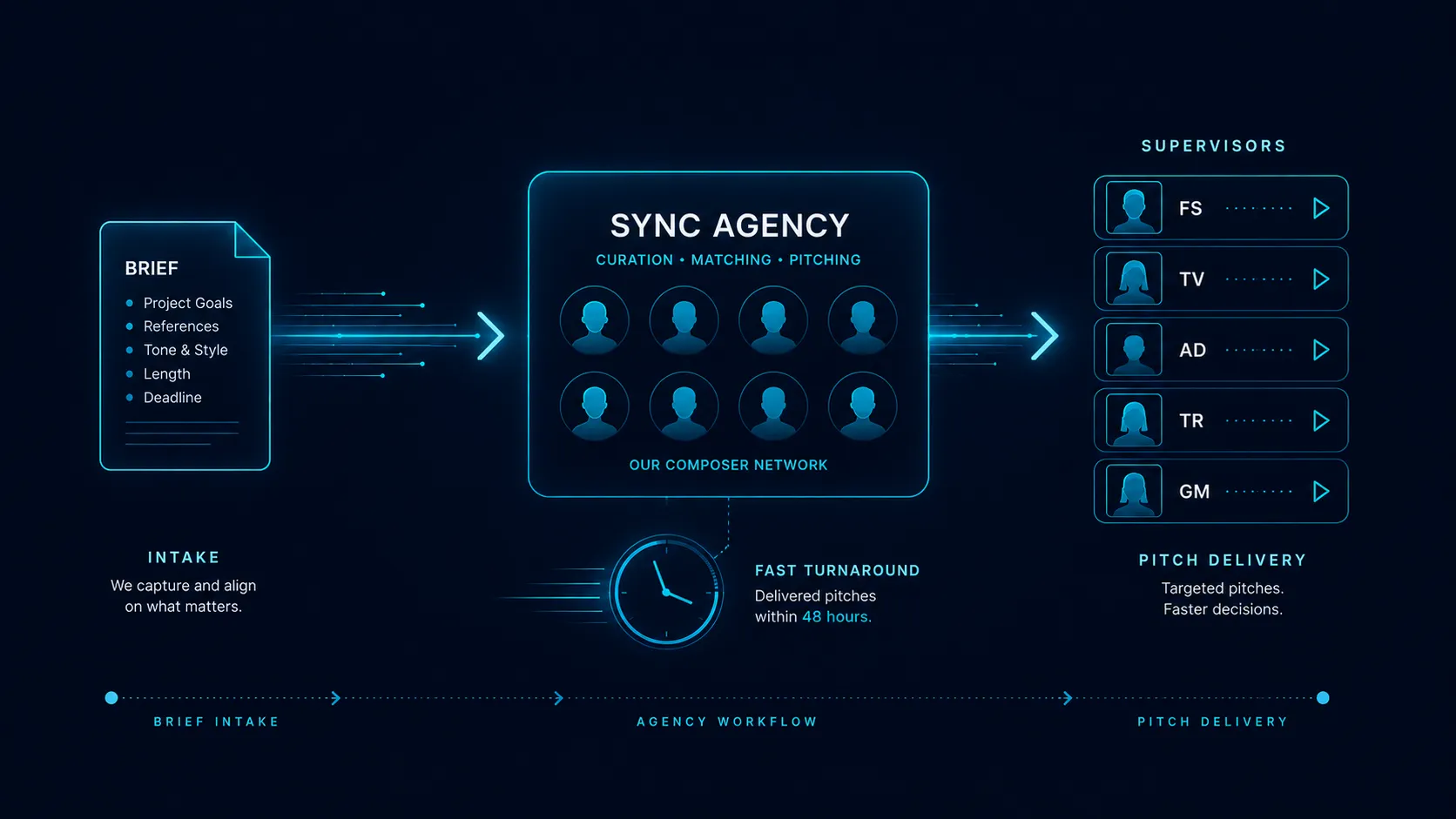
A sync agency runs on speed and curation. The agent who responds first with a tight, brief-specific shortlist wins the placement. The agent who pitches everything to everyone gets filtered into the spam pile. Here is how working sync agencies pitch supervisors in 2026.
Watch: DropCue for Music Supervisors: Free Catalog Search, Clearance Info, Shortlists and Briefs
Watch how music supervisors search, clear and shortlist music in DropCue. Free for verified supervisors.
Who this is for
Sync agencies and music supervision representation companies. Boutique agencies with rosters of 10 to 80 composers. Independent sync agents managing a small composer roster. In-house sync teams at indie publishers and labels. Music coordinators at production companies who pitch their own composer relationships.
Also relevant: managers handling sync for a small composer roster, A&R staff at music publishers, and senior music supervisors who run their own informal composer rolodexes alongside their day jobs.
The audience-specific reality
Sync agency pitching has tightened. Twenty years ago, an agency could spray-and-pray a roster catalog to 50 supervisors and book placements through volume. That model died. Modern supervisors triage 100 to 400 unsolicited submissions a week and have learned to pattern-match agencies that pitch with fit versus agencies that pitch indiscriminately. The agencies that pattern-match as "sends me on-brief stuff" get opened. The agencies that pattern-match as "sends me everything" get archived.
The competitive edge is now in three places. First, speed: respond to a brief inside 24 hours, ideally inside 4. Second, curation: send 5 to 12 tracks tightly matched to the brief, never the full roster. Third, supervisor relationship history: know what the supervisor has used before, what they have rejected, and what they are likely actively searching for.
The third edge is the hardest. It requires a proper CRM where every supervisor has a profile noting their projects, recent placements, style preferences, and engagement history with your roster. Most agencies still run this on spreadsheets. The agencies that have moved to platform-native CRM win more placements per pitch.
Why DropCue fits this workflow
DropCue is the agency-scale pitching tool that compresses the brief-to-pitch loop from hours to minutes.
When a brief lands, the agent filters the catalog by genre + tempo + mood + instrumentation + energy arc + use case. A 2,000-track roster narrows to a 12-track shortlist in 30 seconds. Slow agencies still doing this in spreadsheets take hours. Speed wins placements.
Per-supervisor playlists are private and pre-curated. Build one playlist per top-tier supervisor with the 30 cues from the roster they would most likely use. Refresh quarterly. When their next brief lands, you start from a 30-track shortlist instead of the full catalog.
Cross-composer brief playlists assemble in seconds. Drag tracks from 5 different composers into one branded playlist named after the brief. The supervisor sees one clean playlist with composer attribution. The agency pitches multiple writers in a single URL instead of 5 separate emails. The supervisor evaluates the bundle holistically.
Engagement analytics travel with every pitch. See which composer's tracks the supervisor played and which they replayed. Use this to refine future pitches: if the supervisor consistently engages with one composer's work, push that composer harder for that supervisor's next brief. Stop pitching composers who get zero engagement to that supervisor.
Roster-wide analytics inform A&R. See which composers and which tracks supervisors engage with most across the whole roster. Inform signing decisions, repertoire building, and which composers to feature in your agency-wide outreach.
The features that matter most
✓ Multi-axis catalog filtering
Filter a 2,000-track roster by genre + tempo + mood + instrumentation + energy arc + use case. 12-track shortlist in 30 seconds. Speed beats catalog size at the brief level.
✓ Per-supervisor private playlists
Pre-curate the 30 cues per supervisor most likely to fit their style. When their brief lands, you start from a 30-track shortlist not a 2,000-track catalog.
✓ Cross-composer brief playlists
Drag tracks from 5 composers into one branded playlist. Pitch multiple writers in a single URL. The supervisor evaluates holistically instead of receiving 5 separate emails.
✓ Per-pitch engagement analytics
See which tracks the supervisor played and replayed. Refine future pitches based on what landed. Stop wasting pitches on composers who get zero engagement from a specific supervisor.
✓ Agency-wide branding with composer sub-pages
Every composer has their own portfolio identity at dropcue.app/p/composer-name while the agency runs the master workspace. Composers move between agencies, portfolio identity stays consistent.
✓ Document attachments per track
Attach split sheets, license agreements, and master ownership documentation. When the supervisor needs the docs to clear a placement, they pull them in one click.
Names you may know in this space
Heavy Hitters
Major US sync representation company. Manages catalogs for hundreds of writers across film, TV, and ad placements.
Sugaroo
Boutique sync agency known for tight curation and direct supervisor relationships.
Riptide Music
Independent sync representation focused on indie composers placing into film, TV, and trailer.
Position Music
Trailer-adjacent publisher running sync representation alongside catalog placement.
Pricing for this audience
DropCue plans start at $8 a month with annual billing. Pro plans scale by catalog size from $15 a month for 1,000 tracks up to higher tiers for larger catalogs. Same pricing for agencies and composers, and free for verified music supervisors. DISCO prices its Plus and Pro plans per user ($18.99 and $29.99 a month each, checked October 2026), and DropCue team seats are also priced per seat, so compare the total for the people who need a login. Agencies switching also gain a faster, more modern interface and integrated supervisor analytics.
Frequently asked questions
How does an agency get a supervisor to open their pitches consistently?
Three things compound. First, brief fit: only pitch cues that match the brief, never the full roster. Second, response speed: ship inside 24 hours of the brief landing, ideally inside 4. Third, relationship investment: meet supervisors at industry events, follow up casually, learn their style preferences. Agencies that do all three average 2 to 3x the open rate of agencies that do none.
How big should an agency roster be?
Quality over quantity. A 30-composer roster with deep tagging and active curation outperforms an 80-composer roster managed sloppily. The largest agencies (Heavy Hitters, Sugaroo) run 80 to 200 writers because they have dedicated catalog managers. Boutique agencies typically cap at 30 to 50 to maintain personalized supervisor relationships.
What is the typical commission split for sync placements?
Industry standard is 25 to 50 percent of net placement fee. 25 to 30 percent for non-exclusive representation, 40 to 50 percent for exclusive representation. Some boutique agencies negotiate split percentages on a per-deal basis based on their level of involvement.
Should an agency pitch the same cue to multiple supervisors simultaneously?
Yes, unless the cue is on hold for a specific project. Holds are temporary exclusivities (typically 5 to 14 days) granted to a supervisor while they evaluate a cue for a placement. Communicate hold status clearly to all parties. After the hold releases, the cue is free to re-pitch elsewhere.
How does an agency build a supervisor CRM?
Start simple. One row per supervisor: name, projects they currently work on, style preferences, recent placements they loved, recent rejections, last contact date, last engagement with your roster. Update after every meaningful interaction. The agencies that maintain this discipline systematically out-pitch the agencies that wing it. DropCue's per-supervisor analytics feed directly into this discipline.
How does this compare to DISCO for agency use?
DISCO has a longer track record and stronger penetration at major studios. DropCue is faster, more modern, and significantly priced for agency scale. Most agencies that switch report saving 40 to 60 percent on annual platform costs. The DISCO switcher tool handles bulk migration including catalog metadata, ALT mix grouping, and supervisor contact import.