Guide
Music Licensing CRM: Track Pitches, Placements, and Supervisor Relationships
 Marc Aaron Jacobs
Founder, DropCue · Composer
Marc Aaron Jacobs
Founder, DropCue · Composer
Most composers run their pitch pipeline out of a sent-mail folder and their memory. That works up to about thirty pitches, then placements start falling through gaps that nobody notices because nobody is tracking them.
Who this is for
Composers, sync agents, and publishers who pitch regularly enough that they cannot remember every conversation. Anyone who has re-pitched the same track to the same supervisor by accident, or lost track of a cue that was verbally approved six months ago and never confirmed.
Especially relevant for sync agencies managing pitches on behalf of a roster, where the pipeline has to survive someone being on holiday.
The audience-specific reality
Sync is a long-cycle business with a short memory. A pitch goes out in March, the supervisor likes it, the show gets pushed, the cue lands in a September episode, and the cue sheet arrives the following March. Twelve months from pitch to paperwork is normal.
Nothing about that survives in a sent-mail folder. The information you actually need later is: which track went to which supervisor, on what date, for which project, what they said, whether it was held, whether it aired, and what it paid. That is a pipeline, and pipelines need states.
General-purpose CRMs technically handle this and are miserable for it, because their object model is a sales deal with a dollar value and a close date. A sync pitch is a track against a brief with a hold state and a possible placement that pays out a year later. Forcing that into a sales pipeline means fighting the tool on every record.
The other half of the problem is engagement data. Knowing you sent a pitch is weak. Knowing the supervisor played track four twice and skipped the rest is what tells you what to send next time.
Why DropCue fits this workflow
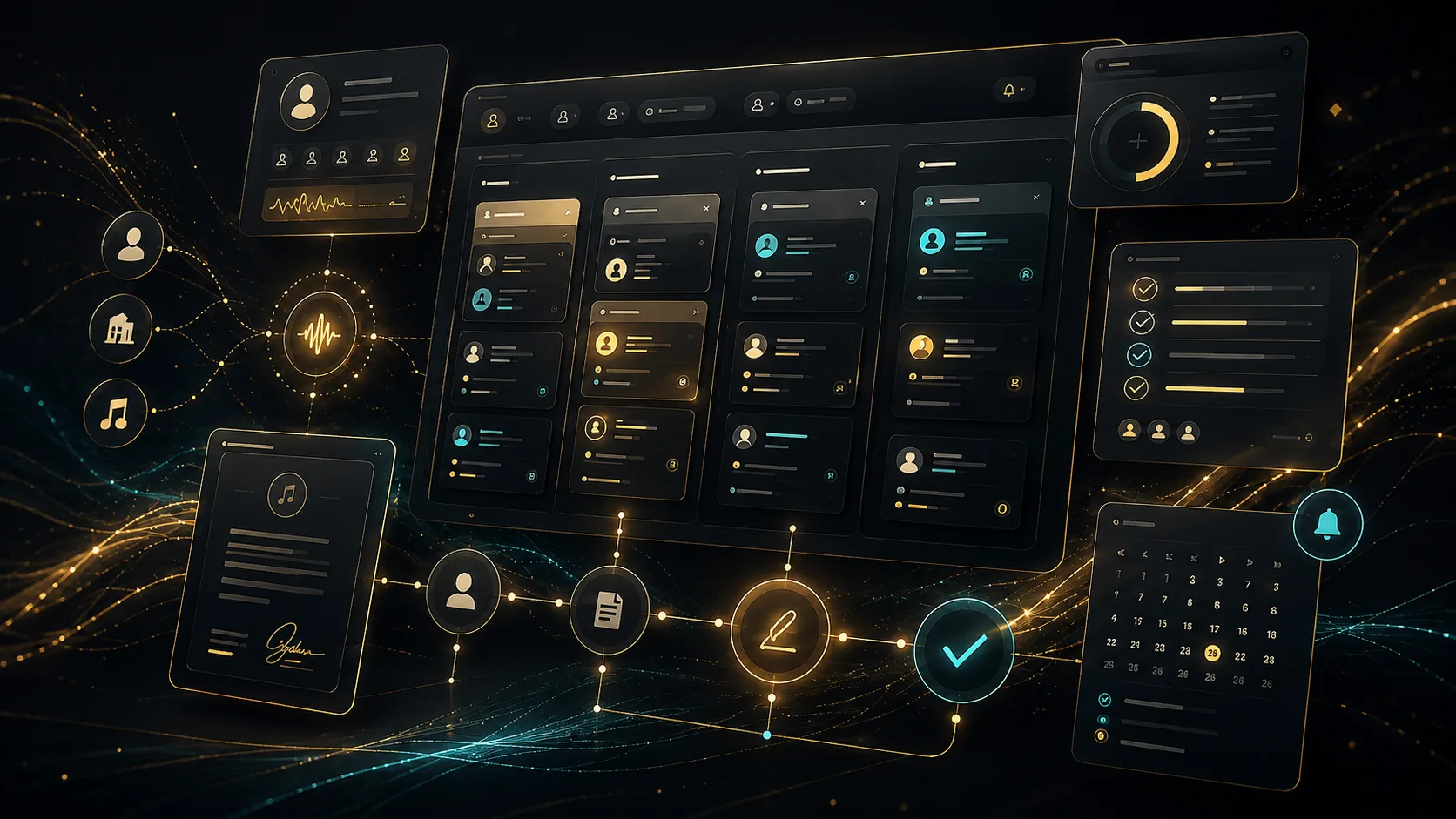
The Pitch Pipeline in the DropCue Business Suite is built around the sync object model rather than a sales one. A pitch is tracked against a project and a contact, moves through states, and can resolve into a placement rather than a closed-won deal.
Engagement data comes from the same system that sent the pitch. Because pitches go out as DropCue share links, the analytics are attached to the pitch record automatically. You see who opened it, which tracks played, how long each played, and how many times. There is no separate tracking pixel step and no guessing whether the link was ever clicked.
Contacts live alongside the pipeline. Supervisor and music-department contacts carry company, role, tags, and notes, and share recipients get saved to contacts automatically. Pitching to a saved contact autocompletes from the address book rather than from memory.
The Business Suite also carries the pieces that surround a placement: a royalty tracker for importing PRO statements, an agreement generator for sync and work-for-hire contracts, and a clients and license tracker. That covers the span from pitch through paperwork to payment in one place.
One honest caveat. This is a pitch pipeline built for sync, not a full enterprise CRM. There is no deal forecasting, no email sequence automation inside the pipeline, and no territory management. If you need Salesforce, this is not that. If you need to know what you pitched and what happened, this is aimed at exactly that.
The features that matter most
✓ Pitch Pipeline with sync-shaped states
A pitch tracks against a project and a contact and resolves into a placement, rather than being forced into a sales deal with a close date.
✓ Engagement data attached to the pitch
Pitches go out as share links, so opens, plays, play duration, and repeat listens land on the pitch record without a separate tracking step.
✓ Contacts with company, role, and tags
Supervisor contacts carry the context you need a year later. Share recipients save to contacts automatically, so the address book builds itself.
✓ Royalty tracker
Import PRO statements to connect a placement back to what it actually paid, which is the number that tells you whether a relationship is worth the time.
✓ Agreement generator
Generate sync and work-for-hire agreements as PDF or Word from the same system holding the placement, instead of hunting for last year's template.
Names you may know in this space
Salesforce
The default enterprise CRM. Some sync agencies run pitches through it and spend most of their configuration effort forcing a sales-deal object model to behave like a pitch with a hold state.
HubSpot
Common lighter-weight CRM choice. Same core mismatch as Salesforce for sync work, plus no connection to the listening data that tells you which cue actually landed.
Airtable
What a lot of composers and small agencies actually use for a pitch tracker. Flexible enough to model the pipeline correctly, with no link to delivery or engagement analytics.
DISCO
Widely used for delivery across the sync industry. Keeping pitch tracking and delivery in one system is the specific gap a separate spreadsheet or CRM leaves open.
Pricing for this audience
The Pitch Pipeline is part of the Business Suite, which is included in the Studio tier. Studio starts at $29 a month with annual billing for 1,000 tracks and scales on the same ladder as Pro up to $99 a month for 20,000 tracks. Studio includes everything in Pro plus the Business Suite and DropCue University. There is no per-placement fee and no revenue share on anything you book.
Frequently asked questions
How is this different from using a general CRM like HubSpot or Salesforce?
General CRMs model a sales deal: one value, one close date, one owner. A sync pitch is a track against a brief that may sit in a hold state for months and resolve into a placement paying out a year later. You can force that into a sales CRM, and people do, but you fight the object model on every record and you get none of the listening data.
Does the pipeline show whether a supervisor actually listened?
Yes, and this is the main reason to keep the pitch and the delivery in one system. Pitches sent as DropCue share links report opens, which tracks played, how long each played, and repeat listens. A supervisor who played track four three times is telling you something a sent-mail folder cannot.
Can I track placements through to payment?
The Business Suite includes a royalty tracker that imports PRO statements, plus a clients and license tracker. That covers connecting a placement to what it paid. It does not collect royalties on your behalf, which is the PRO's job.
Does it handle a roster of composers, not just my own catalog?
Sync agencies and publishers use it against multi-writer catalogs, since splits are per-track. Full multi-seat team workspaces with role-based access are still on the roadmap rather than shipped, so today a team shares an account.
Is there email automation for follow-ups?
There is an email campaign tool for sending pitch emails with an embedded playlist and per-recipient tracking, but automated follow-up sequences triggered from pipeline state are not built. Follow-up timing is still a human decision here.