Guide
Best Music Discovery Platform for Music Supervisors (2026)
 Marc Aaron Jacobs
Founder, DropCue · Composer
Marc Aaron Jacobs
Founder, DropCue · Composer
A music discovery platform should let a supervisor narrow thousands of cues to the right few in seconds, audition without downloading, and clear the track directly. Here is what to look for in 2026, and how the main options compare for supervisors.
Who this is for
Music supervisors choosing a discovery platform, or supplementing the one they have. Supervisors and coordinators at trailer houses, ad agencies, networks, studios, and post houses. Independent supervisors who search across many composers and libraries. Editors and creative directors who do their own music search.
Also relevant: production companies standing up a music search workflow, and teams comparing catalog tools on cost, speed, and access model.
The audience-specific reality
Discovery is the supervisor's real job: not waiting for the right pitch, but finding the right cue. A good discovery platform compresses that to minutes. A bad one is a slow library with weak filters that sends you back to email.
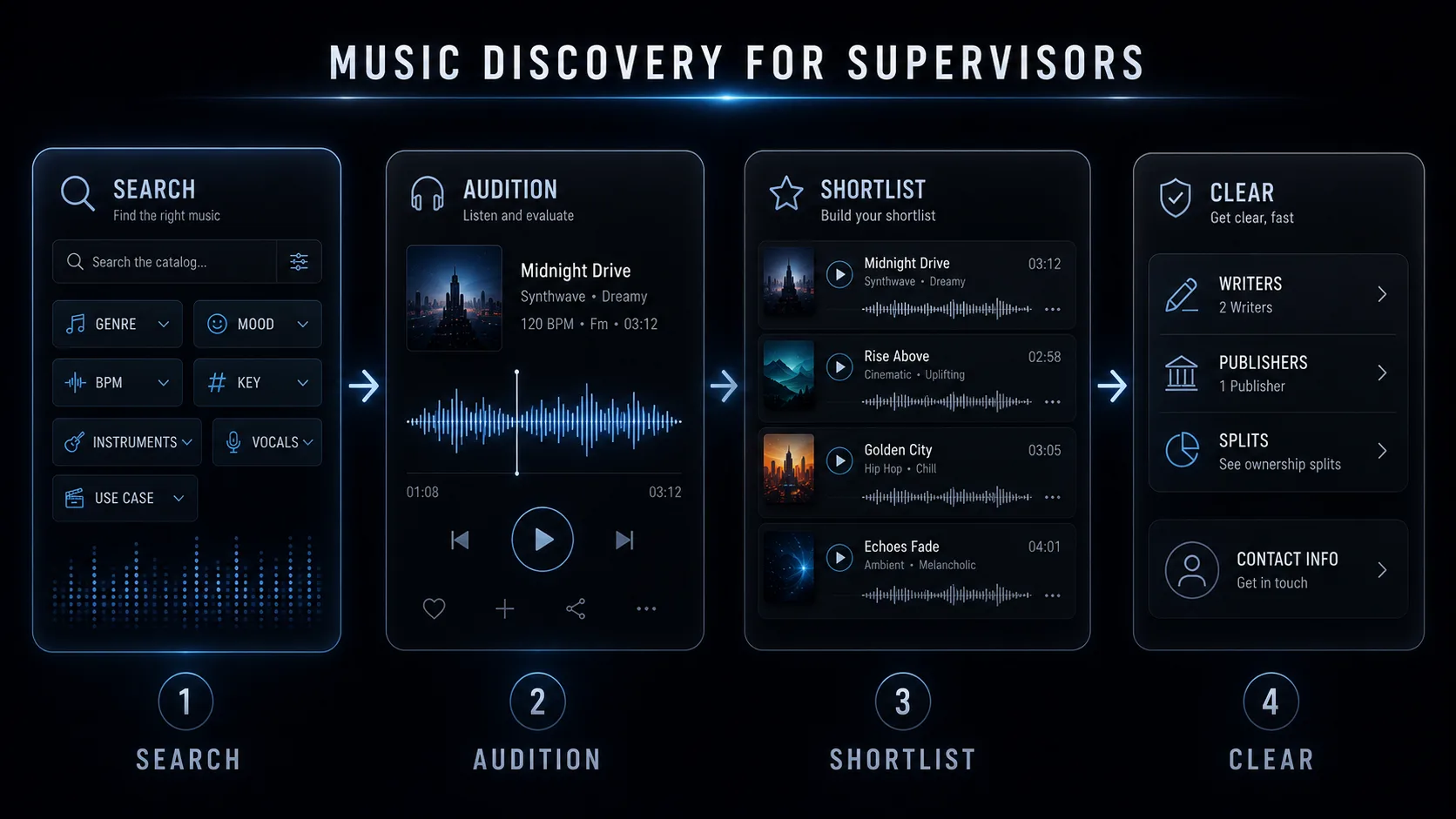
Three things separate the good from the bad. First, search depth: can you filter by genre, mood, BPM, key, instruments, vocals, use case, and reference, and do those filters stack. Second, audition speed: can you scrub a waveform and triage without downloading. Third, the path from found to cleared: are the writers, publishers, and splits right there, with a way to contact the owner.
The fourth, quieter factor is the access model. Some platforms charge supervisors a subscription. Some route them into enterprise sales. The best ones recognize the supervisor is the demand side and keep access free or low friction.
Why DropCue fits this workflow
Judge any platform on six things. This section is the criteria; the platform-by-platform notes are further down, and DropCue is one entry among them rather than the foregone answer.
**1. Do the filters stack, and are the tags canonical?** A single dropdown is not faceted search. You need genre, mood, BPM range, key, instruments, vocals, and use case applied together, against tags that have been normalised. If a catalog carries fifteen spellings of the same sub-genre, the filter is decorative and you will miss cues that were there all along.
**2. Can you audition without downloading?** Inline waveform playback on every result, scrubable. On a fifty-result first pass, the difference between streaming and downloading is most of an afternoon.
**3. Does the shortlist survive contact with your team?** One-click add, reorder, private notes, and an export the director or editor can open without an account. A shortlist you have to rebuild in an email is not a feature.
**4. How close is the rights data to the audio?** Writers, publishers, splits, and PRO information should sit with the track. Be sceptical of anyone promising one-click clearance: on most independent catalogs, including this one, you get the paperwork and a route to the owner, and the negotiation is still a conversation. That is normal. What matters is whether the conversation starts with the facts in hand or with three emails establishing who controls the cue.
**5. Who pays, and what does that do to the catalog?** If supervisors pay to search, the platform's incentive is to sell seats. If rights holders pay to be found, the incentive is to make you findable. Neither is wrong, but it tells you who the product is really designed around.
**6. What is actually in it?** Depth and character are separate questions. A major-label-heavy platform and a pool of independent composers answer different briefs, and the honest answer to "which is better" is "for what."
Against those criteria DropCue does well on stacking filters, canonical tags, inline audition, shortlist exports, and rights data adjacency, is free for verified supervisors because composers fund it, and is mid-sized on depth at roughly 30,000 discoverable tracks from about 95 composers and libraries. It is weakest where you need major-label repertoire, and that is a real limitation rather than a positioning quibble.
The features that matter most
✓ Criterion: do filters stack, on canonical tags?
Ask to apply genre, mood, BPM, key, instruments, vocals, and use case together, then check whether the tag vocabulary is normalised. Fifteen spellings of one sub-genre means the filter silently hides cues that were in the catalog all along.
✓ Criterion: audition without downloading
Inline scrubable waveform on every result. Across a fifty-result first pass this is the single biggest difference in how long a search takes.
✓ Criterion: shortlists your team can actually open
Reorder, private notes, and an export the director or editor opens without an account. If the shortlist has to be rebuilt as an email with attachments, it was never a shortlist.
✓ Criterion: how close the rights data sits to the audio
Writers, publishers, splits, and PRO information on the track itself. Treat any promise of instant one-click clearance on an independent catalog with suspicion; what you want is the paperwork in hand when the conversation starts.
✓ Criterion: who funds the platform
Supervisor-paid platforms are built to sell seats; rights-holder-funded ones are built to make catalogs findable. Neither is wrong, but it predicts what the product optimises for.
✓ Criterion: depth versus character
A major-label-heavy catalog and a pool of independents answer different briefs. Ask what is actually in the catalog rather than how many tracks it claims, especially if you need something that has not been in four other trailers this year.
Names you may know in this space
DISCO
Running since 2015 with major labels, publishers, and large libraries on the platform, so breadth of repertoire is its strength. The trade is access: supervisor plans are custom and quoted, so budget for a procurement cycle rather than an afternoon, and the searching often gets done by a coordinator who never controls that budget.
SourceAudio
Mature search and licensing tooling with a large hosted catalog, oriented toward libraries and their supervisor clients. Supervisor search sits behind a paid subscription after an initial free period.
DropCue
Free self-serve search for manually verified supervisors, funded by the composer side. Around 30,000 discoverable tracks from roughly 95 independent composers and libraries: mid-sized on depth, weighted toward independents rather than major-label repertoire, with writer, publisher, split, and PRO data on each track.
Musicbed
Curated licensing marketplace with a much smaller, heavily vetted catalog and transparent published rates. A different trade: less to search through, more predictable clearance, better suited to advertising and branded work than to a deep cue hunt.
Pricing for this audience
Three models exist and each shapes the product. Free to the searcher, funded by rights holders, which is DropCue's: composers pay from $8 a month to be findable, so search costs supervisors nothing. Enterprise contract, which is DISCO's: a custom quote, a call, and procurement, in exchange for the deepest catalog. And a supervisor subscription, which is roughly SourceAudio's shape. The cost that usually matters is not the invoice, since a network may pay any of these without blinking, but the delay: a manual verification is measured in days, a procurement cycle in weeks or quarters, and briefs do not wait for either.
Frequently asked questions
What separates a good discovery platform from a big one?
Catalog size is the number everyone quotes and the least useful on its own. What decides whether you find the cue is stacking filters on canonical tags, instant waveform audition without downloading, one-click shortlists, and a direct path from found to cleared with writers, publishers, and splits visible. Low access friction matters too.
Which platform is free for supervisors, and what is the catch?
DropCue is free for verified supervisors, funded by the composers and libraries who pay to be findable. The catch is honest and worth stating: it is a mid-sized catalog of roughly 30,000 tracks from about 95 independent composers and libraries, not major-label repertoire, and access requires manual approval because the material is unreleased. DISCO routes supervisors into a custom plan and SourceAudio charges a subscription, both of which buy you considerably more depth.
Should I use one platform or several?
Most working supervisors use several, and the reason is coverage rather than indecision. A deep major-affiliated catalog and a pool of independents surface different music for the same brief, and the cost of checking a second free source is a few minutes. The question is not which platform wins but which combination covers the briefs you actually get.
How much should catalog size influence the decision?
Less than the marketing suggests. Past a few tens of thousands of tracks your limit is retrieval, not inventory: if the filters are weak or the tags are messy, a million tracks just means a million you cannot reach. Weight search quality and tag hygiene above the headline number, then ask what kind of music is actually in there.
What should I ask for in a demo or trial?
Bring a real brief you have already filled, not a hypothetical one. Apply four filters at once and see whether the result set is plausible. Check whether the same sub-genre appears under several spellings. Send a shortlist to a colleague and watch whether they can open it without an account. Then look at one track and see how much rights information is visible before you have contacted anyone.