Guide
Free Catalog Search for Music Supervisors (No Sales Call)
 Marc Aaron Jacobs
Founder, DropCue · Composer
Marc Aaron Jacobs
Founder, DropCue · Composer
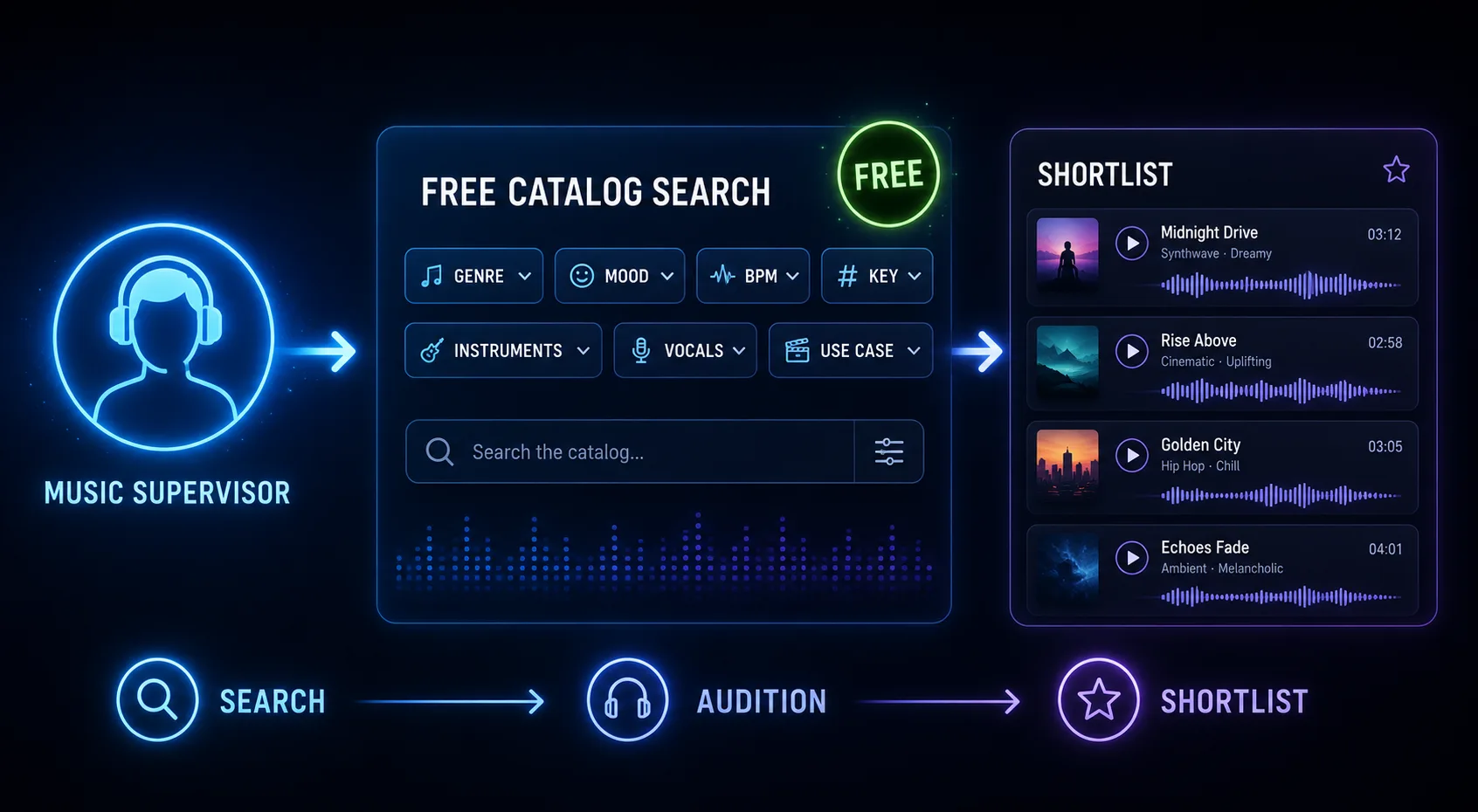
Most platforms make supervisors pay, or make you book an enterprise sales call, just to search a catalog. DropCue gives verified music supervisors self-serve catalog search for free. Filter by genre, mood, BPM, key, instruments, vocals, and use case, audition in seconds, and contact the rights holder directly.
Who this is for
Music supervisors who need to find the right cue without waiting on pitches. Supervisors at trailer houses, ad agencies, TV networks, film productions, and post houses. Music coordinators and assistants who do the first-pass searching. Independent supervisors juggling multiple projects who cannot afford a five-figure catalog subscription.
Also relevant: editors who temp their own music, creative directors briefing music, and anyone who needs to search across many composers and libraries in one place instead of opening one inbox at a time.
The audience-specific reality
The traditional supervisor workflow is reactive. You post a brief or send out word, then wait for composers, agencies, and libraries to pitch you. You end up triaging hundreds of unsolicited submissions a week, most of them off-brief, and the track you actually need is sitting in a catalog you never received a pitch from.
Searching proactively used to mean paying for it. The platforms that let you search a multi-composer catalog either charge a monthly subscription or route supervisors into a custom enterprise plan you have to call sales about. For a working supervisor on a tight project budget, that is friction at exactly the wrong moment.
The shift in 2026 is that proactive search is becoming the default, and the access barrier is dropping. The supervisors who search a catalog directly find the right cue in minutes instead of waiting days for pitches that may never include it.
Why DropCue fits this workflow
This page is the practical walkthrough. For how DropCue compares to DISCO specifically, see the DISCO comparison; for how to evaluate discovery platforms generally, see the buyer's guide.
**Step one, get verified.** Create an account and apply for supervisor access. Applications are reviewed by hand rather than automatically, because the catalog is composers' unreleased work and access is not given to anyone who fills in a form. Say who you are and what you work on. Approval is usually quick, and you will know either way rather than being left pending indefinitely.
**Step two, search.** The catalog currently holds around 30,000 tracks opted into discovery by roughly 95 composers and libraries. Filters stack the way a brief is actually worded: genre, mood, BPM range, key, instruments, vocals or no vocals, use case, and sounds-like. A request for uplifting, no vocals, 90 to 110 BPM, strings and piano for a tender montage is four filters and a few seconds, not an afternoon of listening.
**Step three, audition in the browser.** Every result plays inline with a full waveform, so you scrub to the build, hear whether the drop lands where the picture needs it, and move on. Nothing downloads. On a first pass through fifty results that difference is most of your afternoon.
**Step four, shortlist as you go.** One click adds a track, you can drag to reorder, and private notes stay visible only to your team. Build the shortlist during the search rather than reconstructing it afterwards from memory and browser tabs.
**Step five, turn the shortlist into a deliverable.** Export as a branded share link for the director or editor, a PDF cue sheet, a CSV, or a download-all ZIP. The link plays in a browser, so the person you send it to does not need an account.
**Step six, clear it.** Each track carries its writers, publishers, splits, and PRO information along with a route to the rights holder, so you negotiate directly with whoever controls it. DropCue takes no cut. Be realistic about this step: it is rights data and a contact route, not instant checkout, so for most tracks you are still having a conversation, just one that starts with the paperwork already in front of you.
The features that matter most
✓ Applying and getting approved
Apply with a work email and a verification link. A person reviews it rather than a form auto-approving, because the catalog is composers' unreleased work. You get a decision rather than sitting pending, and no card is involved at any stage.
✓ Faceted catalog search
Filter by genre, mood, BPM, key, instruments, vocals, use case, and sounds-like. Stack filters the way you brief and narrow thousands of cues to a handful in seconds.
✓ Instant waveform audition
Scrub to the drop and hear the build without downloading anything. Triage fast, the way supervisors actually listen.
✓ Shortlists with private notes
One-click add, drag to reorder, and notes only your team sees. Build the brief shortlist as you search instead of starting over later.
✓ Cue sheets and share links
Export a shortlist as a PDF cue sheet, CSV, download-all ZIP, or a branded link to send the director or editor for sign-off.
✓ What you get when you find the cue
Writers, publishers, splits, and PRO information sit on the track with a route to the owner. You still negotiate the licence, but the conversation opens with the facts instead of three emails establishing who controls it.
Names you may know in this space
Trailer houses
Mob Scene, Trailer Park, and Buddha Jones-style shops that burn through hundreds of cues per campaign and need fast, filterable search.
Ad agencies
Creative teams briefing music on tight timelines who need to audition and shortlist without a procurement cycle for a subscription.
Indie film and TV supervisors
Supervisors on project budgets who cannot justify a five-figure catalog subscription but still need to search proactively.
Pricing for this audience
Free means free here, with no trial clock and no card on file. There is no supervisor tier to upgrade to later, because supervisors are not the customer: composers, libraries, and agencies pay from $8 a month to host and pitch their catalogs, and their reason for paying is that supervisors can find them. Charging you to search would work against the people who actually fund the platform. The one thing that is gated is access itself, since approval is manual, and the honest reason is that this catalog is composers' unreleased material rather than a public library.
Frequently asked questions
Is catalog search really free for music supervisors?
Yes. Verified music supervisors search the opted-in DropCue catalog for free. No credit card and no enterprise sales call. DropCue makes its money on the composer side, so the people searching do not pay.
How do I get access?
Apply at dropcue.app/supervisors/signup with your company and a verification link such as an IMDb credit, LinkedIn, or company profile. We review every supervisor by hand to keep the catalog protected, usually within a day, then you can start searching.
What can I filter by?
Genre, mood, BPM, key, instruments, vocals, use case, and sounds-like. Filters stack, so you can narrow thousands of tracks to a handful that match the brief in seconds.
Can I download tracks or send a shortlist to my team?
Yes. Audition with full waveform playback, build a shortlist with private notes, then export it as a branded share link, a PDF cue sheet, a CSV, or a download-all ZIP. The director or editor can review without an account.
How do I clear a track I find?
Each track shows the writers, publishers, splits, and PRO info, and a way to contact the rights holder directly. DropCue is a discovery layer, so you negotiate the license directly with the rights holder.
How big is the catalog, honestly?
Around 30,000 tracks opted into discovery by roughly 95 composers and libraries, and it grows as more opt in. That is a real working catalog and it is smaller than DISCO or SourceAudio, which have years of head start and major-label relationships. What it is weighted toward is independent composers and boutique libraries who chose to be findable, so it is a good place to look for something that has not already been in four other trailers. For a like-for-like comparison see the [DISCO page](/disco-alternative-for-music-supervisors).